
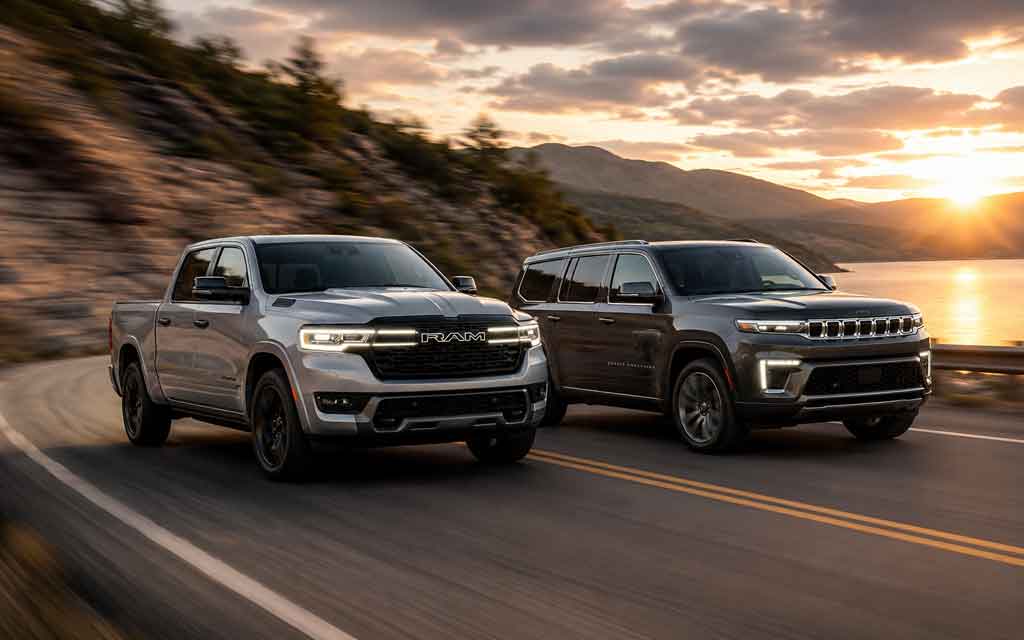
Meta Description: Stellantis is bringing America’s first extended-range electric vehicles (EREVs) to market in 2026. Here’s everything you need to know about the Ram 1500 REV and Jeep Grand Wagoneer REEV — the new “super-hybrids” designed for real American driving.
American truck and SUV buyers have long asked for the best of both worlds: electric driving for daily use and the freedom to drive long distances or tow heavy loads without range anxiety. In 2026, Stellantis is answering that call with two groundbreaking extended-range electric vehicles (EREVs): the Ram 1500 REV and the Jeep Grand Wagoneer REEV.
These are not traditional hybrids. They are full electric vehicles that carry a large battery for daily driving and a gasoline-powered generator that extends range when needed. Industry observers are calling them the first wave of “super-hybrids” — vehicles that combine the driving experience of an EV with the practicality Americans expect from full-size trucks and luxury SUVs.
Production of both models is scheduled to begin in the second half of 2026, with customer deliveries expected as 2027 model-year vehicles.
What Exactly Is an Extended-Range EV (EREV)?
An EREV is different from both a traditional hybrid and a pure battery electric vehicle:
- It has a large battery (in this case ~92 kWh) and electric motors that drive the wheels.
- It can drive on electricity alone for a meaningful distance (around 145 miles in the Ram and Jeep applications).
- When the battery gets low, a gasoline engine acts purely as a generator to recharge the battery or power the motors directly.
- The driver never plugs in if they don’t want to, but can still enjoy electric driving for most daily use.
This architecture removes the biggest objections many American buyers have about EVs: range anxiety on road trips, reduced capability when towing, and the need for frequent charging on long drives.
Ram 1500 REV: The Range-Extended Full-Size Truck
The Ram 1500 REV (previously known internally as Ramcharger) is Stellantis’ flagship extended-range pickup. Key specifications and features include:
- Electric-only range: Approximately 145 miles
- Total range: More than 600 miles (some early claims reached up to 690 miles)
- Power output: Over 600 horsepower
- Towing and payload: Class-leading capability expected for a full-size truck
- Powertrain: 92 kWh battery + 3.6L V6 generator engine
- Availability: Production starting second half of 2026 (2027 model year)
Stellantis originally planned a fully electric version of the Ram 1500 REV but later shifted strategy. The company concluded that American truck buyers — who often tow, haul, and drive long distances — were not yet ready to give up the flexibility of a gasoline generator for extended trips.
The result is a vehicle that offers the instant torque and quiet operation of an electric truck for daily driving and work, while the generator ensures owners can travel across the country or tow heavy loads without worrying about charging infrastructure.
Jeep Grand Wagoneer REEV: Luxury with Extended Capability
The Jeep Grand Wagoneer REEV uses the same fundamental powertrain architecture as the Ram 1500 REV. Stellantis has positioned it as potentially “America’s first range-extended electric vehicle,” suggesting it could reach showrooms slightly ahead of the Ram.
Key highlights:
- Same ~92 kWh battery + V6 generator setup
- Strong electric-only range (targeting similar 145-mile figure)
- Total range well over 600 miles
- High power output (600+ hp expected)
- Luxury-focused interior and capability suited for the Grand Wagoneer nameplate
The Grand Wagoneer REEV targets buyers who want a premium full-size SUV with electric driving benefits but without compromising on long-distance travel or towing ability — a common requirement for luxury SUV owners in the U.S.
Why Stellantis Made the Pivot to EREVs
The decision to launch these vehicles as extended-range models rather than pure battery electrics reflects a broader strategic shift happening across the industry in 2026.
Several factors influenced Stellantis’ approach:
- Strong American demand for trucks and SUVs that can handle real-world use cases (towing, long highway trips, remote areas with limited charging).
- Slower-than-expected build-out of fast-charging infrastructure in many parts of the country.
- The expiration of the federal $7,500 EV tax credit in late 2025, which changed the economics for some buyers.
- Profitability realities — EREVs allow Stellantis to offer electric driving experience while leveraging existing gasoline engine technology for the generator.
Rather than forcing buyers into a pure EV before they are ready, Stellantis chose to meet customers where they are while still advancing electrification.
How EREVs Compare to Pure EVs and Traditional Hybrids
EV Powertrain Comparison
Pure Battery EV (BEV)
- Electric-only Driving: Full capability
- Total Range: Battery dependent
- Towing & Heavy Use: Reduced performance as battery depletes
- Charging Needed: Yes
- Tailpipe Emissions: Zero
- Best For: Daily commuting and drivers with regular charging access
Traditional Hybrid (HEV)
- Electric-only Driving: Limited
- Total Range: Excellent
- Towing & Heavy Use: Good
- Charging Needed: Rarely (self-charging)
- Tailpipe Emissions: Lower than conventional gasoline vehicles
- Best For: Efficiency-focused drivers seeking maximum fuel economy
Extended-Range EV (EREV)
- Electric-only Driving: Strong (145+ miles)
- Total Range: Excellent (600+ miles)
- Towing & Heavy Use: Strong, with generator support
- Charging Needed: Optional
- Tailpipe Emissions: Lower than traditional gasoline vehicles
- Best For: Truck and SUV owners, long-distance travel, and drivers who want electric driving without range anxiety.
EREVs sit in a sweet spot for many U.S. buyers: they deliver most of the benefits of electrification without requiring a complete change in driving behavior.
Implications for American Buyers and Green Tech
The arrival of the Ram 1500 REV and Jeep Grand Wagoneer REEV represents a pragmatic step in America’s green technology transition.
For millions of truck and SUV owners, these vehicles offer a realistic path to electric driving for daily commutes, school runs, and local errands while maintaining the freedom and capability they expect for vacations, work, and adventure. This “no-compromise” approach could accelerate overall emissions reductions faster than waiting for pure EVs to fully satisfy every use case.
From a manufacturing perspective, Stellantis is leveraging its existing engine production capabilities for the generator while building new electric drivetrain expertise. This balanced strategy supports American jobs across both traditional powertrain and emerging EV supply chains.
Critics argue that EREVs are not “true” zero-emission vehicles because they still have a gasoline engine. Supporters counter that they dramatically reduce fuel consumption and emissions compared with conventional trucks and SUVs, especially when most daily driving happens on electricity.
Timeline and Availability
- Production start: Second half of 2026
- Model year: Primarily 2027
- Expected arrival: Late 2026 into 2027, depending on trim and market
- Initial focus: North American market (where full-size trucks and luxury SUVs are most popular)
Pricing has not been officially confirmed, but early indications suggest the Ram 1500 REV will start well above $100,000 in higher trims, with the Grand Wagoneer REEV positioned at the luxury end of the spectrum.
The Bigger Picture: A Multi-Powertrain Future
The Stellantis EREVs are part of a larger industry trend in 2026. While companies like Tesla and Rivian continue to push pure EV technology forward, many legacy automakers are adopting a more flexible approach — offering pure EVs where they make sense, strong hybrids for efficiency, and now extended-range vehicles for capability-focused segments.
This multi-powertrain reality acknowledges that different buyers have different needs. For the large portion of the American market that loves trucks and full-size SUVs, EREVs may prove to be the most practical bridge technology yet.
FAQs
What is an Extended-Range EV (EREV)? An EREV is a vehicle that drives primarily on electricity but carries a gasoline generator to extend range when the battery is low. It offers electric driving for daily use without range anxiety on long trips.
How far can the Ram 1500 REV drive on electricity alone? Early specifications target approximately 145 miles of electric-only range, with total range exceeding 600 miles when using the generator.
When will the Ram 1500 REV and Jeep Grand Wagoneer REEV be available? Production is scheduled to begin in the second half of 2026, with customer deliveries expected as 2027 model-year vehicles.
Are these vehicles considered electric or hybrid? They are classified as extended-range electric vehicles. They deliver a full electric driving experience for most use cases while using a generator for extended range.
Why did Stellantis choose EREV technology instead of pure EVs? Stellantis determined that many American truck and SUV buyers need greater range and towing flexibility than current pure EVs comfortably provide, especially for long-distance and heavy-duty use.



Leave a Comment