
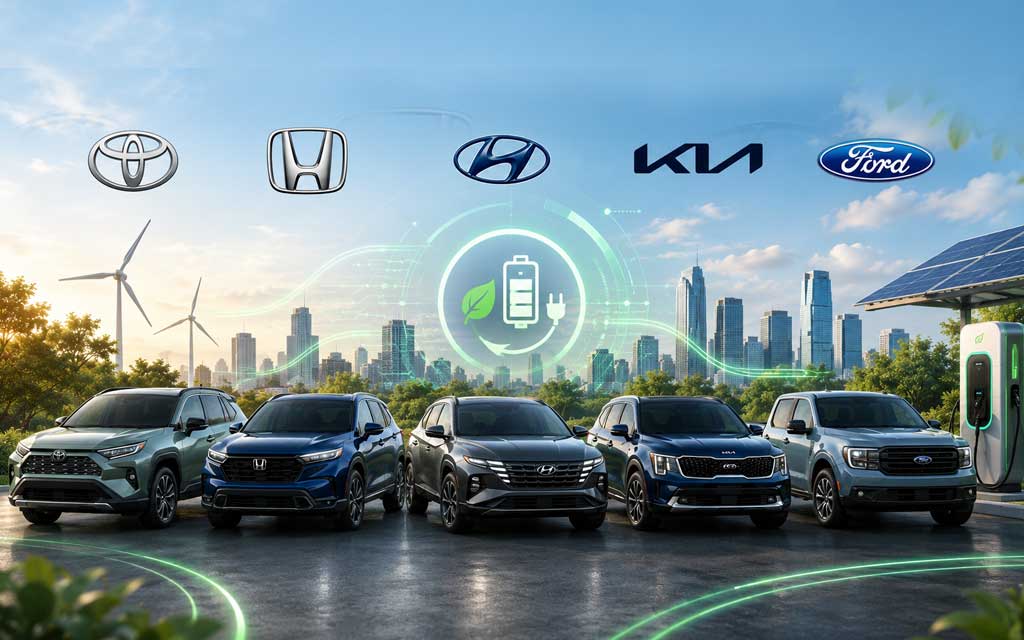
American roads in mid-2026 tell a clear story. While pure electric vehicles continue expanding in certain coastal and urban markets, hybrids—both traditional and plug-in—are experiencing a genuine boom. Shoppers facing incomplete charging networks, higher EV purchase prices, and residual range anxiety are gravitating toward vehicles that deliver substantial efficiency gains without forcing a complete lifestyle change. Toyota, Honda, Hyundai, and select U.S. manufacturers have responded with refined powertrains, smarter software, and increasingly sophisticated energy-management systems that make today’s hybrids more capable and livable than ever.
Toyota: The Hybrid Benchmark Gets Sharper
Toyota remains the volume and technology leader. For 2026 the redesigned RAV4 made a decisive move: the standard lineup is hybrid-only. The fifth-generation hybrid system pairs a 2.5-liter engine with electric motors to produce 226 horsepower in front-wheel-drive form and 236 horsepower with all-wheel drive. Real-world owners and EPA estimates commonly report combined figures in the low-to-mid 40s mpg range, with some configurations approaching 47 mpg city on select trims.
The RAV4 Plug-in Hybrid steps up dramatically. Combined system output reaches 324 horsepower, enabling brisk acceleration (around 5.4 seconds to 60 mph in some tests) and an EPA-estimated all-electric range of roughly 54 miles on higher trims—enough for many daily commutes on electricity alone before the hybrid system seamlessly takes over.
Beyond the RAV4, the Camry Hybrid continues as a sedan efficiency champion, the Highlander Hybrid serves larger families, and the Prius family (including plug-in variants) remains the pure efficiency play. Toyota’s systems emphasize seamless power blending, regenerative braking that feels natural, and over-the-air capability that continues refining energy strategies after the vehicle leaves the dealership. Newer multimedia systems, larger digital clusters, and updated Toyota Safety Sense suites add contemporary interior tech without overwhelming the driver.
Honda: Smooth, Refined, and Practical
Honda’s two-motor hybrid system powers the popular CR-V Hybrid with a combined 204 horsepower. The powertrain prioritizes refinement: quiet operation, linear response, and strong real-world economy often landing near 40 mpg combined (higher in city-focused driving). For 2026 Honda added a TrailSport Hybrid variant with more rugged styling, all-terrain tires, and enhanced low-speed traction management that better splits torque between axles in slippery conditions.
Interior updates include larger standard touchscreens (9-inch across more of the lineup), wireless Apple CarPlay and Android Auto, wireless charging, and expanded digital instrument clusters. Honda Sensing remains comprehensive, and the packaging preserves useful cargo space despite the hybrid battery placement. The Accord Hybrid continues to offer similar efficiency benefits in sedan form. Honda’s approach favors everyday usability and quiet competence over peak horsepower numbers.
Hyundai and Kia: Feature-Rich Contenders
Hyundai and Kia have rapidly closed the gap with aggressive hybrid and plug-in offerings. The Tucson Hybrid delivers competitive combined output (around 231 horsepower in recent configurations) and solid efficiency, while the Tucson Plug-in Hybrid adds meaningful electric-only range for daily driving. Larger options such as the Santa Fe Hybrid and Kia Sorento Hybrid (plus their plug-in counterparts) bring three-row practicality with hybrid efficiency that was rare in this segment a few years ago.
These brands often lead on standard equipment: dual large screens, advanced driver-assistance suites, strong warranty coverage, and stylish interiors. Their dual-clutch or multi-mode hybrid systems deliver punchy response and competitive real-world fuel economy. For buyers who value tech density and longer standard warranties, the Korean hybrids present compelling alternatives to the Japanese incumbents.
American Options: Ford’s Practical Hybrids
Among U.S. manufacturers, Ford has maintained a practical hybrid presence. The Escape Hybrid and Escape Plug-in Hybrid offer familiar crossover packaging with meaningful efficiency gains. The Maverick Hybrid remains a standout in the compact truck segment—pairing hybrid efficiency with surprising capability and lower operating costs than traditional small trucks. The F-150 Hybrid continues to serve buyers who need full-size truck utility with better fuel economy than pure gasoline counterparts. These models emphasize capability and American-market practicality alongside efficiency.
Real-World Numbers, Ownership Costs, and Interior Experience
Across the segment, traditional hybrids routinely deliver 40+ mpg combined in mixed driving, with many owners seeing even better results in urban or suburban use thanks to regenerative braking and electric-motor assistance at low speeds. Plug-in hybrids add 30–50+ miles of electric range (depending on model), allowing many drivers to complete weekdays mostly on electricity when home charging is available, then rely on gasoline for longer trips without range anxiety.
Total cost of ownership often favors hybrids. Purchase prices sit below comparable pure EVs in many cases, insurance and maintenance can be more predictable, and fuel costs drop significantly versus conventional gasoline vehicles. Residual values for popular hybrids (especially Toyota) have historically been strong. Interior technology has converged: large touchscreens, wireless smartphone integration, digital clusters, and advanced safety suites are now widespread rather than premium-only features.
Why Hybrids Thrive While Infrastructure Catches Up
Pure EVs still face practical barriers for many American households—apartment living without reliable charging, long rural or multi-state trips, and uneven public-charger reliability. Hybrids eliminate those friction points. They require no new infrastructure for the gasoline side of the powertrain and only optional Level 2 charging for plug-in variants. Battery packs are smaller than those in full EVs, reducing pressure on critical mineral supply chains and often resulting in lower upfront costs and simpler manufacturing.
Supply-chain resilience is another quiet advantage. Hybrids leverage existing gasoline engine production capacity alongside electric components, giving manufacturers more flexibility when pure-EV battery or motor supply tightens. For buyers, the result is broader availability and fewer long wait times compared with some high-demand electric models.
Environmental Reality Check
Hybrids are not zero-emission vehicles. They still burn gasoline and produce tailpipe emissions, albeit at substantially lower rates than conventional counterparts. Lifecycle analyses generally show meaningful carbon reductions versus pure gasoline vehicles, especially in regions where the electricity grid remains carbon-intensive (reducing the relative advantage of pure EVs). Plug-in hybrids can approach EV-like local emissions when charged regularly. As grids clean up and hybrid systems grow more efficient through software and AI optimization, their environmental contribution as a high-volume bridge technology remains significant.
Buying Advice for 2026
- Prioritize real-world needs: daily commute distance, access to home charging, and long-trip frequency. Traditional hybrids suit most buyers; plug-ins shine when overnight charging is easy.
- Test drive for refinement. Toyota and Honda systems feel particularly seamless; Hyundai/Kia often feel more responsive.
- Compare total ownership costs, including fuel, insurance, maintenance, and expected residual value—not just MSRP.
- Examine warranty coverage and dealer network. Hyundai and Kia frequently offer longer powertrain warranties; Toyota’s reputation for longevity remains a strong selling point.
- Look at software and safety suites. Over-the-air update capability and mature driver-assistance systems add long-term value.
The Road Ahead: AI-Optimized Hybrids
The next wave of hybrid technology is already visible. Predictive energy management uses navigation data, traffic patterns, topography, and learned driver behavior to decide when to use electric motors, when to run the engine, and how aggressively to regenerate. AI-assisted systems can pre-condition batteries, optimize cabin climate for efficiency, and refine power-split strategies over time via over-the-air updates. Future models will likely integrate deeper vehicle-to-grid or smart-home energy features and even more refined multi-motor or series-parallel architectures.
In 2026 the smartest hybrids are no longer simply “gas cars with an electric assist.” They are sophisticated, software-defined powertrains that deliver efficiency, flexibility, and performance while the pure-electric ecosystem continues to mature. For a large share of American drivers, that combination remains the most practical path to lower fuel costs and reduced emissions right now—and the technology is only getting smarter.


Leave a Comment