
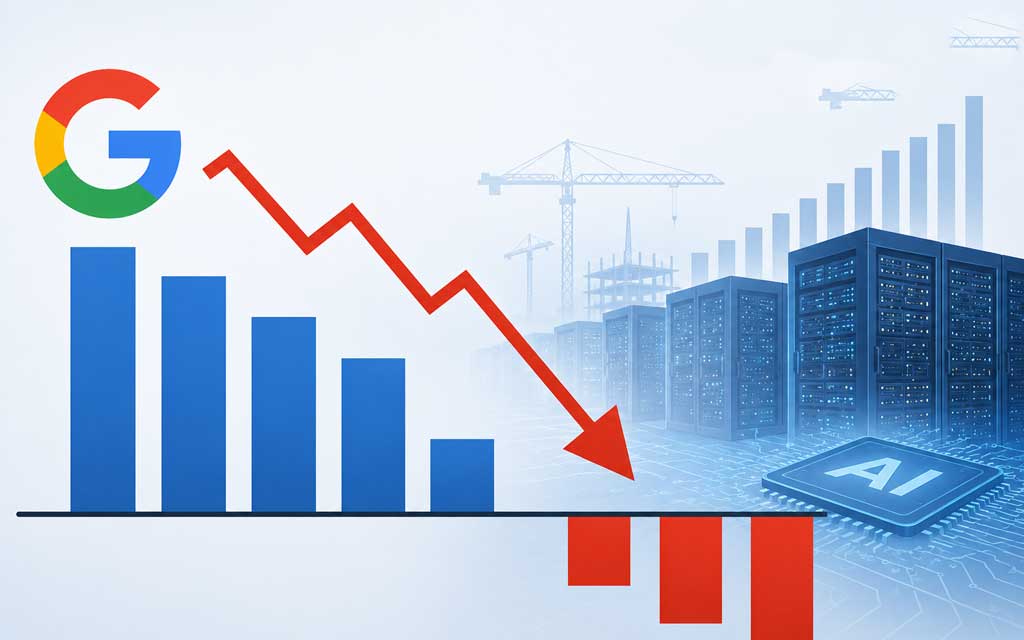
For more than a decade, Alphabet has been one of the most reliable cash-generating machines in corporate history. That reputation took a notable hit this week.
In its second-quarter 2026 results, Google’s parent company reported free cash flow of approximately –$5.9 billion — the first time the metric has turned negative in at least ten years, and according to several analyses, the first negative quarterly print since the company went public. The culprit was not weak operations. It was an unprecedented surge in artificial intelligence infrastructure spending.
Capital expenditures hit $44.9 billion in the quarter, roughly double the year-earlier level. The vast majority of that money went into servers, data centers, and networking gear required to train and serve Google’s Gemini models and the exploding demand for Google Cloud AI services. Management simultaneously raised full-year 2026 capital expenditure guidance to $195–205 billion, up from the previous $180–190 billion range, and signaled that spending would climb further in 2027.
Strong Business, Heavy Investment
The underlying business remains robust. Alphabet reported revenue of $119.8 billion, up 24% year-over-year. Google Cloud was the standout, with revenue jumping 82% to $24.8 billion, driven by AI infrastructure and solutions demand. Cloud backlog swelled to $514 billion. Search and other advertising continued to grow solidly, and YouTube delivered steady gains.
CEO Sundar Pichai framed the quarter as evidence that the company’s AI bets are working across the portfolio. Nearly 90% of the Fortune 100 are now using Gemini Enterprise, and the company is already pretraining its next-generation models while testing Gemini 3.5 Pro. CFO Anat Ashkenazi was more direct about the cash-flow impact: free cash flow is expected to remain under pressure as Alphabet invests aggressively to capitalize on the AI opportunity and generate attractive long-term returns.
In short, the company is choosing to convert today’s cash generation into tomorrow’s capacity. That choice is now visible on the free-cash-flow line.
Why Investors Are Watching Closely
Free cash flow has long been a key measure of Big Tech’s financial strength. Positive and growing free cash flow funded share buybacks, dividends (in Alphabet’s case, more recently), acquisitions, and the perception of fortress-like balance sheets. A negative print — even a temporary one driven by deliberate investment — changes the narrative.
Alphabet is not alone. Across the hyperscalers, capital spending on AI has reached levels that are beginning to outpace the growth in operating cash flow for some companies. Analysts note that the group’s combined capital expenditures are on track to rise sharply in 2026, creating temporary pressure on free cash flow even as AI-related revenues accelerate.
For Alphabet specifically, the numbers are striking: quarterly capex has climbed from roughly $22 billion a year ago to nearly $45 billion. Roughly 60% of the latest spend went to servers and the rest to data centers and networking, according to management commentary. The company has also raised equity to help fund the build-out, underscoring the scale of the commitment.
The Strategic Bet
Google argues the spending is not optional. Demand for AI training and inference capacity is rising faster than many expected, and falling behind on infrastructure risks losing share in both cloud and consumer AI products. The $514 billion cloud backlog provides some visibility into future revenue. Strong growth in Gemini usage and enterprise adoption offers early proof points that the investments are translating into commercial traction.
Still, the market reaction was cautious. Shares declined in after-hours trading as investors digested the higher spending guidance and the negative free-cash-flow number. The core question is no longer whether AI demand exists — the cloud numbers answer that — but how efficiently Alphabet can convert massive capital outlays into durable profits and cash flow over the next several years.
Looking Ahead
Management has been clear: free cash flow will likely stay under pressure while the company builds capacity. Trailing-twelve-month free cash flow remains positive but is declining as the quarterly investment wave continues. How long the negative or compressed free-cash-flow period lasts will depend on the pace of demand, the efficiency of new data centers and custom chips (including Google’s own TPUs), and the company’s ability to monetize AI features across Search, Cloud, YouTube, and Workspace.
For now, Alphabet is making a high-conviction, capital-intensive bet that the AI opportunity justifies temporarily sacrificing one of its most admired financial metrics. The second-quarter results show both the power of that opportunity — record cloud growth and solid overall revenue — and the cost of pursuing it at full speed.
Whether investors view the negative free cash flow as a temporary and necessary investment phase or a warning about the capital intensity of the AI era will shape the stock’s trajectory in the months ahead. One thing is already clear: the era of effortless, ever-rising free cash flow at the largest technology companies is, at least for now, colliding with the realities of building the infrastructure for artificial intelligence.



Leave a Comment