
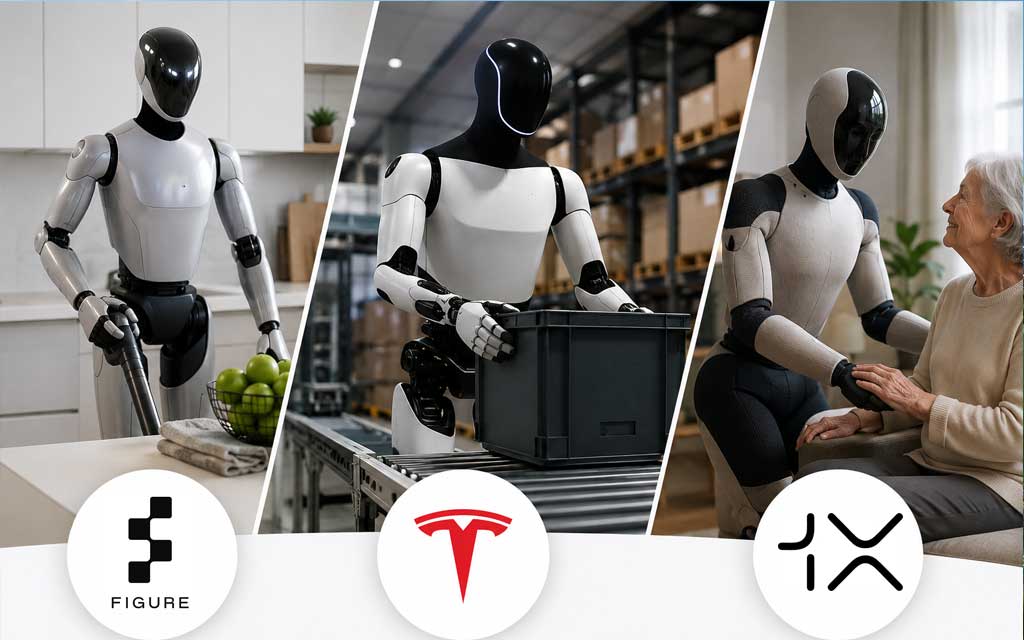
In a sunny California living room this summer, a bipedal robot carefully folds a stack of laundry, navigates around a curious toddler, and later helps clear the dinner table. Across the country in a Texas warehouse pilot, similar machines move bins and assist human workers on repetitive tasks. These scenes, once confined to research labs and carefully staged demos, are beginning to appear in real American environments in 2026. Humanoid and specialized AI robots from companies like Figure, Tesla, and 1X are edging from prototype into limited real-world use, raising both excitement about everyday assistance and hard questions about cost, safety, jobs, and readiness.
The Contenders Taking Shape
Figure AI has emerged as one of the most visible players. Its Figure 03 humanoid, powered by the company’s Helix AI system, is designed for general-purpose work. Figure has publicly highlighted progress in production at its BotQ facility, scaling output dramatically and generating more real-world data to improve Helix’s ability to handle unpredictable home environments—stairs, cluttered floors, shifting object locations. Videos and updates show the robot performing household sequences such as laundry, dishwashing, and basic cleaning with growing autonomy. The company’s stated direction includes moving more capability from industrial settings into homes, with goals of useful multi-day operation in unfamiliar environments.
Tesla’s Optimus program occupies a different but closely watched lane. On the company’s Q2 2026 earnings call, Elon Musk described Optimus as potentially Tesla’s biggest product ever and emphasized the intense focus on solving remaining challenges—particularly human-like hand dexterity, reliability in unstructured settings, and building an entirely new supply chain for thousands of unique components. Limited production was targeted to begin in late July or August 2026 at the Fremont facility on a converted vehicle line, with longer-term volume ambitions measured in the hundreds of thousands to millions. As of mid-2026 many units remain oriented toward learning and internal development rather than widespread external deployment.
A more explicitly consumer-facing effort comes from 1X, the Palo Alto-based company behind the NEO home robot. NEO is marketed for household chores and personalized assistance, with early-access ownership priced around $20,000 and a subscription option discussed. The company has highlighted advanced hand designs with high degrees of freedom intended to approach human-level dexterity, quieter operation, and safety-oriented design. U.S. deliveries were planned to roll out through 2026 for early customers, positioning NEO among the first humanoids aimed squarely at residential buyers rather than pure industrial use.
Alongside these humanoids, more specialized robots—advanced vacuum and mopping systems, companion devices, and light commercial platforms—continue maturing and finding places in American homes and small businesses.
Practical Applications Emerging
Elderly care and independent living represent one of the most emotionally resonant use cases. Aging populations create demand for help with medication reminders, mobility monitoring, light fetching tasks, and simple companionship. Early systems can already handle scheduled check-ins, fall-detection alerts linked to family or caregivers, and basic household support. Engineers working on these platforms often describe the goal as extending independence rather than replacing human caregivers. “The robot handles the repetitive physical tasks so the human caregiver can focus on connection and complex judgment,” one robotics specialist involved in pilot programs noted in industry discussions.
Cleaning and household maintenance remain the most immediately practical domain. Beyond refined robot vacuums, humanoids are being trained on multi-step sequences—sorting laundry, loading dishwashers, wiping surfaces, and organizing clutter. Success still varies with home layout and the novelty of the environment, but continuous learning from fleet data is steadily improving performance.
Education and small-business support appear in more limited pilots. In classrooms or after-school settings, robots can assist with interactive learning or repetitive administrative tasks. In small retail, hospitality, or light manufacturing, they handle inventory movement, basic cleaning between shifts, or simple customer-facing information roles under supervision.
Early pilot programs have appeared in California and Texas technology and logistics hubs, where companies test robots in controlled home-like environments or warehouse settings before broader release. These trials generate the data needed to harden AI models while exposing practical friction points—door thresholds, soft furniture, pets, and unpredictable human behavior.
Safety, Standards, and Trust
Safety remains non-negotiable for machines that share physical space with people. Developers emphasize compliant actuators that yield under unexpected force, extensive sensor suites (vision, tactile, proximity), emergency stop mechanisms, and software constraints that limit speed and force near humans. Soft exterior designs and careful whole-body control algorithms aim to reduce injury risk. Regulatory frameworks are still catching up; existing industrial robot standards are being adapted, while consumer-focused guidelines evolve through a mix of industry self-regulation, state-level attention, and eventual federal interest.
Ethicists stress transparency and accountability. “When a robot makes a mistake in a home—damaging property or, worse, causing harm—who is responsible: the manufacturer, the software provider, or the owner?” one technology ethicist observed in recent forums. Clear logging, remote oversight options, and conservative default behaviors are frequently cited as essential trust-building measures.
Costs, Benefits, and the Job Conversation
Current humanoid prices place them firmly in early-adopter or commercial territory. Early-access consumer units in the $20,000 range, plus potential subscription or service fees, mean most households will wait for costs to fall. Benefits become clearer at scale: reduced physical strain for elderly or disabled users, time savings for busy families, and productivity gains for businesses facing labor shortages in repetitive roles.
Job displacement discussions are active but nuanced. California has launched tools to monitor AI-related workforce impacts as part of broader state efforts to track and respond to technological change. Many analysts distinguish between automation of narrow, repetitive tasks and the creation of new roles in robot maintenance, fleet management, AI training data, and human-robot team supervision. Historical automation waves show both displacement and new opportunity; the difference with general-purpose robots is the potential breadth of tasks they may eventually address. Workforce experts emphasize proactive retraining and the likelihood that collaboration—humans handling judgment, creativity, and interpersonal work while robots handle strength, repetition, and endurance—will define the near term.
A Balanced Horizon
Optimistic scenarios paint a future of widespread human-robot collaboration: robots handling physically demanding or tedious household work so people reclaim time for family, creativity, or rest; support for aging in place that eases pressure on healthcare systems; and small businesses gaining leverage against labor constraints. Continuous AI improvement, driven by real-world fleet data, could accelerate capability far beyond today’s demonstrations.
Challenges remain substantial. Reliability in truly unstructured homes is still incomplete. Costs must drop significantly for mass adoption. Public acceptance depends on demonstrated safety and clear value. Supply chains for specialized components need to mature. Privacy concerns around always-sensing home robots require careful design and policy. And the societal conversation about work, purpose, and economic distribution will intensify as capabilities grow.
In July 2026 the robots walking American floors and factory aisles are no longer pure science fiction, nor are they yet ubiquitous household appliances. They are early, expensive, imperfect, and rapidly improving tools. Figure’s Helix-powered systems, Tesla’s production push with Optimus, 1X’s consumer-oriented NEO, and a growing ecosystem of specialized assistants mark the beginning of a new gadget frontier—one that will test engineering skill, regulatory wisdom, and society’s readiness to share daily life with intelligent machines. The most successful path forward will likely treat robots not as replacements for people, but as collaborators that expand what humans can accomplish together.




Leave a Comment