
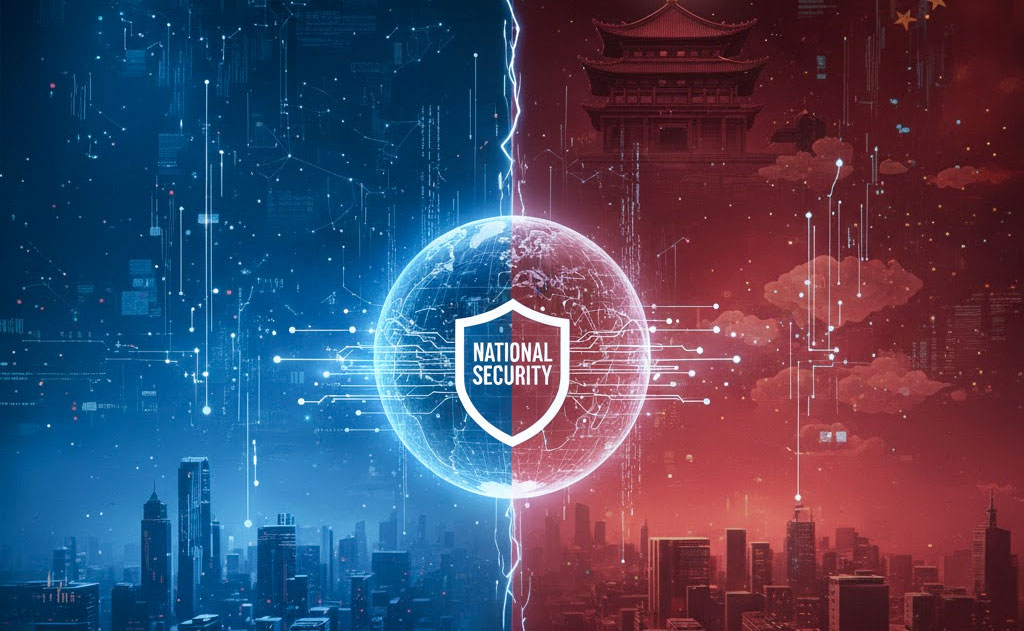
As we enter 2026, the US China tech rivalry national security landscape intensifies, with quantum computing and artificial intelligence (AI) at the forefront. These technologies are not just innovations—they hold the potential for profound quantum AI military advantage, influencing everything from encrypted communications to autonomous warfare. The military and cybersecurity implications are evolving rapidly, as both nations push toward practical applications that could shift global power dynamics.
This forward-looking analysis examines projected developments in 2026, building on 2025 momentum. Drawing from recent assessments by the U.S.-China Economic and Security Review Commission (USCC), RAND Corporation, and intelligence reports, we’ll explore how maintaining U.S. edge in these domains remains critical—without overstating risks, but grounded in expert insights and ongoing trends.
Quantum Computing in 2026: Toward Practical Advantage and Cryptographic Shifts
Quantum technologies are transitioning from lab demonstrations to industrial ecosystems. China’s state-driven investments—estimated at over $15 billion in recent plans—have accelerated progress, with 2025 milestones like the Zuchongzhi-3 (105 qubits) and commercial deployments via the Tianyan platform setting the stage for 2026 expansions.
Experts anticipate China deploying operational quantum key distribution (QKD) satellite constellations by 2026, enhancing secure communications for military and allied networks. The USCC’s 2025 report warns that China’s lead in quantum communications could provide persistent advantages in unbreakable links, challenging U.S. intelligence gathering.
In computing, 2026 may see China scaling superconducting and photonic systems further, potentially integrating quantum processors into AI training for complex simulations. Origin Quantum’s 2025 work fine-tuning billion-parameter AI models on quantum hardware hints at synergies emerging next year.
The U.S. counters with renewed National Quantum Initiative funding ($625 million for research centers) and DARPA’s benchmarking initiatives. However, the USCC recommends a “Quantum First” goal by 2030, emphasizing scalable systems and post-quantum cryptography (PQC) migration to preempt “Q-Day”—when quantum computers could decrypt legacy data.
Cybersecurity implications loom large: “Harvest now, decrypt later” threats persist, with adversaries stockpiling data. NIST’s PQC standards, finalized in 2024-2025, will see broader hybrid deployments in 2026, as regulators push mandates for critical infrastructure. Falling behind risks exposing military command systems or sensitive alliances.
As one USCC insight notes: “Whoever leads in quantum (and AI) will control the encryption of the digital economy… and gain asymmetric advantage in intelligence and targeting.”
AI’s Evolving Role: Intelligentized Warfare and Autonomous Systems
China’s “intelligentized warfare” doctrine integrates AI deeply into PLA operations, with 2025 developments like AI-enhanced electronic warfare and generative models for intelligence analysis paving the way for 2026 advancements.
Procurement trends show the PLA adopting domestic LLMs (e.g., DeepSeek variants) for battlefield prediction, target recognition, and decision support. Robotic systems, including motion-mimicking combat robots and drone swarms, are expected to mature, enabling low-risk operations in contested environments.
The 15th Five-Year Plan (2026–2030) prioritizes quantum and AI as economic growth engines, embedding military-civil fusion to accelerate dual-use tech. This could yield AI-driven predictive logistics or autonomous platforms overwhelming defenses.
U.S. responses include the Replicator program for thousands of AI-enabled drones and ethical guidelines for human oversight. Yet, reports highlight China’s numerical advantages in unmanned systems and rapid scaling via state support.
Military implications: AI reduces decision cycles, but risks escalation if systems misinterpret actions. Hybrid human-AI command remains key, as CNAS experts emphasize avoiding over-reliance that could disrupt stability.
In cybersecurity, AI-powered attacks—phishing, malware generation—will proliferate, with defenses needing robust, ethical AI countermeasures.
Synergies and Risks: Quantum-Enhanced AI on the Horizon
The convergence of quantum and AI amplifies threats. Quantum acceleration could optimize AI training or break codes in real-time, offering quantum AI military advantage in simulations, drug discovery for biodefense, or materials for advanced weapons.
China’s 2026 plans include photonic chip scaling and hybrid quantum-AI applications, while U.S. investments focus on error-corrected logical qubits.
Broader risks include supply chain vulnerabilities—China dominates rare earths critical for quantum hardware—and talent competition.
The Path Forward in 2026: Balanced Leadership
Lagging in this US China tech rivalry national security arena risks eroding deterrence, but the U.S. holds strengths in private innovation, alliances, and ethical frameworks. Recommendations include increased funding, international norms for autonomous weapons (targeting 2026 treaties), and accelerated PQC transitions.
As the UN’s International Year of Quantum (2025) transitions to action, 2026 will test resolve. Quantum and AI are pillars of future security—staying ahead preserves prosperity and peace; complacency invites shifts in the global order.
I’m Ethan, and I write about the tech that’s actually going to change how we live — not the stuff that just sounds impressive in a press release. I cover AI, EVs, robotics, and future tech for VFuture Media. I was on the ground at CES 2026 in Las Vegas, walking the show floor so I could give you a real read on what matters and what’s just noise. Follow me on X for daily takes.
Honestly, we’re still debating this one in the comments. Where do you land? Drop your take below — the best discussions on this site have always come from readers who actually know their stuff.



Leave a Comment