
Published on December 20, 2025 | By VFuture Media Team
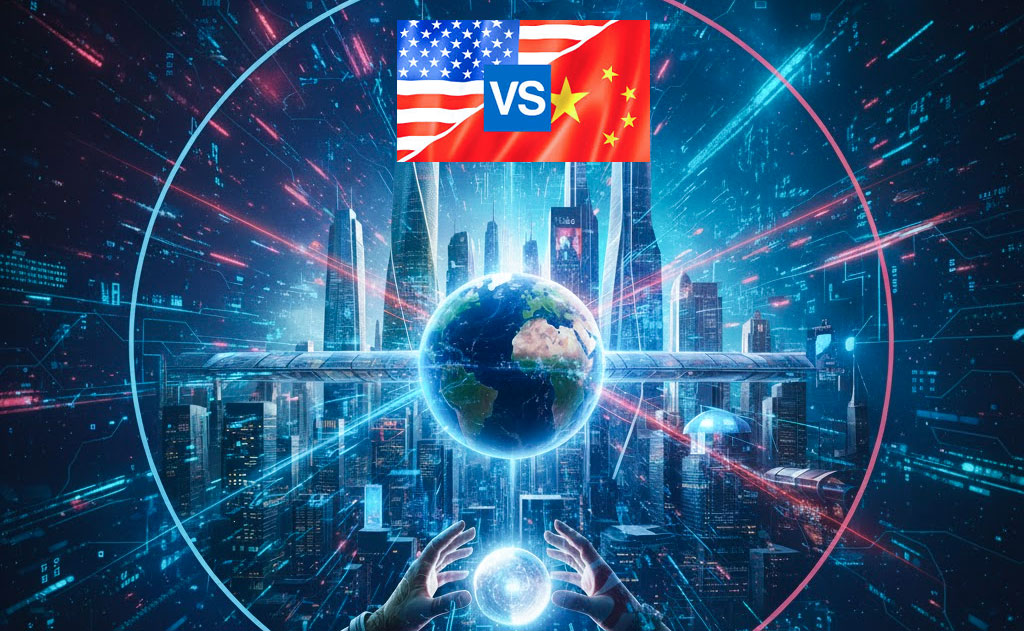
The year 2025 will be remembered as the moment the world fully grasped a seismic shift: in many of the technologies that will shape the next half-century, China is no longer chasing the United States—it is pulling decisively ahead.
This isn’t about raw GDP or military might anymore. It’s about who controls the platforms of tomorrow: the batteries that power mobility, the algorithms that drive intelligence, the quantum systems that could break today’s encryption, the solar panels that will dominate clean energy, and the chips that underpin everything digital.
What makes this rivalry so gripping is the asymmetry of approaches. The United States excels through private-sector dynamism, venture capital firepower, and groundbreaking foundational research. China counters with relentless state coordination, massive scale, and a willingness to prioritize volume and deployment over immediate profitability. The result? In category after category, China is translating ambition into tangible dominance.
Let’s examine five critical battlegrounds—Electric Vehicles, Artificial Intelligence, Quantum Technologies, Renewable Energy, and Semiconductors—through the lens of hard 2025 data. The numbers tell a story that’s equal parts alarming and awe-inspiring.
Electric Vehicles: China’s Total Ecosystem Supremacy
Start with the most visible arena: electric vehicles. By November 2025, China had already sold 11.6 million EVs—more than 60% of the global total. Its domestic market share consistently exceeds 50%, a threshold no other major economy has reached. The United States, meanwhile, limps along at around 10% share, with sales essentially flat year-over-year after federal incentives expired.
But sales are only part of the picture. China produces roughly 70% of the world’s EVs and has deployed nearly 10 million charging stations—twenty times more than the United States. This isn’t just manufacturing leadership; it’s ecosystem mastery. Chinese companies like BYD and CATL control the entire supply chain from minerals to batteries to finished vehicles, driving costs so low that EVs are now cheaper than gasoline equivalents in China’s largest segments.
The U.S. response—tariffs, the Inflation Reduction Act’s domestic-content rules, and attempts to rebuild supply chains—has slowed the bleeding but hasn’t reversed the tide. Legacy automakers like Ford are writing down billions on EV programs while Chinese brands flood emerging markets from Thailand to Brazil. The result is a world where the default affordable electric car is increasingly Chinese-made, reshaping global trade patterns and energy security calculations overnight.
Artificial Intelligence: Volume vs. Cutting-Edge Depth
Artificial intelligence presents a more nuanced contest, but the momentum is still shifting eastward.
China now files approximately 70% of global AI patents, including a staggering lead in generative AI filings accumulated over the past decade. This patent avalanche reflects a deliberate national strategy: subsidize research, flood universities with funding, and prioritize applied AI in manufacturing, surveillance, and consumer apps.
In contrast, the United States dominates private investment ($109 billion in 2024 alone versus China’s $9 billion) and still produces the majority of frontier models—40 notable large language models in 2024 compared to China’s 15. American companies like OpenAI, Anthropic, and Google DeepMind continue to set the performance benchmarks that the rest of the world chases.
Yet the gap is closing faster than most Western observers admit. Chinese models, often open-sourced and optimized for efficiency, are achieving near-parity at dramatically lower training costs. More importantly, China leads in real-world deployment: AI-driven predictive maintenance in factories, smart-city infrastructure, and facial recognition systems at scale. Where the U.S. debates ethical frameworks and safety, China implements.
The long-term risk? If AI advantages compound through data flywheels and ecosystem effects, sheer volume of deployment could eventually translate into qualitative leaps.
Quantum Technologies: China’s Quiet but Relentless Advance
Quantum technologies remain early-stage, but the stakes—unbreakable encryption, ultra-precise sensing, exponentially faster computation—couldn’t be higher.
Here, China’s lead is unambiguous. It holds roughly 60% of global quantum-related patents and has committed over $15 billion in public funding, triple the U.S. figure. Beijing’s achievements read like science fiction made real: the world’s longest quantum-secure communication network (over 12,000 km), the Jiuzhang quantum computer demonstrating advantage in specific tasks, and Micius, the quantum-enabled satellite that achieved unhackable key distribution across continents.
The United States retains strengths in fundamental research and private innovation—companies like IBM, Google, and IonQ push quantum computing milestones—but government coordination lags. The National Quantum Initiative provides important funding, yet it pales beside China’s centralized push.
Perhaps most telling is talent flow: while the U.S. still attracts top global researchers, an increasing number of ethnic Chinese PhDs are returning home, lured by state-of-the-art facilities and patriotic appeals.
Renewable Energy: China’s Industrial Juggernaut Redefines Global Climate Math
The clean energy transition was supposed to be a shared global effort. Instead, it has become overwhelmingly Chinese.
In 2025, China installed more new solar and wind capacity than the rest of the world combined—again. It achieved its 2030 renewable targets five years early and now manufactures over 90% of global solar panels, 80% of battery components, and the majority of wind turbine parts.
This dominance has driven costs down dramatically—solar module prices fell another 30% in 2025 alone—accelerating the global shift away from fossil fuels. Paradoxically, China’s coal expansion continues in parallel, but its renewable buildout is so massive that it single-handedly accounts for most of humanity’s progress toward Paris Agreement goals.
The United States, despite the Inflation Reduction Act’s historic incentives, remains a minor player in manufacturing scale. Domestic solar production is growing but starts from near-zero. The geopolitical implication is profound: the green transition increasingly depends on supply chains controlled by a strategic rival.
Semiconductors: The One Area Where America Still Holds Crucial Ground
If there’s a bright spot for the United States, it’s advanced semiconductors—the bleeding-edge chips below 5nm that power frontier AI and military systems.
Through TSMC (heavily backed by U.S. security guarantees) and domestic efforts under the CHIPS Act, America maintains leadership in the most sophisticated nodes. Export controls have successfully slowed China’s progress in extreme ultraviolet lithography and high-end GPU production.
Yet even here, the picture is mixed. China leads in legacy chip production (nodes above 10nm essential for autos, appliances, and industry) and has poured $47 billion into its latest Big Fund to achieve self-sufficiency. Patent filings in semiconductors grew 42% year-over-year in China versus single digits in the U.S.
The danger is bifurcation: a high-end Western ecosystem and a parallel Chinese one that’s “good enough” for most applications and vastly larger in volume.
The Bigger Story: Two Different Philosophies of Technological Power
What ties these threads together is a fundamental difference in approach.
The American model bets on entrepreneurial genius, open science, and market signals. It produces world-changing breakthroughs—mRNA vaccines, GPT models, reusable rockets—but struggles to translate invention into industrial dominance at global scale.
China’s model prioritizes national security, long-term planning, and overwhelming scale. It accepts lower margins, tolerates overcapacity, and mobilizes resources at speeds democracies rarely match. The result is leadership in deployment, manufacturing, and the physical infrastructure of future technologies.
Neither approach is objectively superior; each has blind spots. America’s openness fosters creativity but risks technology diffusion. China’s control accelerates progress but can stifle disruptive innovation.
Where This Leaves Us in 2025
The data is unambiguous: across most measurable dimensions—patents, manufacturing share, infrastructure deployment—China leads in four of these five critical domains. The United States clings to advantages in foundational research, private investment, and the very highest-end semiconductors, but these edges are narrowing.
This isn’t cause for despair but for urgency. The technologies examined here will determine economic prosperity, military balance, and humanity’s response to climate change. A world where key platforms are predominantly Chinese-designed and manufactured carries profound implications for standards, security, and influence.
Yet history shows technological leadership is never permanent. The U.S. rose by out-innovating Britain in the 19th century and the Soviet Union in the 20th. Today’s challenge demands renewed focus on education, research funding, immigration of talent, and—crucially—translating invention into production at scale.
China’s advance is one of the defining stories of our era: a nation that was largely absent from cutting-edge technology in 1990 now setting the pace in fields that didn’t exist then. Whether this rivalry produces a splintered technological world or sparks mutual advancement depends on choices made in the years ahead.
At VFuture Media, we’re not picking sides—we’re watching one of the most consequential competitions in human history unfold in real time.
Sources: International Energy Agency, Stanford AI Index 2025, World Intellectual Property Organization, ASPI Critical Technology Tracker, BloombergNEF, Rho Motion, and official government reports as of December 2025.
We started VFuture Media because we wanted tech news written by people who actually follow this industry — not content farms chasing keywords. If that resonates, we’d love to have you as a regular reader. Pull up a chair.
I’m Ethan, and I write about the tech that’s actually going to change how we live — not the stuff that just sounds impressive in a press release. I cover AI, EVs, robotics, and future tech for VFuture Media. I was on the ground at CES 2026 in Las Vegas, walking the show floor so I could give you a real read on what matters and what’s just noise. Follow me on X for daily takes.



Leave a Comment