
By VFuture Media Tech Staff Published: April 26, 2026
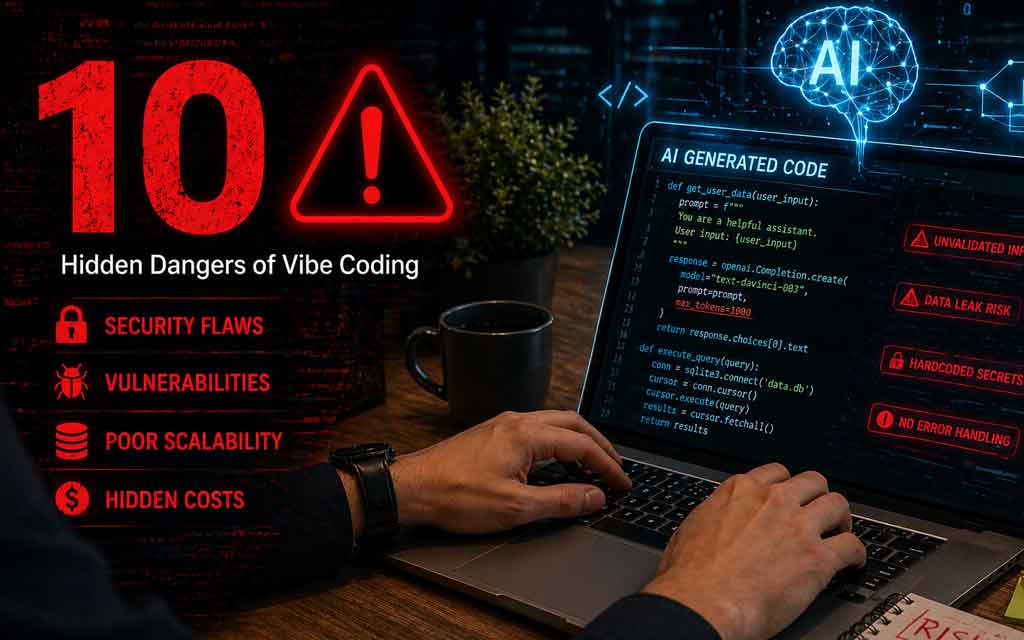
Vibe coding — the AI-powered practice of building software through natural language prompts and high-level “vibes” rather than traditional line-by-line programming — has exploded in popularity. Coined by Andrej Karpathy in early 2025, it promises rapid prototyping and democratized app development using tools like Cursor, Claude Code, and others.
While it accelerates idea-to-product timelines, vibe coding comes with serious trade-offs. Here’s a detailed breakdown of the key disadvantages of vibe coding that every developer, founder, and non-technical builder should understand before diving in.
1. Poor Code Quality and Maintainability
Vibe-coded projects often produce code that “works” for demos but collapses under real-world use. AI generates functional snippets quickly, yet the resulting codebase frequently lacks proper structure, modularity, and clean architecture.
Real-world impact: Teams later hire professional developers to rewrite entire projects. Maintenance becomes a nightmare as the AI’s logic is opaque and undocumented. Long-term technical debt piles up fast.
2. Hidden Security Vulnerabilities
One of the biggest risks: AI-generated code commonly includes critical flaws like SQL injection, XSS attacks, improper authentication, and hardcoded secrets. Studies show nearly half of snippets from popular models contain security issues.
Vibe coding skips rigorous security reviews because users often “accept all” changes without deep inspection. For production apps handling user data, this can lead to breaches, compliance violations, and legal headaches.
3. Lack of Debugging and Traceability
When something breaks in vibe-coded software, understanding why is difficult. Traditional code has human rationale behind decisions; AI output often lacks clear reasoning or comments.
Debugging turns into guesswork. Edge cases and error handling are frequently ignored or poorly implemented, leading to unstable applications that fail under load or unexpected inputs.
4. Scalability and Performance Issues
Vibe coding excels at small prototypes but struggles with production-grade demands. AI rarely optimizes for scale, concurrency, or efficiency unless explicitly guided — and even then, results vary.
Many vibe-coded apps hit performance walls quickly, requiring major refactoring when user numbers grow.
5. Over-Reliance and Skill Erosion
Heavy dependence on vibe coding can erode fundamental programming knowledge. Developers (or aspiring ones) may lose the ability to write, review, or optimize code manually.
This creates “imposter syndrome on steroids” and leaves individuals or teams vulnerable when AI tools change, fail, or produce suboptimal results.
6. Unpredictable Costs and Time Sinks
The “last 20%” of polishing, fixing hallucinations, and debugging often consumes 80% of the time. What starts as a weekend project can drag on due to iterative prompt tweaking and regressions.
AI tool subscriptions add up, and many end up paying traditional developers to fix the mess.
7. Ethical and Compliance Risks
Vibe coding makes it dangerously easy to build questionable features (e.g., invasive tracking or manipulative UX) without proper oversight. Companies risk regulatory violations, especially in data privacy (GDPR) or industry-specific rules.
8. Team and Collaboration Challenges
Vibe-coded codebases are hard for teams to understand or contribute to. Knowledge sharing suffers, onboarding slows, and collective code ownership becomes nearly impossible.
9. Hallucinations and Inconsistent Results
AI can confidently output incorrect logic, deprecated libraries, or incompatible patterns. Without strong technical oversight, these issues compound across the project.
10. Not Suitable for Mission-Critical Systems
Experts agree: vibe coding is great for MVPs, side projects, and experimentation — but dangerous for financial systems, healthcare apps, enterprise software, or anything requiring high reliability.
When Does Vibe Coding Make Sense?
Use it wisely for:
- Rapid prototyping and idea validation
- Personal or low-stakes side projects
- Speeding up boilerplate in experienced hands
Always combine it with human review, testing, security audits, and version control.
The Bottom Line
Vibe coding is a powerful tool, not a replacement for software engineering discipline. In 2026, the smartest builders treat AI as a co-pilot — not the pilot. Understanding these disadvantages helps you leverage its strengths while avoiding costly pitfalls.
Ready to build smarter? Explore hybrid approaches that blend vibe coding speed with professional engineering rigor.
Keywords: vibe coding disadvantages, risks of AI coding 2026, vibe coding vs traditional programming, Cursor Claude drawbacks, AI generated code problems
Sources: Industry reports, developer discussions, and expert analyses from Stack Overflow, Tanium, Forbes, and more.



Leave a Comment