
By Ethan Brooks, USA-based Tech Analyst May 2, 2026
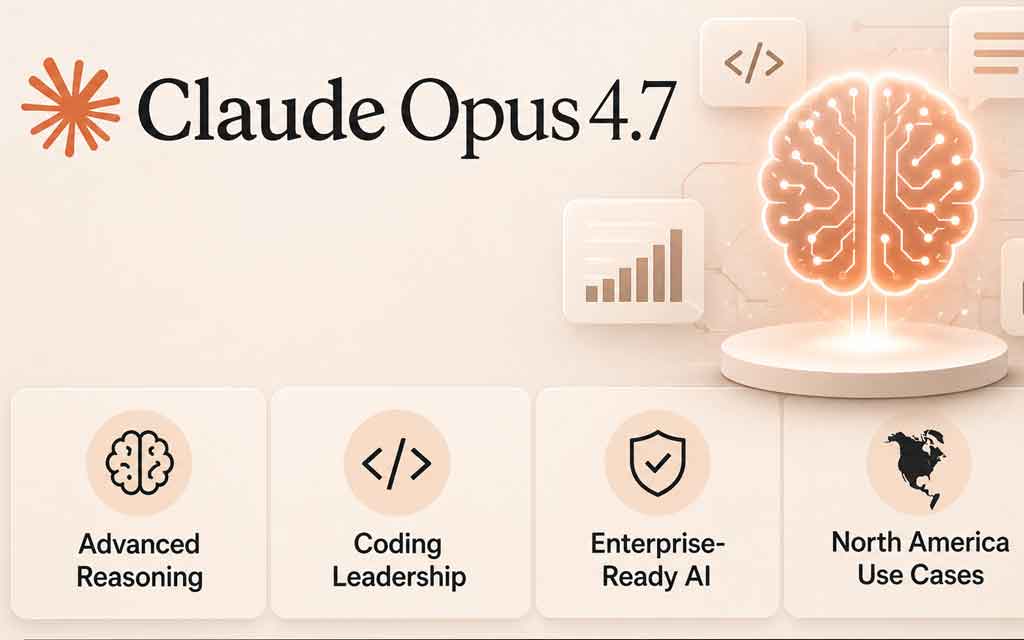
SAN FRANCISCO — Anthropic has strengthened its position in the frontier AI race with significant updates to the Claude family, including Claude Opus 4.7 and Claude Sonnet 4 variants rolling out in May 2026. Known for thoughtful reasoning, strong safety alignments, and exceptional coding performance, the latest Claude models are gaining rapid traction among North American enterprises that prioritize reliability, transparency, and responsible AI deployment over raw benchmark chasing.
As organizations across the United States and Canada navigate the complexities of scaling generative AI while managing risk, compliance, and talent demands, Claude’s latest release offers a compelling balance of capability and control. This in-depth report examines the new models’ technical advances, benchmark leadership, pricing, real-world enterprise applications, implementation considerations, and strategic implications for North American businesses in 2026.
Technical Highlights of Claude 4.7 Updates
Anthropic focused this release on deepening long-horizon reasoning, improving agentic reliability, and enhancing coding and analysis workflows while maintaining the company’s signature constitutional AI approach to safety and helpfulness.
Superior Reasoning & Analysis Claude Opus 4.7 excels at complex, multi-step problems that require careful chain-of-thought reasoning. It handles nuanced ethical considerations, long-document synthesis, and strategic planning with fewer logical errors than many competitors. This makes it particularly valuable for legal analysis, policy work, financial modeling, and scientific research teams in North America.
Coding Leadership Early May 2026 evaluations show Claude models leading or near-leading on agentic coding benchmarks such as SWE-Bench variants. Developers praise its ability to understand large codebases, suggest architectural improvements, write comprehensive tests, and debug subtle issues. Canadian and US software teams report faster sprint velocities and higher code quality when using Claude for pair-programming-style assistance.
Multimodal & Long-Context Improvements Enhanced vision capabilities allow better interpretation of charts, diagrams, screenshots, and physical documents. Context windows support very long inputs, enabling analysis of entire books, lengthy contracts, or extensive code repositories in a single session.
Agentic & Tool-Use Reliability Claude 4.7 demonstrates more consistent performance when using tools, browsing, or orchestrating multi-step workflows. This reduces the need for heavy human supervision in automated processes such as data pipeline management or customer onboarding automation.
Safety & Transparency Anthropic’s constitutional AI framework continues to differentiate the models, producing more predictable, less hallucinatory outputs with built-in refusals for harmful requests. Enterprise versions include detailed audit logs and customization options that help organizations meet stringent US and Canadian compliance standards.
Benchmarks and Independent Evaluations (May 2026)
In head-to-head May 2026 testing:
- Claude Opus 4.7 frequently ranks at or near the top on rigorous reasoning and coding suites.
- Strong results in long-context retrieval and multi-document QA tasks.
- Competitive multimodal scores, particularly for technical diagrams and real-world image understanding.
- Excellent efficiency metrics for its capability class, appealing to cost-conscious enterprises.
While no single model dominates every category, Claude’s combination of reasoning depth, coding strength, and safety profile makes it a preferred choice for high-stakes deployments where accuracy and trustworthiness matter most.
Pricing, Access, and Total Cost Considerations for North American Buyers
Anthropic offers flexible pricing tiers designed for startups through large enterprises:
- Standard API Access — Usage-based pricing suitable for experimentation and moderate production.
- Team / Enterprise Plans — Dedicated instances, priority support, custom fine-tuning, and advanced governance features. These are especially popular with regulated industries such as finance, healthcare, and government contractors in the US and Canada.
- Cloud Marketplace Availability — Easy procurement through major providers with existing enterprise agreements.
North American organizations should budget based on expected token volume. Many start with pilot spend in the low five figures per month before scaling. Enterprise agreements often include volume discounts, committed spend benefits, and professional services support that improve overall economics and speed of deployment.
Real-World Impact Across US and Canadian Industries
Software Engineering & Product Development Engineering organizations are using Claude to accelerate development cycles, improve documentation, and maintain higher code standards. The model’s ability to reason about architecture and best practices is frequently cited as a differentiator.
Legal, Compliance & Risk Teams Law firms and corporate legal departments leverage Claude for contract review, regulatory analysis, and policy drafting. Its careful reasoning and lower hallucination rate reduce review burden while maintaining high accuracy.
Financial Services & Analytics Banks, investment firms, and fintech companies apply the models to risk assessment, report generation, and customer insights. Canadian institutions particularly value the strong alignment and explainability features.
Healthcare & Life Sciences With appropriate safeguards, Claude assists in literature review, clinical note summarization, and research hypothesis generation while supporting HIPAA-compliant deployments.
Customer Experience & Support Enterprises deploy Claude-powered agents that handle complex inquiries with nuance and appropriate escalation, improving resolution times and customer satisfaction.
Education & Research Universities and think tanks use the models for literature synthesis, grant writing assistance, and student support tools.
Implementation Best Practices for North American Organizations
Successful adoption typically follows a structured path:
- Assessment & Use-Case Prioritization — Identify processes where reasoning depth or coding support will deliver clear ROI.
- Pilot & Governance — Start with controlled environments, implement prompt engineering standards, and establish review workflows.
- Integration — Connect via API or preferred cloud marketplace with existing security and monitoring tools.
- Scaling & Optimization — Monitor performance, costs, and user feedback. Fine-tune where permitted and expand to additional departments.
- Change Management — Train teams on effective prompting, limitations awareness, and human-AI collaboration best practices.
Many companies partner with Anthropic solution providers or experienced consultancies to accelerate value realization while mitigating risks.
Competitive Context in the May 2026 AI Landscape
Claude competes directly with OpenAI’s GPT-5.5 (strong ecosystem and general capabilities), Google’s Gemini family (multimodal and search strengths), and various open-source and specialized models. Claude often wins evaluations where careful, reliable reasoning and safety are paramount. Its constitutional approach resonates with North American enterprises operating under strict governance and ethical standards.
Strategic Outlook: Why Claude Matters for North American Leadership in 2026
The May 2026 Claude updates reinforce Anthropic’s role as a leader in trustworthy frontier AI. For US and Canadian organizations, adopting these models is not just about performance — it is about building AI systems that align with corporate values, regulatory requirements, and long-term societal expectations.
Forward-thinking leaders are combining Claude with strong data strategies, human oversight frameworks, and continuous evaluation processes. The organizations that do this well will achieve sustainable competitive advantages through higher-quality outputs, faster innovation cycles, and reduced risk exposure.
Final Recommendation: Evaluate Claude 4.7 (particularly Opus for complex work and Sonnet for balanced cost/performance) through targeted pilots. Focus on use cases where reasoning reliability or coding excellence provides outsized value. Engage early with Anthropic’s enterprise team or trusted partners to design compliant, scalable deployments.
As the AI landscape evolves rapidly through 2026, models like Claude that combine power with principled design will be essential tools for responsible innovation in North America.



Leave a Comment