
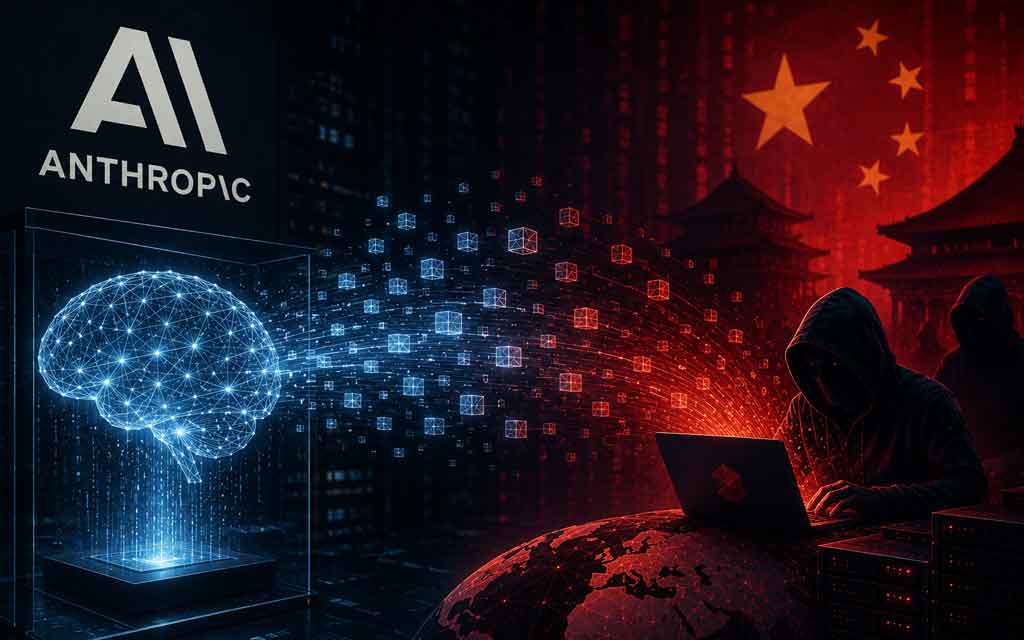
Anthropic accuses Alibaba-linked operators of the biggest AI theft ever — using 25,000 fake accounts and nearly 29 million Claude conversations to distill its model capabilities. The U.S.-China AI war just escalated.
Anthropic has accused operators tied to Alibaba’s Qwen lab of orchestrating what it calls the largest known “distillation attack” against a leading U.S. AI model.
According to a letter Anthropic sent to U.S. senators and White House officials, Chinese actors created nearly 25,000 fraudulent accounts and ran approximately 28.8–29 million conversations with Claude between April and June 2026. The goal: extract Claude’s advanced capabilities — especially in software engineering and agentic reasoning — to train and improve their own competing models without paying for API access.
This wasn’t a one-off breach. It was an industrial-scale operation designed to bypass Anthropic’s decision to block Claude in China.
What Is a Distillation Attack?
In AI terms, distillation is a legitimate technique where a smaller or less capable model is trained on the outputs of a more powerful “teacher” model. It allows companies to create efficient versions of frontier models.
When done without permission by querying a competitor’s API at massive scale and using those responses as training data, it becomes a form of intellectual property theft.
Anthropic says the attackers specifically targeted Claude’s most valuable skills:
- Complex software engineering
- Multi-step reasoning and agentic behavior
- High-quality code generation and problem-solving
By feeding millions of high-quality Claude responses into their own training pipelines, the attackers could significantly boost their models’ performance at a fraction of the normal development cost.
Not Just Alibaba — A Pattern of Chinese AI Labs
This latest accusation builds on earlier revelations from Anthropic. In February 2026, the company publicly detailed similar large-scale distillation campaigns by three other Chinese AI labs:
- DeepSeek
- Moonshot AI
- MiniMax
Those earlier campaigns involved over 16 million exchanges through roughly 24,000 fake accounts. The Alibaba-linked operation appears to have been even larger and more sophisticated.
Together, these incidents paint a picture of systematic efforts by multiple Chinese AI companies to “free-ride” on the capabilities of leading U.S. models.
Anthropic’s Response and Call to Action
Anthropic has already escalated the issue beyond technical defenses. The company sent a detailed letter to key U.S. policymakers, including members of the Senate Banking Committee, describing the attacks and urging urgent government intervention.
Their core argument:
- AI model capabilities represent valuable intellectual property.
- Systematic extraction via distillation undermines the economic incentives for frontier AI development.
- Without stronger protections and enforcement, U.S. companies will be at a permanent disadvantage.
The letter comes amid broader U.S. government concerns. Earlier in 2026, the White House publicly accused China of industrial-scale theft of AI technology, highlighting distillation as a key tactic.
Why This Matters Beyond Anthropic
This isn’t just one company’s problem. It highlights several critical issues in the global AI race:
1. The Limits of Technical Defenses Even with regional blocks and fraud detection, determined actors can still access models at massive scale using proxies, fake identities, and distributed infrastructure.
2. Economic Asymmetry U.S. companies invest billions in training frontier models. If competitors can effectively copy large portions of that capability through distillation, the return on investment collapses.
3. National Security Implications Advanced AI capabilities have clear dual-use potential. Systematic extraction by foreign entities raises concerns about technology transfer in strategically important domains.
4. The Future of Model Access Incidents like this accelerate the shift toward more closed, controlled access to frontier models — and increase pressure for stronger export controls and international norms around AI IP.
The Bigger Picture: A War of Industrial Espionage
The AI competition between the U.S. and China is no longer just about who can train the biggest model fastest. It’s increasingly about who can protect (or acquire) capabilities most effectively.
Anthropic’s public accusation — and its direct appeal to Congress and the White House — marks a significant escalation. It moves the conversation from technical blog posts about model safety into the realm of national policy and economic security.
Whether this leads to new legislation, stronger enforcement of existing rules, or further restrictions on API access remains to be seen. What’s clear is that the era of relatively open access to the world’s most powerful AI models is coming under intense pressure.
The war for AI supremacy isn’t just being fought in research labs and data centers anymore. It’s being fought through networks of fake accounts, proxy servers, and billions of stolen model outputs.
And according to Anthropic, one of the largest battles just became public.
What do you think? Is systematic model distillation a form of theft that requires stronger government intervention, or is it an inevitable part of competitive AI development? How should U.S. companies and policymakers respond?
Sources: Anthropic letter to U.S. officials (June 2026), Reuters, Bloomberg, and Anthropic’s earlier public disclosures on distillation attacks.


Leave a Comment