
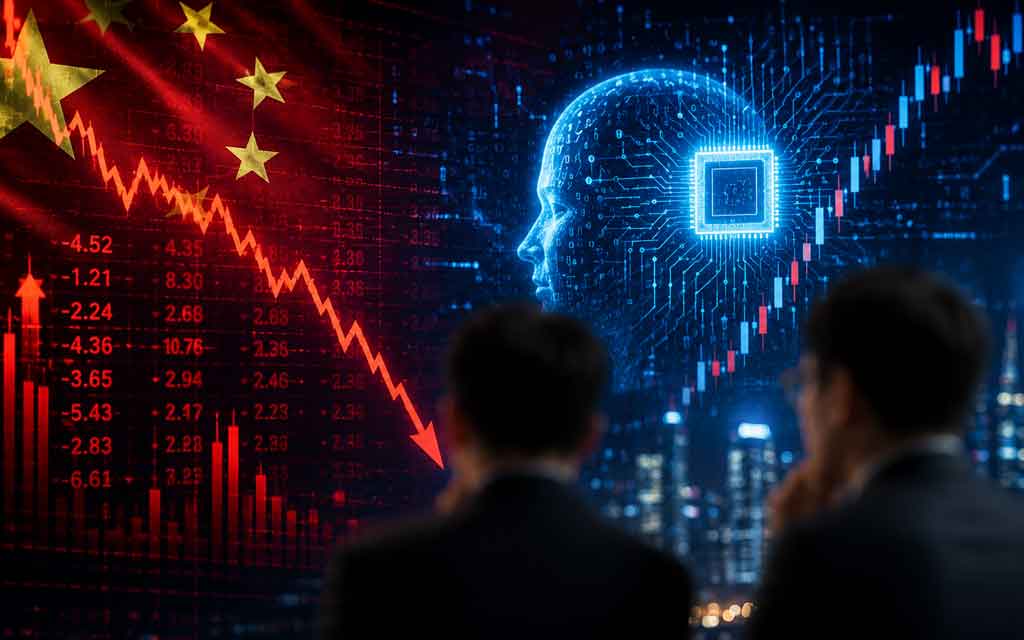
Two of China’s most prominent hedge fund managers are sounding the alarm: the global AI stock boom has entered “super bubble” territory and a sharp correction may be imminent.
According to a Bloomberg report published on June 26, 2026, Wealspring Asset and Shanghai Banxia Investment Management Center have warned clients that AI-related equities have detached from fundamentals. Their concerns center on unsustainable valuations, slowing revenue growth expectations at leading AI developers, and a lack of durable competitive moats for many companies in the AI infrastructure supply chain.
The warnings come as AI stocks — led by Nvidia and other chipmakers — have driven much of the market’s gains in recent years, but are now facing renewed scrutiny amid high valuations and questions about when (or if) the massive investments in AI infrastructure will translate into proportional profits.
Who Are the Funds Raising the Alarm?
Wealspring Asset (founded by Yang Dong) Yang Dong is a well-known figure in Chinese investing circles, famous for correctly calling the market top in 2007. In a recent investor letter, he described global AI stocks as a “super bubble” and stated that “the collapse point may not be far away.”
Shanghai Banxia Investment Management Center The firm told investors that “the trigger for the AI bubble to burst has already appeared.” They specifically pointed to mounting pressure on the breakneck revenue growth expectations for leading AI companies, including Anthropic.
At least four other Chinese hedge funds have reportedly turned more cautious on AI investments, advising clients to reduce exposure due to stretched valuations and uncertain long-term advantages for many infrastructure plays.
These are not fringe voices. They come from managers with long track records in one of the world’s most competitive and volatile markets.
Why Are They Calling It a “Super Bubble”?
The Chinese funds’ concerns revolve around several key issues:
- Valuations Detached from Reality Many AI-related stocks trade at multiples that assume years of explosive growth. When growth expectations moderate even slightly, the re-rating can be brutal.
- Slowing Revenue Momentum at Key Players Banxia specifically highlighted signs that revenue growth at companies like Anthropic is facing pressure. In a sector where valuations are heavily tied to future growth narratives, any hint of deceleration is significant.
- Lack of Durable Moats Several funds argue that many companies benefiting from the AI infrastructure boom (chips, data centers, power, cooling) do not have strong, lasting competitive advantages. Once the initial buildout phase slows, pricing power and margins could compress.
- Massive Capex vs. Monetization Timeline Hyperscalers and AI labs are spending hundreds of billions on data centers, chips, and energy. The funds question whether the return on this investment will arrive fast enough to justify current stock prices.
These arguments echo long-standing bearish cases on AI, but coming from experienced Chinese managers at this moment adds weight — especially as some global investors (including Michael Burry) have also expressed skepticism about certain AI names.
Context: Where We Stand in the AI Cycle
The AI rally since 2023 has been extraordinary. Nvidia’s market cap exploded as it became the pick-and-shovel provider for the AI gold rush. Other chipmakers, cloud providers, and software companies rode the wave.
However, by mid-2026, several dynamics have shifted:
- Adoption vs. Hype: While AI tools are widely used, many enterprises are still in pilot or experimentation phases rather than large-scale production deployments that move the needle on revenue.
- Infrastructure Costs: Power, chips, and data center construction costs remain extremely high. Some forecasts suggest the industry may need trillions in cumulative investment.
- Monetization Reality: Companies like OpenAI and Anthropic are growing fast but still face questions about when (or if) they reach sustainable high-margin profitability.
- Recent Market Action: Chip stocks have seen volatility, with sharp drops in names like Samsung and SK Hynix in recent sessions, and broader Nasdaq pressure.
The Chinese hedge funds are essentially arguing that the market has moved from “rational exuberance” into outright bubble territory.
Counterarguments: Why the Bull Case Remains Strong
Not everyone agrees the bubble is about to burst. Key counterpoints include:
- Real Technological Progress: Capabilities in reasoning, agents, and multimodal AI continue to advance rapidly. This is not purely speculative — there are measurable improvements.
- Corporate Spending Intent: Many large companies have explicitly guided to continued heavy AI-related capex. Earnings calls from hyperscalers still show strong demand signals.
- Productivity Gains: Early evidence suggests AI is already delivering measurable productivity improvements in coding, customer service, and analysis — which could eventually support higher corporate earnings.
- Historical Precedents: Major technology shifts (internet, cloud, smartphones) went through periods of over-optimism followed by consolidation, but ultimately created enormous value. Some argue we are in the “overbuilding” phase that precedes the next leg up.
Proponents of the bull case often say that even if there is a correction, the long-term winners will be clear — and the current selloff (if it materializes) could be a buying opportunity.
What Investors Should Watch Next
If the Chinese hedge funds are right, here are the key indicators to monitor:
- Earnings Growth vs. Expectations: Watch quarterly results from Nvidia, Microsoft, Google, Amazon, and AI labs like Anthropic and OpenAI (where data is available).
- Capex Guidance: Any pullback in planned AI infrastructure spending from big tech would be a major red flag.
- Power and Supply Chain Constraints: Continued difficulty securing power and advanced chips could slow the buildout and hurt related stocks.
- Valuation Compression: Forward P/E ratios and price-to-sales multiples for AI leaders — any rapid derating would confirm bubble concerns.
- Insider Selling and Fund Flows: Continued heavy selling by executives at AI-related companies or outflows from AI-themed ETFs/funds.
Outlook: Bubble, Correction, or Healthy Reset?
History shows that calling market tops is extremely difficult — even experienced managers like Yang Dong have mixed records on timing. Chinese hedge funds have also been early (or wrong) on previous global calls.
That said, their warnings deserve attention because:
- They come from managers operating in a market that has seen its own share of bubbles and corrections.
- They are putting their clients’ capital at risk by speaking out.
- Several independent signals (high valuations, insider selling, questions around monetization speed) align with their thesis.
Whether this marks the beginning of a major AI correction or simply a healthy pause in an otherwise transformative technology cycle remains to be seen. Markets can remain irrational longer than expected — but they can also correct violently when sentiment shifts.
For now, the debate has intensified: Is AI in a “super bubble,” or are we still in the early innings of one of the most important technological shifts in decades?
Frequently Asked Questions
Which Chinese hedge funds are warning about the AI bubble? Wealspring Asset (Yang Dong) and Shanghai Banxia Investment Management Center are the most prominent. At least four others have reportedly turned cautious.
What specific trigger did they mention? Banxia pointed to signs that revenue growth expectations at companies like Anthropic are facing pressure. Wealspring called the entire AI stock complex a “super bubble.”
Is this just a China-specific view? No. Similar concerns have been raised by some Western investors (including Michael Burry’s bearish positions on certain names) and are reflected in recent volatility in chip stocks.
What should long-term investors do? Most advisors recommend avoiding panic. Focus on companies with strong balance sheets, real revenue traction, and durable advantages. Consider position sizing and diversification rather than making binary “all-in or all-out” bets on the AI theme.
Could this warning be wrong? Absolutely. Many technology bubbles have been called prematurely. The ultimate test will be whether AI delivers transformative productivity gains and profits at scale in the coming years.
Bottom Line Chinese hedge funds with strong track records are publicly warning that the AI rally has entered dangerous “super bubble” territory. Their concerns about valuations, slowing growth expectations, and weak moats are worth watching — even if timing a top remains notoriously difficult.
Whether this proves to be a prescient call or an early warning that gets ignored for months (or years) will play out in the coming quarters. For investors, the prudent approach is to stay informed, remain diversified, and focus on fundamentals rather than hype.
Tags: AI bubble, Chinese hedge funds, AI stock warning, Nvidia valuation, Anthropic growth, AI market 2026, super bubble
CTA:
Do you think the AI rally is in a super bubble, or is this just another healthy correction in a transformative cycle? Share your view in the comments. Subscribe for more on AI investing, market warnings, and tech sector analysis.



Leave a Comment