
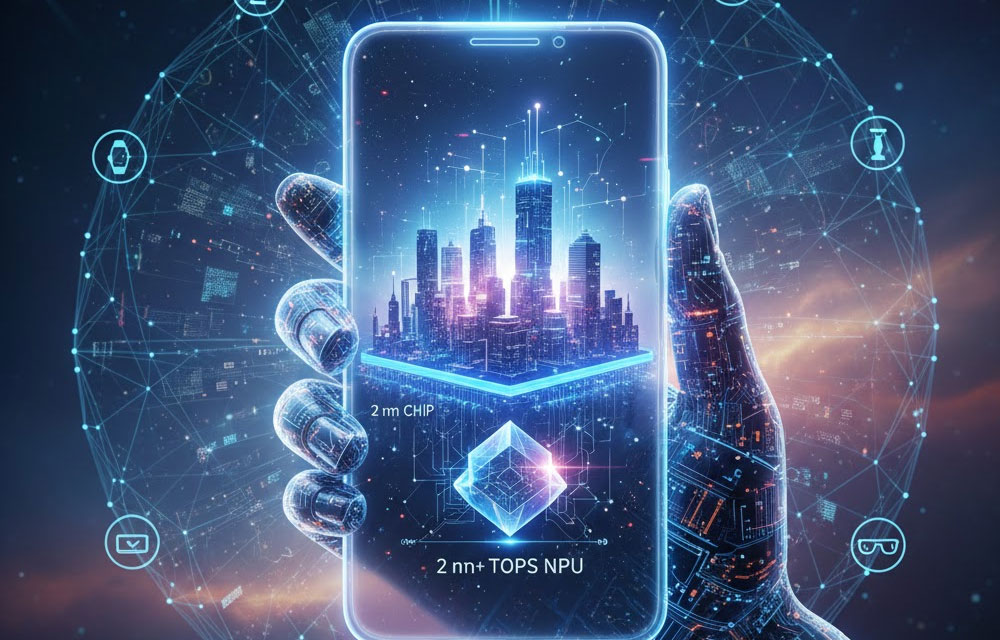
By 2026, two-thirds of all AI compute will happen through inference running directly on the devices in your pocket, on your wrist, or behind the wheel of your car. This isn’t hype from a single chipmaker — it’s the consensus forecast from Qualcomm, Gartner, Counterpoint Research, and even conservative analysts at McKinsey. The era of “always-on,” instantly responsive, deeply personal intelligence is no longer science fiction. It’s arriving in flagship smartphones, electric vehicles, AR glasses, and wearables starting late 2025 and hitting mainstream volume throughout 2026.
Welcome to the edge AI inference explosion.
As the senior technology analyst at VFutureMedia, I’ve spent the past year dissecting roadmaps from TSMC, Samsung Foundry, Apple, Google Tensor, Qualcomm, MediaTek, and Tesla. The conclusion is unambiguous: 2026 is the year the phone in your hand finally becomes smarter than most desktop software you used five years ago — and it will do it without ever phoning home unless you explicitly allow it.
Let’s break down exactly why this shift is happening, who is leading it, what it means for privacy, performance, battery life, and most importantly, how it will change the way you live, work, and play.
The Great Inference Migration: From Cloud to Edge in 24 Months Flat
AI has two distinct phases: training and inference.
Training massive foundation models (think Llama 3, Gemini Ultra, or GPT-5) still demands warehouse-scale GPU clusters that burn megawatts of power. That stays in the cloud for the foreseeable future.
Inference, however, is different. It’s the “thinking” phase — taking a trained model and applying it to new data in real time. Speech recognition, photo enhancement, language translation, predictive text, object detection, and generative outpainting are all inference tasks. And inference is 80–90 % of actual daily AI cycles for consumers.
Because inference is far less memory- and power-hungry than training, it can run efficiently on specialized silicon inside your device. Advances in three areas have made the 2026 tipping point inevitable:
- Process node shrinkage (3 nm and 2 nm commercial production in 2025–2026)
- Dedicated neural processing units (NPUs) delivering 60–100 TOPS at under 8 W
- Aggressive model optimization techniques — quantization, pruning, distillation, and speculative decoding — that shrink 70B-parameter models to fit in 15–25 GB of DRAM while losing less than 2 % accuracy.
The result? A 2026 flagship Android phone or iPhone will casually run multimodal models that would have required an RTX 4090 just two years earlier.
The Silicon Arms Race: Who’s Winning the Edge AI Chip War in 2026
Qualcomm Snapdragon 8 Elite & X Elite Series
Already shipping in late-2024 devices, the Snapdragon 8 Elite delivers 45 TOPS in its Hexagon NPU today. The 2025–2026 successor (widely rumored as Snapdragon 8 Gen 5) is expected to cross 100 TOPS while staying inside a 6–8 W thermal envelope. Qualcomm’s Oryon CPU cores plus Adreno GPU plus Hexagon NPU combination gives Android flagships a balanced trifecta for gaming, imaging, and generative tasks.
Apple A19 Pro & M5 Series
Apple has been the quiet king of on-device AI since the A17 Pro in 2023. The A19 Pro (expected September 2025) and especially the A20 in 2026 are rumored to push the Neural Engine past 90–110 TOPS with dramatic efficiency improvements thanks to TSMC’s 2 nm node. Apple’s vertically integrated software stack means every TOPS is used more effectively than almost any Android competitor.
Google Tensor G5 & G6
Google’s 2025 Tensor G5 (built on TSMC 3 nm) and 2026 G6 will finally close the performance gap with Apple and Qualcomm. Leaked roadmaps show 80+ TOPS in the NPU and heavy investment in on-device Gemini Nano successors that can run 30–70B class models locally.
MediaTek Dimensity 9500 Series
Don’t sleep on MediaTek. Its APU 890 in the Dimensity 9400 already hits 50 TOPS today. The 2026 Dimensity 9600/9700 series is targeting 110–120 TOPS at aggressive price points, making high-end edge AI standard in $400–600 phones globally.
Tesla AI5 (HW5) — The Outlier That Changes Everything
While phone chips grab headlines, Tesla’s AI5 hardware computer is the most ambitious edge inference platform on the planet. Sampling in late 2026 and shipping in volume 2027, AI5 delivers an estimated 2,000–2,500 TOPS at under 400 W total system power — roughly 40× the inference throughput of today’s HW4 while using less energy per teraflop.
That’s not a typo. A single Tesla built in 2027 will have more on-device AI compute than every phone on the market combined. Full self-driving, real-time 360° video understanding, personalized cabin experiences, and robotaxi fleet coordination will all happen locally.
Real-World Edge AI Features You’ll Use Every Day in 2026
Forget vague promises. Here are concrete capabilities coming to consumer devices:
- Live video translation and dubbing in 4K 60 fps with lip-sync (no cloud required)
- Generative photography: remove objects, extend backgrounds, re-light scenes — instantly
- Personal memory assistant that can search every photo, video, and conversation you’ve ever had on-device
- Real-time health anomaly detection from wearable PPG and ECG sensors using 13B+ parameter models
- Offline multimodal search: point your camera at anything and ask complex questions
- Proactive context engine that predicts your next action with >90 % accuracy (e.g., auto-opens boarding pass when you arrive at airport parking)
- Private voice cloning for ultra-natural text-to-speech that never uploads your voice
All of these either already exist in limited form in 2024–2025 flagships or are publicly demonstrated and scheduled for 2026 rollout.
The Privacy Revolution Nobody Saw Coming
For years, privacy advocates complained that cloud AI required sending intimate data to megacorporations. Edge AI ends that debate.
When a 70B model runs entirely on your phone:
- Your voice stays on your phone
- Your photos stay on your phone
- Your location history stays on your phone
- Your browsing habits stay on your phone
End-to-end encryption becomes trivial because there’s no transmission to encrypt. Regulations like GDPR, CCPA, and upcoming AI Acts in the EU practically mandate on-device processing for sensitive categories. By 2026, shipping a voice assistant that uploads raw audio will be as unacceptable as shipping an app that reads your SMS without permission.
Apple, Google, and Samsung are already branding this shift: Apple Private Cloud Compute (with on-device fallback), Google Private AI Compute, Samsung Knox Matrix with on-device AI vault. The marketing might differ, but the engineering reality is the same: the most personal data never leaves the device.
The Elephant in the Room: Battery Life in an Inference-Heavy World
Let’s be brutally honest — running transformer inference locally can absolutely crush battery life if done naively.
A 70B Llama-style model generating tokens at 30–50 tokens/second can consume 15–25 W on older architectures. Even optimized 3 nm silicon doing continuous generative tasks can cut a phone’s battery life from 8 hours of screen-on time to 3–4 hours.
This is the single biggest hurdle manufacturers face in 2026.
The solutions are coming fast:
- 2 nm and 1.4 nm process nodes in late 2026–2027
- 4-bit and 2-bit quantization with negligible quality loss
- Dynamic voltage/frequency scaling that powers down the NPU for microseconds
- Speculative decoding and caching that reduce actual compute by 60–80 %
- Mixture-of-Experts (MoE) architectures that activate only 10–20 % of parameters per query
Apple and Qualcomm have both demonstrated 35–45 % efficiency gains year-over-year for three consecutive generations. Another two leaps of that magnitude gets us to “good enough” for mainstream adoption.
The Software Layer: Operating Systems Built Around Edge Inference
iOS 20 (2026) and Android 17/One UI 9 will be the first mobile operating systems designed from the ground up around always-on edge AI.
Expect system-level features like:
- Unified on-device memory vector database for personal data
- API access to 70B-class models for third-party apps (with user consent)
- Background agent framework that lets AI apps run proactively while respecting Do Not Disturb
- Privacy nutrition labels that show exactly which model ran where
Developers who ignore on-device capabilities will ship apps that feel archaic by mid-2026.
What This Means for You in 2026 and 2027
Your next phone upgrade will be the biggest leap since the original iPhone — not because of cameras or screens, but because of intelligence.
You’ll stop thinking of your phone as a communication device and start treating it as a true extension of your mind. It will remember everything you allow it to remember. It will anticipate needs before you voice them. It will protect your data better than any cloud service ever could.
And yes, battery life will still matter — but the gap between “AI beast mode” and “normal use” will shrink dramatically as the silicon and software mature.
Final Verdict: The Phone Becomes the Brain
By the end of 2026, the distinction between “smartphone” and “personal AI supercomputer” will be meaningless. The inference overload isn’t a problem to solve — it’s the feature we’ve all been waiting for.
The only real question left is which ecosystem you trust with the most intimate details of your life when the device already knows you better than most humans do.
Are you excited for always-on edge AI in 2026, or does the idea of that much intelligence in your pocket make you uneasy? Let me know in the comments — I read every single one.
The future isn’t coming. It’s already compiling.
If you found this useful, the best thing you can do is share it with someone who’d actually appreciate it. And if you want more like it, we’re here every week.




Leave a Comment