
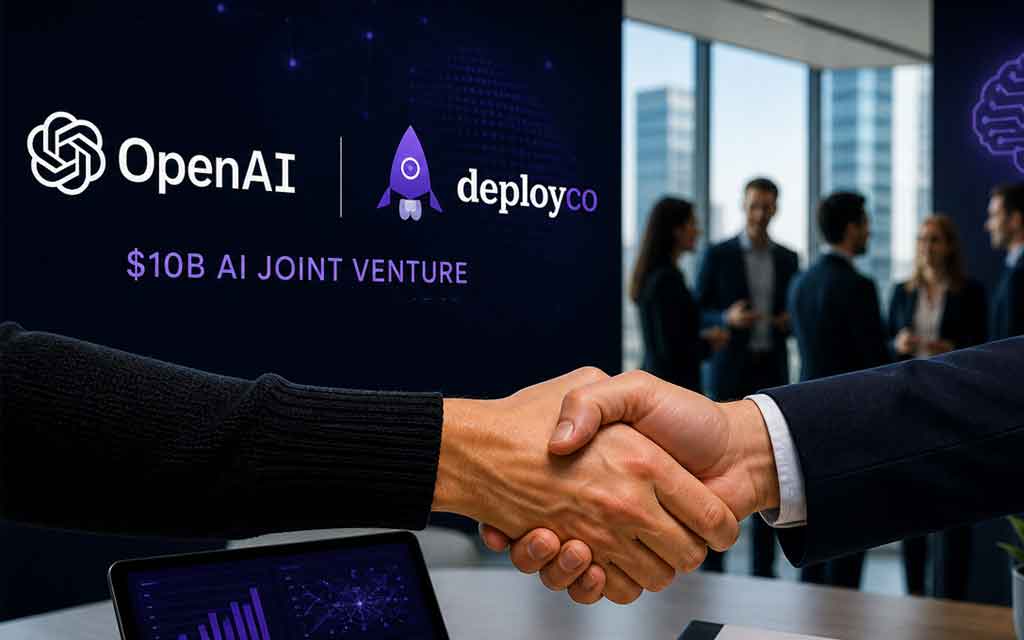
OpenAI just launched “The Deployment Company” (DeployCo), a $10 billion joint venture with private equity giants to fast-track AI adoption across thousands of US businesses. What this means for American companies in 2026 and beyond.
Introduction: OpenAI Doubles Down on Enterprise Deployment
In a major move announced in late April 2026, OpenAI formed a new joint venture internally known as “The Deployment Company” or DeployCo. This $10 billion entity, backed by OpenAI’s commitment of up to $1.5 billion, partners with leading private equity firms to rapidly deploy OpenAI’s AI tools across portfolio companies.
This isn’t just another partnership — it’s a strategic push to close the “AI deployment gap” and make advanced AI accessible to mainstream American businesses at scale. For US executives, SMBs, and enterprises struggling with integration challenges, DeployCo promises hands-on expertise, customized solutions, and faster ROI.
As Ethan Brooks at vFutureMedia, I’ve been covering OpenAI’s enterprise evolution closely. In this comprehensive 2000-word analysis, we’ll break down the JV details, its structure, impact on American companies, competitive implications versus Anthropic and others, real-world use cases, and what it signals for the future of business AI adoption in the United States.
What Is DeployCo? Key Details of the Joint Venture
DeployCo (a Delaware LLC) is designed specifically as a deployment accelerator for OpenAI’s workplace and enterprise AI tools.
Core Elements of the Deal:
- Valuation: Targeting ~$10 billion.
- OpenAI Commitment: Up to $1.5 billion in capital.
- Private Equity Partners: Includes heavyweights like TPG, Advent International, Bain Capital, and others managing hundreds of billions in assets and thousands of portfolio companies.
- Investor Returns: OpenAI offering guaranteed minimum returns around 17.5% to attract capital.
- Focus: Accelerating AI integration across PE-owned businesses — from manufacturing and healthcare to finance and retail.
The venture builds on OpenAI’s earlier moves, including “OpenAI Frontier” platform and partnerships with McKinsey, BCG, Accenture, and cloud providers like AWS and Databricks. It positions OpenAI as both a model builder and a full-service deployment company.
Internal Link: Interested in AI platforms? Read our OpenAI Frontier Platform Review 2026.
Why Now? OpenAI’s Enterprise Push in 2026
Enterprise revenue now makes up over 40% of OpenAI’s total and is projected to reach parity with consumer by end of 2026. However, many companies still face high integration costs, talent shortages, and change management hurdles.
DeployCo addresses this directly by:
- Providing dedicated “Forward Deployed Engineers” and consultants.
- Leveraging PE firms’ control over portfolio companies for rapid rollout.
- Sharing best practices learned from hundreds of large enterprise deployments.
- Reducing friction through pre-built integrations and agentic workflows.
This aggressive strategy helps OpenAI compete with Anthropic, which has historically shown stronger enterprise traction.
How DeployCo Will Help US Businesses Adopt AI
For American Companies, the Benefits Are Concrete:
- Fast-Track Deployment: Instead of months or years, AI agents can go live in weeks with expert support.
- Industry-Specific Solutions: Custom agents for supply chain optimization, customer service, financial forecasting, compliance, and more.
- Cost Efficiency: Shared infrastructure and proven playbooks lower upfront investment.
- Risk Mitigation: Built-in governance, security, and compliance frameworks aligned with US regulations (SOC 2, HIPAA, etc.).
- Scalability: Start with pilot projects in one department and expand across the entire organization.
Real-World Examples for US Markets:
- A Midwest manufacturing firm (via PE portfolio) uses AI agents for predictive maintenance, reducing downtime by 30–40%.
- A national retail chain automates personalized marketing and inventory management.
- Healthcare providers in California or New York deploy secure AI for administrative tasks and patient scheduling.
Small and mid-sized businesses gain indirect access as PE firms standardize tools across holdings.
Technical & Integration Capabilities
DeployCo leverages OpenAI’s latest models (GPT-5 series, o3 reasoning models) with:
- Advanced agentic capabilities for multi-step autonomous tasks.
- Deep integrations with Microsoft 365, Google Workspace, Salesforce, ServiceNow, and ERP systems.
- Secure, private deployments via Azure, AWS, or hybrid setups.
- Custom fine-tuning and domain-specific knowledge bases.
The “deployment-first” approach includes change management training, employee upskilling, and continuous optimization via over-the-air improvements.
Americas-Focused Impact: Jobs, Economy & Competition
US Economic Boost:
- Accelerates AI adoption across thousands of American companies, driving productivity gains estimated in the hundreds of billions.
- Creates high-paying jobs in AI consulting, implementation, data science, and prompt engineering.
- Strengthens US technological leadership against international competitors.
Vs. Rivals:
- Anthropic: Strong in safety-focused enterprise but less aggressive on deployment scale.
- Google Gemini / Microsoft Copilot: Deep ecosystem ties but sometimes slower customization.
- DeployCo Advantage: Combines frontier models with dedicated capital and PE distribution muscle.
This JV could help OpenAI capture significant market share in the rapidly growing enterprise AI sector.
Challenges and Considerations for Businesses
While promising, companies should consider:
- Data privacy and IP protection in shared deployment models.
- Integration costs and potential vendor lock-in.
- Need for internal AI governance policies.
- Measuring true ROI beyond hype.
OpenAI’s track record with safety and the new JV’s focus on responsible deployment help mitigate many risks.
Future Outlook: The Deployment Era of AI
DeployCo signals OpenAI’s shift from pure research to becoming a comprehensive AI deployment powerhouse. By late 2026 and into 2027–2028, expect:
- Broader availability beyond initial PE partners.
- More industry-specific vertical solutions.
- Deeper agentic AI that handles complex business processes end-to-end.
- Potential expansion into government and public sector deployments.
This positions OpenAI strongly in the race toward transformative business AI while delivering tangible value to American companies today.
Conclusion: A Turning Point for Enterprise AI Adoption
OpenAI’s launch of “The Deployment Company” (DeployCo) in 2026 is one of the most significant enterprise AI moves this year. By partnering with private equity and committing substantial capital, OpenAI is removing traditional barriers and helping businesses across America harness powerful AI faster than ever before.
For US leaders evaluating AI strategies, this development offers a clear pathway to competitive advantage. Whether you run a startup, mid-market firm, or large enterprise, the era of practical, scalable AI deployment has arrived.
What are your biggest AI adoption challenges? Would you consider DeployCo-style support for your organization? Share in the comments below and subscribe to vFutureMedia’s AI newsletter for ongoing insights, tool reviews, and enterprise case studies.
Ready for more? Check our Best Enterprise AI Platforms 2026 Guide or OpenAI vs Anthropic Enterprise Comparison.
Author Bio Ethan Brooks is a senior technology and AI writer at vFutureMedia.com with over 8 years covering artificial intelligence, enterprise software, and future tech. Based in the US, Ethan delivers practical, in-depth analysis to help American businesses and professionals navigate the AI revolution.


Leave a Comment