
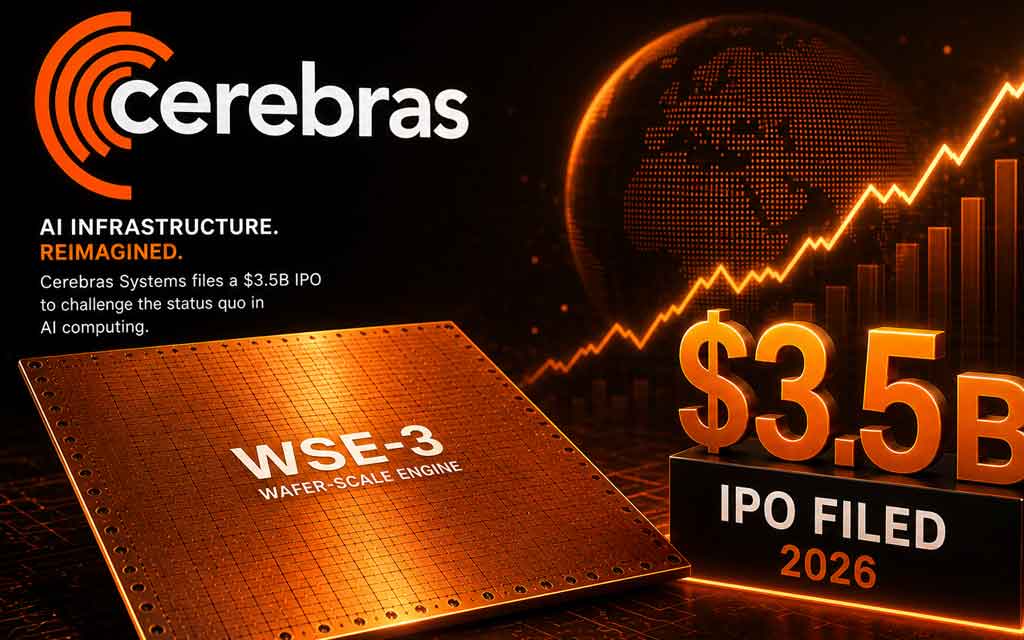
Cerebras Systems files $3.5B IPO on Nasdaq (ticker CBRS) at $115–$125/share, targeting ~$27B valuation. Discover the WSE-3 wafer-scale chip, $20B OpenAI deal, AWS integration, and how this Silicon Valley contender challenges Nvidia in 2026.
Introduction: A Bold Challenger Enters the Public Markets
On May 4, 2026, Cerebras Systems set the stage for one of the most anticipated tech IPOs of the year. The Sunnyvale, California-based AI chipmaker filed final terms for its initial public offering: 28 million shares priced between $115 and $125 each, aiming to raise up to $3.5 billion. At the high end, the company could command a fully diluted valuation of approximately $27 billion.
Trading is expected to begin on Nasdaq under the ticker CBRS around mid-May. This marks Cerebras’ second attempt at going public after withdrawing plans in 2025, now fueled by explosive revenue growth, massive enterprise deals, and its groundbreaking Wafer Scale Engine technology.
As Ethan Brooks at vFutureMedia, I’ve tracked the AI hardware race closely. In this 2000-word deep dive tailored for American investors, businesses, and tech enthusiasts, we’ll explore Cerebras’ revolutionary architecture, financial momentum, key partnerships, competitive positioning against Nvidia, risks, and what the IPO means for the future of AI infrastructure in the United States.
The Wafer-Scale Revolution: Meet the WSE-3
Cerebras’ secret weapon is the Wafer Scale Engine 3 (WSE-3) — the largest chip ever built.
WSE-3 Key Specifications:
- Size: 46,225 mm² — roughly the size of a dinner plate (57x larger than Nvidia’s flagship GPUs)
- Transistors: 4 trillion
- AI Cores: 900,000 specialized cores
- On-Chip Memory: 44 GB SRAM with 21 petabytes/second bandwidth
- Performance: Up to 125 petaFLOPS (FP16 sparse)
- Power: ~23 kW per CS-3 system
Unlike traditional GPU clusters that rely on thousands of smaller chips connected via slow interconnects, Cerebras puts an entire supercomputer’s worth of compute on a single wafer. This eliminates communication bottlenecks, delivering dramatically faster training and inference — especially for massive models.
The CS-3 supercomputer built around WSE-3 powers clusters up to 256 exaFLOPS when scaled.
Internal Link: Curious about AI hardware? Read our Nvidia Blackwell vs Alternatives 2026 Guide.
Financial Surge: From Losses to Profitability
Cerebras delivered impressive 2025 results in its S-1 filing:
- Revenue: $510 million (up 76% from $290 million in 2024)
- Net Income: $238 million GAAP profit (major swing from prior losses)
- Remaining Performance Obligations (RPO): $25+ billion
This growth stems from high-demand AI inference workloads and landmark contracts. The company has shifted successfully from pure R&D to commercial scale.
Game-Changing Deals: OpenAI, AWS, and Beyond
OpenAI Partnership: Cerebras signed a multi-year agreement worth over $20 billion (expanded from initial $10B reports) for 750 megawatts of compute capacity through 2028. OpenAI uses Cerebras systems for ultra-fast inference, achieving thousands of tokens per second on models like GPT-OSS variants.
AWS Integration: Collaboration brings Cerebras CS-3 systems into Amazon Bedrock, offering customers the fastest inference options alongside AWS Trainium.
Additional momentum comes from sovereign AI projects and enterprise deployments, though a significant portion of early revenue ties to clients in the UAE (e.g., G42 partnerships).
These deals validate Cerebras’ technology and provide massive backlog visibility heading into the IPO.
How Cerebras Challenges Nvidia’s Dominance
Nvidia controls ~80-90% of the AI accelerator market, but Cerebras offers a fundamentally different architecture:
Advantages of Cerebras Approach:
- Superior memory bandwidth for large language models
- Faster inference speeds with lower latency
- Simpler scaling (fewer chips = less complexity)
- Higher performance per watt in certain workloads
- Cloud-like consumption model via partnerships
Nvidia Strengths: Mature software ecosystem (CUDA), massive installed base, and full-stack dominance.
Cerebras targets customers frustrated with GPU cluster complexity and power demands. For hyperscalers and AI labs building the next generation of models, wafer-scale can mean weeks instead of months for training runs.
US Market Impact: Jobs, Innovation & National AI Leadership
As an American company, Cerebras’ success strengthens domestic AI hardware capabilities at a critical time. The IPO will fuel expansion of manufacturing partnerships (primarily with TSMC), R&D in Silicon Valley, and potential US-based production scaling.
Broader Implications for America:
- Creates high-skilled engineering and sales jobs
- Reduces reliance on single-vendor supply chains
- Supports US leadership in the global AI race against international competitors
- Attracts more capital into deep-tech hardware innovation
For US businesses adopting AI, greater competition means better options, faster innovation, and potentially lower long-term costs.
Risks and Challenges Ahead
Despite strong momentum, investors should note:
- Customer Concentration: Heavy reliance on a few large deals (OpenAI, UAE entities)
- Manufacturing: Dependence on TSMC and wafer-scale production complexities
- Competition: Nvidia’s ecosystem moat and new entrants like Groq, AMD, and custom chips from hyperscalers
- Valuation: $27B+ is premium pricing in a volatile market
- Path to Scale: Delivering on massive power commitments (hundreds of MW) requires significant infrastructure
Execution on these fronts will determine long-term success.
Future Outlook: Post-IPO Roadmap for 2026–2028
Proceeds from the IPO will likely fund next-generation WSE-4 development, expanded cloud offerings, and sales force growth. Analysts expect continued hyper-growth as inference demand explodes and more enterprises move beyond pilots.
By 2027–2028, Cerebras could capture a meaningful slice of the multi-hundred-billion-dollar AI accelerator market if it delivers on its performance promises.
Conclusion: A Historic Moment in AI Hardware
Cerebras’ $3.5 billion IPO represents more than a company going public — it’s a bet on alternative AI architectures in a Nvidia-dominated world. With revolutionary wafer-scale technology, blockbuster deals, and proven financial turnaround, CBRS could become a must-watch stock for anyone invested in the future of AI.
For American investors, this IPO offers direct exposure to cutting-edge US innovation. For businesses, it signals more choices in the AI infrastructure arms race.
Will you be watching the CBRS debut? Do you see wafer-scale as the future or a niche player? Share your thoughts in the comments and subscribe to vFutureMedia’s AI & Hardware newsletter for ongoing coverage, valuation updates, and investment insights.
Ready for more? Explore our Top AI Chip Stocks 2026 Ranking or Nvidia vs Emerging Challengers Deep Dive.
Author Bio Ethan Brooks is a senior technology and semiconductor writer at vFutureMedia.com with over 8 years covering AI hardware, chips, and emerging tech. Based in the US, Ethan delivers balanced, investor-focused analysis on the companies shaping America’s AI future.




Leave a Comment