Reranking Models Explained
Rerankers reorder search results by reading the query and each passage together. How cross-encoders, ColBERT and LLM rerankers work in RAG pipelines.
A reranking model (reranker) takes a short list of search results and reorders them by how well each one answers the query. Unlike the embedding models used for first-stage retrieval, which encode the query and documents separately, most rerankers are cross-encoders that read the query and a candidate passage together, so they can judge relevance more precisely. The cost is speed, so rerankers run only on the top few dozen or few hundred candidates in a two-stage "retrieve, then rerank" pipeline that is now standard in RAG systems.
Why first-stage retrieval needs a second opinion
Vector search is fast because it does most of its work ahead of time. Every document is turned into a vector once, and at query time the system only compares the query vector against stored vectors. That design has a built-in limitation: the document's vector was computed without ever seeing the question.
Elastic's documentation states the problem plainly for these bi-encoder models: "Documents and query embeddings are computed separately, so they aren't aware of each other" [9]. A passage about "Python memory leaks" and a question about "why my Python script slows down over time" may land near each other or not, depending on how the embedding model happened to compress each one.
Keyword search has its own blind spots, which is why many systems use hybrid search. But whatever produces the candidate list, the list is ordered by cheap signals. A reranker replaces those signals with a more expensive, more careful judgment on a much smaller set.
This matters for generation too. Research on long contexts found that LLMs use information best when it appears at the beginning or end of the input, with performance degrading for facts in the middle [12]. Putting the most relevant passages first, and dropping weak ones, gives the LLM a better chance of using the right evidence.
How a cross-encoder reranker works
Bi-encoder vs cross-encoder
The Sentence Transformers documentation gives the clearest contrast [1]:
- A bi-encoder turns each text into its own embedding; you compare embeddings with cosine similarity.
- A cross-encoder passes "both sentences simultaneously to the Transformer network" and outputs a relevance score. It "does not produce a sentence embedding" [1].
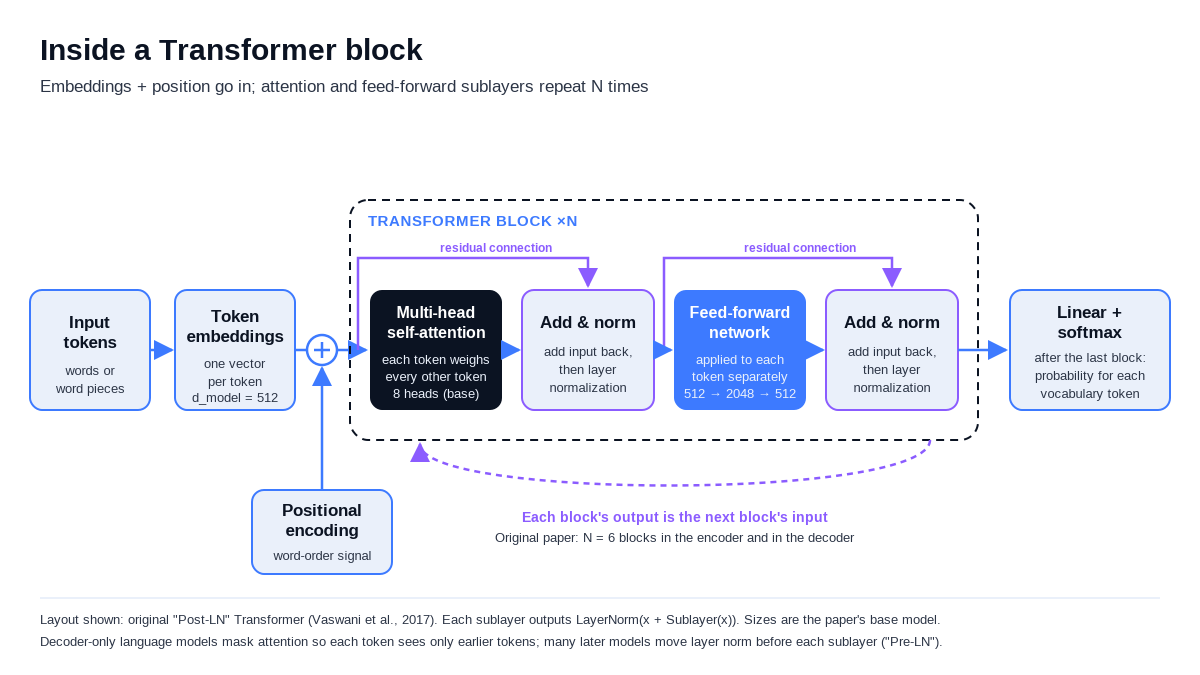
Because the model's attention layers see query words and passage words at the same time, a cross-encoder can notice that "slows down over time" relates to "memory leak," or that a passage mentions the right product but the wrong version.
Voyage AI describes its rerankers the same way: "cross-encoders that jointly process a pair of query and document, enabling more accurate relevancy prediction" [8].
Why you can't use a cross-encoder for everything
Accuracy comes at a steep price. A cross-encoder must run the full model once for every query-document pair, at query time, with nothing precomputed.
The Sentence-BERT authors quantified this for a related task: finding the most similar pair among 10,000 sentences with BERT as a cross-encoder takes about 50 million inference computations, roughly 65 hours, compared with about 5 seconds using separately computed sentence embeddings [11]. Sentence Transformers' docs summarize that cross-encoders "achieve better performances than Bi-Encoders" but "do not scale well for large datasets" [1].
The two-stage pattern
The standard solution combines both [1][9]:
- Retrieve. A fast method (vector, keyword or hybrid search) pulls the top N candidates from millions of documents.
- Rerank. A cross-encoder scores each of the N candidates against the query.
- Select. Keep the top k (often far fewer than N) for the LLM prompt.
The Sentence Transformers example retrieves 100 hits with a bi-encoder, then uses a cross-encoder "to re-rank these 100 hits by computing the score for every (query, hit) combination" [1]. Elastic describes reranking as a technique that "makes sense on a small top-k result set, as one of the final steps in a pipeline" [9].
A short history in three papers
monoBERT (2019). Rodrigo Nogueira and Kyunghyun Cho showed that a "simple re-implementation of BERT for query-based passage re-ranking" reached the top of the MS MARCO passage leaderboard at the time, improving MRR@10 by about 27% relative to the previous best [2]. That result established the cross-encoder reranker as a standard component.
ColBERT (2020). Omar Khattab and Matei Zaharia proposed a middle ground called late interaction. Query and document are encoded separately, but into one vector per token rather than one per text. At scoring time, each query token finds its most similar document token through a "MaxSim" operator, and those scores are summed [3]. Document representations can be precomputed. The authors reported running two orders of magnitude faster than comparable BERT-based models with competitive effectiveness [3].
BEIR (2021). This benchmark tested retrieval systems across 18 datasets without task-specific training. It found reranking and late-interaction models achieved the best zero-shot performance on average, but at high computational cost [4]. That is the trade-off in one sentence.
Types of rerankers
Type | How it scores | Strengths | Trade-offs |
|---|---|---|---|
Cross-encoder | Full model over query + passage pair | High accuracy; the default choice [1][9] | Cost grows with every candidate |
Late interaction (ColBERT-style) | Token-level MaxSim over precomputed vectors [3] | Faster than cross-encoders; can also retrieve | Large storage for token vectors |
LLM reranker | A general LLM is prompted to order passages [5] | Strong reasoning; flexible instructions | Typically the slowest and costliest option |
Hosted rerank API | Vendor-run cross-encoder (Cohere, Voyage, others) [6][8] | No model hosting; multilingual options | Data leaves your environment; per-call pricing |
LLMs as rerankers
Large language models can rerank directly. A 2023 EMNLP paper found that properly instructed ChatGPT and GPT-4 were competitive with, and sometimes better than, state-of-the-art supervised rerankers on popular benchmarks [5]. The authors also distilled that ability into a small model: a 440-million-parameter model outperformed a 3-billion-parameter supervised model on BEIR [5]. In practice, many teams use dedicated cross-encoders for routine reranking and reserve LLM reranking for cases where the extra cost is justified.
Commercial rerankers, as of November 2026
Cohere Rerank. The API takes a query and a list of documents and returns each document's index with a relevance_score [6]. Current models listed include rerank-v5.0-pro, rerank-v5.0-fast, the v4.0 pro and fast models, and rerank-v3.5, with Cohere saying its rerankers are trained for 100+ languages [6]. For v5.0 models, Cohere allows up to 10,000 documents per request and truncates each document to max_tokens_per_doc, which defaults to 4,096 tokens [7]. For structured records, Cohere recommends formatting fields as YAML strings [6].
Voyage AI rerankers. rerank-3 is the recommended model and rerank-3-lite is the faster, lower-cost option, both with a 32,000-token context [8]. A request can include up to 1,000 documents, and total tokens (query tokens times number of documents, plus all document tokens) cannot exceed 600,000 for these models [8]. Truncation is on by default [8].
Elastic. Elasticsearch's text_similarity_reranker retriever lets you add reranking inside a search request and combine it with RRF and other retrievers. Elastic lists its own Elastic Rerank model plus Jina AI, Cohere and Google Vertex AI endpoints, and states that it supports only cross-encoders for semantic reranking [9].
Model names and limits change frequently; confirm against the vendor's current docs.
Benefits
- Better precision at the top. Rerankers are built to get the first few results right, which is what a RAG prompt consumes.
- Fewer, better passages in the prompt. Reranking lets you retrieve broadly and pass narrowly.
- Measurable gains in practice. In Anthropic's Contextual Retrieval evaluation, adding a reranker on top of contextual embeddings and contextual BM25 raised the reduction in top-20 retrieval failures from 49% to 67% [10]. Anthropic reranked the top 150 chunks and kept 20 [10]. These are vendor-reported results on its chosen datasets.
- Drop-in. A reranker sits after any retriever, so you can add one without rebuilding your index.
Limitations and risks
- Latency and cost. Every candidate costs a model call. Anthropic notes that reranking "inevitably adds a small amount of latency," and that reranking more candidates trades extra latency and cost for better results [10]. How much depends on the model, hardware, candidate count and passage length; benchmark your own setup.
- It can't find what retrieval missed. A reranker only reorders the candidates it receives. If the right passage isn't in the top N, reranking can't help. Improve recall first.
- Long documents get truncated. Rerankers have input limits. Elastic warns that many cross-encoders handle long documents poorly [9]. Cohere truncates at
max_tokens_per_doc[7], and Voyage truncates by default [8]. Your chunk size should fit the reranker. - Score thresholds need care. Cohere says its relevance scores are normalized to between 0 and 1 but depend on the query, so they aren't directly comparable across queries. It suggests calibrating a cutoff using 30 to 50 representative queries paired with borderline-relevant documents [7].
- Data handling. Hosted rerank APIs send your query and passages to a third party. Check data retention terms for regulated content.
How to choose and tune a reranker
- Fix recall first. Measure whether the right passage appears in your top 50 to 150 candidates. If not, work on retrieval, embeddings or chunking before adding a reranker.
- Pick a candidate count (N). More candidates raise the chance the answer is included but cost more to rerank. Anthropic used 150 [10]; Sentence Transformers' example uses 100 [1]. Test a few values.
- Pick the output count (k). Anthropic found passing 20 chunks performed best among the 5, 10 and 20 it tested [10]. Your best k depends on your LLM's context budget.
- Match languages and domains. Check whether the model supports your languages; Cohere lists 100+ but notes that performance may vary across languages [6].
- Decide hosted vs self-hosted. Hosted APIs are fastest to adopt; open cross-encoders give you control over data and cost.
- Evaluate on your own queries with metrics that focus on the top of the list, such as MRR@10 or NDCG@10.
Outlook
The direction visible in vendor docs as of November 2026 is longer reranker context windows (Voyage's current models accept 32,000 tokens [8]) and support for semi-structured inputs like YAML [6]. Research has shown LLM ranking ability can be distilled into much smaller models [5], which suggests the gap between "accurate" and "affordable" rerankers may keep narrowing; that is an expectation, not a certainty.
Frequently asked questions
What is the difference between an embedding model and a reranker?
An embedding model converts each text into a vector independently, so documents can be indexed ahead of time and searched quickly. A reranker, usually a cross-encoder, reads the query and a document together and outputs a relevance score, which is more accurate but must be computed at query time for each pair [1].
Do I need a reranker for RAG?
Not always, but it's one of the most common upgrades. If your retriever finds the right passage but not in the top few positions, a reranker usually helps. If the right passage isn't retrieved at all, fix retrieval first.
How many documents should I rerank?
Enough to include the answer reliably, few enough to keep latency acceptable. Published examples use 100 [1] and 150 [10] candidates; test on your own data. Vendor limits apply: Voyage allows up to 1,000 documents per request [8] and Cohere's v5.0 models up to 10,000 [7].
Can an LLM be used as a reranker?
Yes. Research found instructed GPT-4 and ChatGPT were competitive with supervised rerankers on standard benchmarks [5]. LLM reranking is usually slower and more expensive than a dedicated cross-encoder.
Is ColBERT a reranker or a retriever?
It can be both. ColBERT precomputes token-level document vectors and scores with late interaction, so it can rerank candidates or, with a vector index, retrieve directly from a large collection [3].
Sources
- Sentence Transformers. "Cross-Encoders: Retrieve & Re-Rank and applications." https://sbert.net/examples/cross_encoder/applications/README.html
- Nogueira, R. and Cho, K. "Passage Re-ranking with BERT." arXiv:1901.04085. https://arxiv.org/abs/1901.04085
- Khattab, O. and Zaharia, M. "ColBERT: Efficient and Effective Passage Search via Contextualized Late Interaction over BERT." SIGIR 2020. https://arxiv.org/abs/2004.12832
- Thakur, N. et al. "BEIR: A Heterogenous Benchmark for Zero-shot Evaluation of Information Retrieval Models." NeurIPS 2021 Datasets and Benchmarks. https://arxiv.org/abs/2104.08663
- Sun, W. et al. "Is ChatGPT Good at Search? Investigating Large Language Models as Re-Ranking Agents." EMNLP 2023. https://arxiv.org/abs/2304.09542
- Cohere. "Rerank overview." https://docs.cohere.com/docs/rerank-overview
- Cohere. "Best practices for using Rerank." https://docs.cohere.com/docs/reranking-best-practices
- Voyage AI. "Rerankers." https://docs.voyageai.com/docs/reranker
- Elastic. "Semantic reranking." https://www.elastic.co/docs/solutions/search/ranking/semantic-reranking
- Anthropic. "Introducing Contextual Retrieval." September 2024. https://www.anthropic.com/news/contextual-retrieval
- Reimers, N. and Gurevych, I. "Sentence-BERT: Sentence Embeddings using Siamese BERT-Networks." EMNLP 2019. https://arxiv.org/abs/1908.10084
- Liu, N. F. et al. "Lost in the Middle: How Language Models Use Long Contexts." TACL. https://arxiv.org/abs/2307.03172