

Samsung’s AI Partnership Strategy: Deep Dive into NVIDIA Collaboration & Beyond
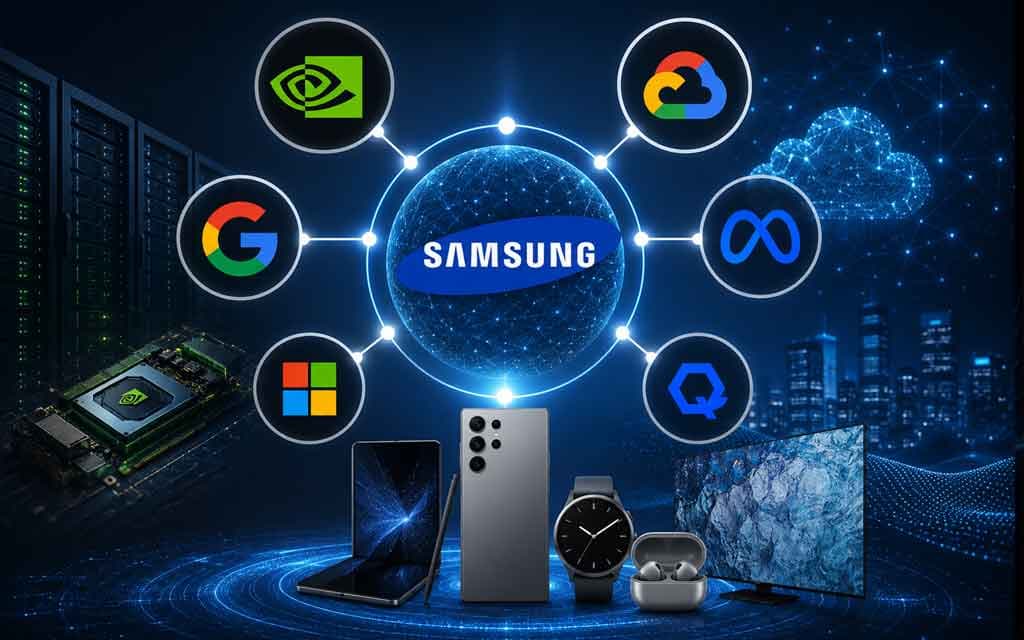
NEXT_PUBLIC_GOOGLE_ADSENSE_ID to enableSamsung Electronics has positioned itself as one of the most aggressive players in the AI hardware and ecosystem race. While the company has multiple AI-related collaborations, its partnership with NVIDIA stands out as the most strategic and far-reaching.
Here’s a detailed exploration of Samsung’s key AI partnerships as of June 2026.
1. Samsung + NVIDIA: The Core Strategic Alliance
Samsung and NVIDIA share a 25+ year relationship that has evolved from simple memory supply into a comprehensive AI infrastructure partnership.
Key Highlights of the Partnership:
- High Bandwidth Memory (HBM): Samsung is a major supplier of HBM3E and is ramping up HBM4 and HBM4E for NVIDIA’s next-generation AI platforms (including the Vera Rubin architecture).
- AI Factory Initiative: Samsung is building its own AI-powered semiconductor factories using NVIDIA’s accelerated computing platforms and Omniverse digital twin technology. This includes deploying over 50,000 NVIDIA GPUs for smart manufacturing, predictive maintenance, and digital twins.
- Foundry & Custom Solutions: Beyond memory, Samsung is expanding into foundry services and custom AI chip manufacturing in collaboration with NVIDIA.
- Public Recognition: At NVIDIA GTC 2026, Jensen Huang specifically highlighted Samsung’s role in supporting NVIDIA’s AI ecosystem, including manufacturing the Language Processing Unit (LPU) for Groq.
This partnership is no longer limited to component supply. It now spans R&D, design, manufacturing, and AI infrastructure.
2. Samsung’s Broader AI Partnership Ecosystem
While NVIDIA is the most critical partner, Samsung maintains several other important AI collaborations:
Samsung’s Key AI Partnerships Beyond NVIDIA
Google – On-Device AI (Galaxy AI)
Google’s Gemini models power many Galaxy AI features, helping Samsung strengthen its consumer AI leadership and deliver advanced AI experiences directly on Galaxy devices.
Cadence & Synopsys – Advanced Chip Design
Samsung collaborates with leading chip design software companies to accelerate the development of AI chips built on advanced 2nm and 3nm manufacturing processes.
AMD – AI Chip Supply & Memory Solutions
Multi-year agreements involving HBM and advanced memory technologies help Samsung expand its role in the AI hardware supply chain and diversify AI memory demand.
Qualcomm – Mobile & Edge AI
Samsung’s long-standing partnership with Qualcomm supports AI-powered Snapdragon platforms, strengthening the mobile and edge AI ecosystem.
Keysight – AI-RAN (Radio Access Network)
Samsung works with Keysight and NVIDIA on AI-driven network validation for 5G and future 6G infrastructure, supporting the next generation of intelligent telecom networks.
These partnerships highlight Samsung’s strategy of building a comprehensive AI ecosystem spanning consumer devices, semiconductor manufacturing, memory solutions, mobile platforms, and telecommunications infrastructure.
3. Galaxy AI: Samsung’s Consumer AI Push
Samsung is aggressively expanding Galaxy AI across its device ecosystem:
- In early 2026, Samsung announced plans to double the number of AI-powered mobile devices to 800 million units by the end of the year.
- Galaxy AI features are primarily powered by Google’s Gemini models, combined with Samsung’s own on-device processing capabilities.
- The company aims to integrate AI “organically” into all products, functions, and services in 2026.
This strategy focuses on making AI accessible on everyday devices (smartphones, tablets, laptops, TVs, and home appliances) rather than just cloud-based solutions.
4. Samsung’s AI Manufacturing Ambition
One of the most interesting aspects of Samsung’s AI strategy is its focus on AI for manufacturing:
- Samsung is building what it calls an “AI Factory” — a highly automated semiconductor production system powered by NVIDIA technology.
- The goal is to use AI and digital twins to improve yield, reduce costs, and accelerate production of advanced chips (including those for AI).
- This creates a powerful feedback loop: Samsung uses NVIDIA tech to make better chips, which then power more AI systems.
5. Strategic Implications
For Samsung:
- Reduces dependence on any single partner (though NVIDIA remains dominant).
- Positions Samsung as both a supplier and customer in the AI value chain.
- Strengthens its foundry business against TSMC.
For NVIDIA:
- Secures a critical high-volume HBM supplier.
- Gains a partner with massive manufacturing scale for AI infrastructure projects.
- Expands influence into semiconductor manufacturing through Samsung’s AI Factory initiative.
For the Industry:
- Highlights the growing convergence between memory makers, chip designers, and AI platform companies.
- Shows that future AI leadership will depend on vertical integration across hardware, software, and manufacturing.
Summary: Samsung’s AI Partnership Strategy
Samsung’s AI Partnership Ecosystem Overview
AI Infrastructure — NVIDIA
Samsung is strengthening its AI infrastructure business through collaboration with NVIDIA, focusing on HBM memory, AI factories, and custom AI chip opportunities. This remains one of Samsung’s strongest and most strategic AI relationships.
On-Device AI — Google (Gemini)
Google’s Gemini models play a major role in powering Galaxy AI features, helping Samsung expand AI capabilities across smartphones, tablets, and other consumer devices.
Chip Design — Cadence & Synopsys
Samsung works closely with Cadence and Synopsys to develop next-generation AI semiconductors using advanced 2nm and 3nm manufacturing technologies.
Manufacturing — NVIDIA Omniverse
Through NVIDIA Omniverse technologies, Samsung is advancing smart manufacturing initiatives, including AI-powered factory automation, simulation, and digital twin capabilities.
AI Ecosystem Expansion — Multiple Partners
Beyond individual collaborations, Samsung continues to expand its AI ecosystem through partnerships across hardware, software, cloud services, telecommunications, and consumer electronics, accelerating AI adoption throughout its product portfolio.
Final Takeaway
Samsung is not just participating in the AI race — it is trying to own multiple layers of it: memory, foundry, device integration, and even AI-driven manufacturing.
Its deepening partnership with NVIDIA remains the cornerstone of this strategy, but Samsung is also building parallel relationships to maintain flexibility and capture value across the entire AI stack.
NEXT_PUBLIC_GOOGLE_ADSENSE_ID to enable

