
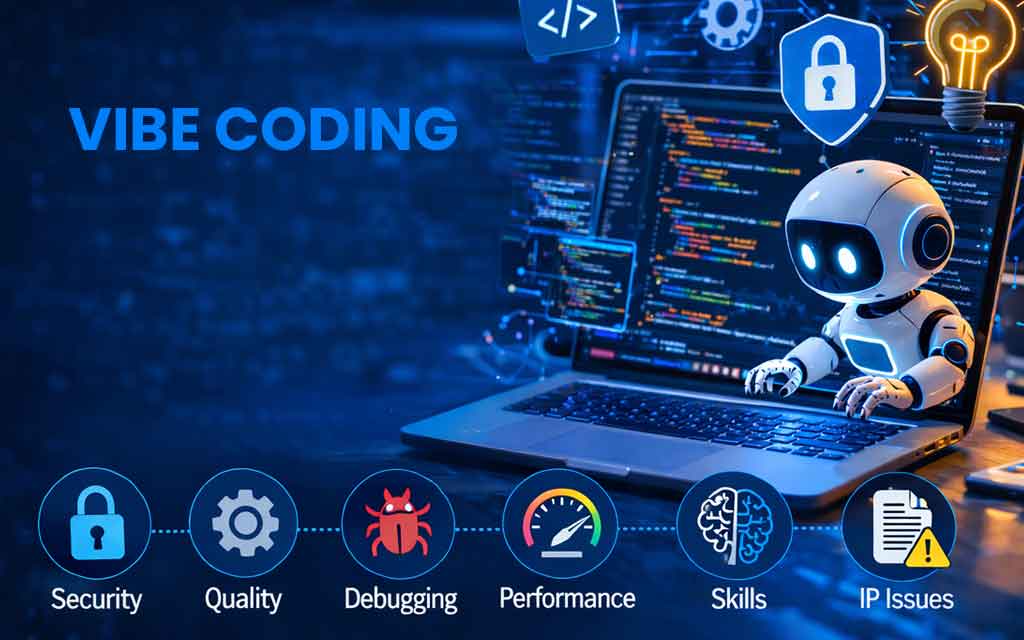
“Vibe coding isn’t just a trend — it’s a fundamental shift in how software gets built. But like every paradigm shift, it introduces new risks that the community is only beginning to reckon with.”
What Is Vibe Coding?
The term vibe coding was coined by OpenAI co-founder Andrej Karpathy in early 2025 to describe a new style of AI-assisted software development. Rather than writing code line-by-line, vibe coders describe their intent in natural language — typically through tools like GitHub Copilot, Cursor, Claude, or ChatGPT — and let the AI generate, revise, and debug code on their behalf.
The appeal is undeniable: faster prototyping, reduced friction for non-developers, and dramatically compressed development cycles. Startups are shipping MVPs in days instead of months. Solo founders are building SaaS tools without traditional engineering teams.
But adoption has outpaced understanding. As vibe coding moves from experimentation into production environments, a growing body of developer experience reveals a pattern of recurring, serious challenges — many of which aren’t obvious until they’ve already caused damage.
Key Industry Statistics
| Metric | Data |
|---|---|
| Developers reporting AI-generated code introducing production bugs | ~40% |
| Increase in debugging time vs. manually written code (some projects) | 3× longer |
| Developers who admit not fully understanding the AI code they ship | 68% |
| Estimated global cost of poor software quality annually (CISQ 2023) | $2.4 trillion |
Challenge 1: Code Quality & Technical Debt
One of the most persistent challenges of vibe coding is the quality of AI-generated output. While modern large language models can produce syntactically correct code, they frequently generate code that is redundant, inconsistent, or architecturally unsound.
Architecture Drift
When prompts are issued iteratively without a holistic design plan, the AI assembles code that works in isolation but lacks coherent architecture. Functions duplicate logic. Naming conventions vary across files. Data flows become tangled and difficult to trace.
The Hidden Cost of “It Works”
In vibe coding, the success metric shifts toward “it runs” rather than “it’s maintainable.” This creates a compounding technical debt problem. Each accepted AI suggestion that shortcuts best practices is another layer of future refactoring cost.
Engineers from traditional backgrounds find themselves inheriting vibe-coded codebases that are nearly impossible to extend cleanly — not because the individual functions are broken, but because the codebase has no coherent design philosophy.
“The AI gave me working code every single time. It was only when I needed to add a new feature six weeks later that I realized no one — including me — could understand what the original code was actually doing.” — Senior Developer, SaaS Startup (2024)
Developer Warning: AI models optimize for immediate correctness, not long-term code health. Always enforce code review standards and architectural guidelines before merging AI-generated code.
Challenge 2: Security Vulnerabilities
Security is arguably the most alarming challenge of vibe coding. Research from Stanford, GitClear, and independent security firms consistently finds that AI code generation tools produce code with measurably higher rates of security vulnerabilities than experienced human developers.
Common AI-Generated Security Flaws
SQL injection vulnerabilities, hardcoded credentials, insufficient input validation, insecure direct object references (IDOR), and broken authentication flows are among the most frequently reported issues in AI-generated code.
Why AI Models Miss Security Context
AI models are trained on vast code repositories, including codebases that contain known vulnerabilities. Without explicit security-focused prompting, models default to patterns that “work” without considering threat models or attack surfaces.
More dangerously, a vibe coder who doesn’t understand the underlying code is unlikely to recognize a security flaw even if they review the output. The combination of AI-generated code and under-informed review creates a perfect storm for breaches.
Security Insight: A 2023 study found that developers using AI code assistants were significantly more likely to introduce security vulnerabilities than those coding manually — and were less aware of the vulnerabilities present in their own code.
Challenge 3: Debugging & Maintainability
Debugging vibe-coded applications presents a unique and frustrating challenge: the person debugging is often working with code they didn’t write and don’t fully understand — and neither does the AI that generated it, in any persistent sense.
The Context Collapse Problem
Each conversation with an AI tool starts fresh. The model doesn’t remember why it made a particular architectural decision three days ago. Asking it to debug its own code often produces new code that conflicts with existing logic rather than fixing the root cause.
Cascading Error Loops
A particularly insidious pattern emerges when developers ask AI to fix bugs in AI-generated code. The model may “fix” the symptom while introducing a new bug elsewhere, leading to what engineers call a cascading error loop — a cycle of AI fixes creating new problems that require new AI fixes.
Without a developer who understands the full system, these loops can persist for days, eroding confidence and dramatically increasing delivery timelines.
Challenge 4: Skill Erosion & Over-Reliance
For junior developers especially, vibe coding raises a critical long-term concern: the erosion of foundational programming skills. When the AI handles the “hard parts,” developers lose opportunities to develop the deep mental models that make great engineers.
The Competency Gap
Developers who rely heavily on vibe coding from early in their careers may struggle with system design, algorithmic thinking, and performance optimization — skills that require deliberate practice and deep engagement with code.
“There is a real danger that we produce a generation of ‘prompt engineers’ who can describe software but cannot reason about it — and that gap becomes catastrophic when the AI gets it wrong.” — Engineering Education Researcher
Organizational Dependency Risk
At the organizational level, over-reliance on AI coding tools creates a dangerous single point of failure. If a tool’s API pricing changes, the service is disrupted, or the model is deprecated, teams that have built workflows entirely around it can find themselves unable to maintain their own codebase.
Challenge 5: Intellectual Property & Licensing
The legal landscape around AI-generated code remains deeply unsettled. When an AI model trained on open-source repositories produces code that closely resembles its training data, questions of copyright, licensing compliance, and IP ownership become genuinely complex.
License Contamination
AI tools may generate code derived from GPL, LGPL, or other copyleft-licensed source code. If this code ends up in a commercial product without attribution or compliance, companies face potential legal exposure — with no easy way to trace the origin of a generated snippet.
Legal Note: Neither AI providers nor the developers using their tools have definitive answers on AI code copyright at this time. Organizations with significant legal exposure should consult IP counsel before deploying vibe-coded applications commercially.
Challenge 6: Context Limitations & AI Hallucinations
AI language models have a finite context window — they can only “see” a limited amount of code at once. For large codebases, this creates a fundamental comprehension gap: the AI generates code without full awareness of the broader system.
Hallucinated APIs & Libraries
AI models sometimes generate code that references APIs, functions, or libraries that don’t exist, or that existed in old versions no longer in use. These hallucinations can be subtle — the code looks plausible until runtime, wasting significant developer time.
Confident but Wrong
A key challenge with AI hallucinations is that the model presents incorrect information with the same tone of confidence as correct information. For vibe coders without deep expertise, there’s no reliable signal to distinguish trustworthy output from fabrication — making verification a constant and often overlooked necessity.
Challenge 7: Performance & Scalability Gaps
AI-generated code frequently prioritizes correctness over efficiency. For prototypes and low-traffic applications, this is acceptable. But as systems scale, performance bottlenecks baked into the original AI-generated code become increasingly costly to resolve.
Inefficient Patterns at Scale
Common AI performance antipatterns include N+1 database queries, unbounded loops, redundant API calls, in-memory operations that should use caching, and over-fetching data. These patterns work fine at small scale but become critical bottlenecks under production load.
Challenge 8: Collaboration & Team Dynamics
Vibe coding introduces friction in collaborative engineering environments. Code that was “vibed into existence” by one developer can be opaque and frustrating for teammates. This creates knowledge silos, review bottlenecks, and onboarding challenges.
The Code Review Problem
Effective code review requires reviewers who can reason about the code. When the original author doesn’t fully understand the AI-generated code, and reviewers don’t either, the safety net of peer review effectively disappears.
How to Overcome These Challenges
Recognizing the challenges of vibe coding is the first step. Here are evidence-backed strategies for using AI-assisted development responsibly and effectively:
- Establish code review gates — require human review of all AI-generated code before merging, with explicit focus on security, architecture, and logic correctness.
- Use AI as a collaborator, not a replacement — treat AI suggestions as a starting point, not a final product. Understand what the code does before accepting it.
- Prompt for security explicitly — include security requirements in every prompt. Ask AI to identify potential vulnerabilities in the code it generates.
- Maintain architecture documentation — document design decisions made during AI-assisted development to preserve institutional knowledge.
- Invest in foundational skills — ensure developers maintain deep coding skills alongside AI tool proficiency. Rotate team members through manual coding exercises.
- Scan AI code with static analysis tools — run automated security and quality checks on all AI-generated code as part of your CI/CD pipeline.
- License audit workflows — implement tooling (e.g., FOSSA, Black Duck) to detect potential license issues in AI-generated code before deployment.
- Create shared prompting standards — develop team-level prompt libraries and conventions to ensure consistent, high-quality AI output across the codebase.
Expert Perspective: The most successful vibe coding practitioners treat AI tools as a powerful junior developer: fast and broadly capable, but requiring supervision, clear direction, and quality review before their work ships to production.
Frequently Asked Questions
What is vibe coding?
Vibe coding is an AI-assisted development approach where developers describe what they want in natural language and let AI tools generate the code. Popularized by Andrej Karpathy in 2025, it focuses on intent and outcomes rather than writing every line manually.
What are the biggest challenges of vibe coding?
The most critical challenges include poor code quality and technical debt, security vulnerabilities, debugging difficulties, skill erosion through over-reliance, intellectual property concerns, AI hallucinations, and performance gaps at scale.
Is vibe coding safe for production applications?
Vibe coding can be used in production environments, but requires rigorous code review, security auditing, and testing pipelines. AI-generated code can introduce subtle vulnerabilities and logic errors that are difficult to catch without expert human oversight.
Can beginners use vibe coding effectively?
Beginners can use vibe coding to explore concepts and build prototypes, but without foundational programming knowledge, they may struggle to identify errors, security issues, and inefficiencies in AI-generated code. Building core skills alongside AI tool use is strongly recommended.
Will vibe coding replace traditional software development?
Vibe coding augments rather than replaces traditional development. Complex systems still require architectural thinking, performance optimization, and security expertise that current AI tools cannot reliably provide without experienced human guidance.
I’m Ethan, and I write about the tech that’s actually going to change how we live — not the stuff that just sounds impressive in a press release. I cover AI, EVs, robotics, and future tech for VFuture Media. I was on the ground at CES 2026 in Las Vegas, walking the show floor so I could give you a real read on what matters and what’s just noise. Follow me on X for daily takes.
The future doesn’t wait — and neither should your feed. If this got you thinking, there’s plenty more where that came from. Browse our latest at VFutureMedia and stick around.




Leave a Comment