
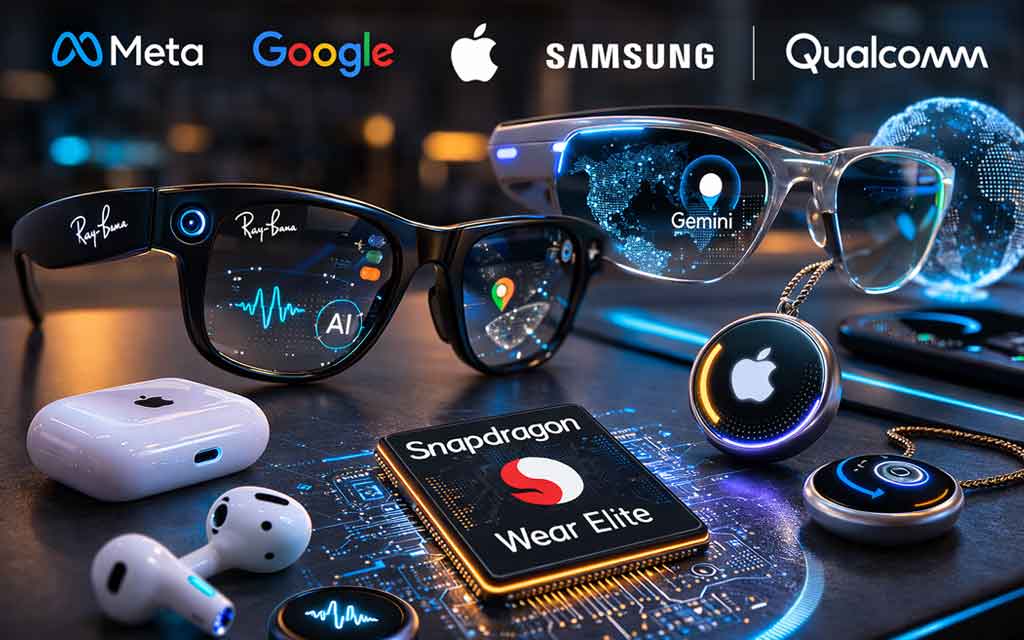
The rise of AI smart glasses and pendants in 2026 marks a pivotal shift in wearable tech, potentially positioning these devices as the “next big gadget after smartphones.” As AI becomes more integrated into daily life, major players like Meta, Google, Apple, Samsung, and Qualcomm are betting heavily on “invisible” or unobtrusive computing—devices that blend seamlessly into everyday wear, offering always-on assistance without pulling out a phone. This trend emphasizes multimodal AI (vision, voice, context awareness) in lightweight form factors, moving beyond screens to proactive, personalized experiences.
Qualcomm’s Snapdragon Wear Elite: Powering the “Invisible” AI Wearables Wave
Qualcomm unveiled the Snapdragon Wear Elite platform at MWC 2026, a 3nm chipset designed for personal AI at the edge. It features the industry’s first dedicated NPU in a wearable platform, supporting up to 2 billion-parameter models on-device for faster, more private processing (up to 12 TOPS AI performance). This enables always-on intelligence across diverse form factors like smartwatches, pins, pendants, headphones, and glasses—ideal for camera-equipped, low-power devices that act as proactive companions.
Qualcomm positions this as a bet on AI redefining the user interface for day-to-day tasks, with expanded connectivity (including satellite) and dramatic performance gains (5x single-core CPU, 7x GPU). Partners like Samsung, Google, and Motorola plan to use it in upcoming wearables, accelerating the shift to “invisible” tech where AI lives ambiently on your body rather than in your pocket.
Meta’s Push: Leading with Ray-Ban Meta and Beyond
Meta has dominated the early AI glasses market with Ray-Ban Meta models, which saw tripled sales in 2025 thanks to their stylish design and AI features like live vision analysis, real-time assistance, and multimodal interactions. Updates in 2026 (e.g., firmware v22) added enhanced live AI, conversation focus, and integrations like Garmin overlays.
Meta continues pushing boundaries with display-equipped versions (e.g., Ray-Ban Display models) and neural controls, though international rollouts faced delays due to high U.S. demand. Meta’s ecosystem leads in consumer adoption, proving that fashionable, camera-enabled glasses can succeed as everyday AI companions.
Google and Samsung: Android XR Ecosystem Challenge
Google plans its first AI-powered glasses in 2026, including audio-only models with Gemini AI for voice interaction and versions with in-lens displays for navigation, translations, and contextual info. Collaborations with partners like Warby Parker and Gentle Monster aim for stylish, everyday wear.
Samsung, partnering with Google (Android XR OS) and Qualcomm, confirmed its AI smart glasses for 2026—featuring an eye-level camera, smartphone connectivity for processing, and Gemini integration for environmental understanding, object recognition, and more. These won’t include a built-in display initially, focusing on lightweight, all-day wear similar to Meta’s Ray-Bans but with Samsung’s AI ecosystem. This positions Android XR as a strong rival to Meta’s dominance.
Apple’s Pendant and Glasses Rumors: Entering the Fray
Apple is accelerating work on AI wearables as part of its broader AI push. Rumors point to smart glasses targeted for late 2026 (or 2027), rivaling Meta’s Ray-Bans with upscale features and deeper integration with upgraded Siri.
More intriguingly, Apple is developing an AI pendant (or pin)—an AirTag-sized device with cameras and microphones that clips to clothing or hangs as a necklace. It serves as an “eyes and ears” accessory for the iPhone, relying on the phone for heavy processing rather than standalone operation (unlike the failed Humane AI Pin). This could launch as early as 2026-2027, emphasizing privacy-focused, ecosystem-tied AI. Apple is also exploring camera-equipped AirPods.
The Bigger Shift: Toward “Invisible” Tech
2026 represents explosive growth for AI wearables, with smart glasses sales projected to surge from ~6 million units in 2025 to 20 million, and market value jumping to $5.6 billion. The focus is on “invisible” tech—subtle, always-on devices that provide contextual AI without screens dominating your view. Challenges remain (battery life, privacy, true AR delays to 2027), but Qualcomm’s chips, Meta’s market lead, Google’s ecosystem, Samsung’s entry, and Apple’s potential make this the year the category matures.
Is this the next big gadget after smartphones? Early signs say yes—hands-free, proactive AI could redefine how we interact with technology. Stay tuned as prototypes turn into reality throughout 2026.
I’m Ethan, and I write about the tech that’s actually going to change how we live — not the stuff that just sounds impressive in a press release. I cover AI, EVs, robotics, and future tech for VFuture Media. I was on the ground at CES 2026 in Las Vegas, walking the show floor so I could give you a real read on what matters and what’s just noise. Follow me on X for daily takes.
The future doesn’t wait — and neither should your feed. If this got you thinking, there’s plenty more where that came from. Browse our latest at VFutureMedia and stick around.


Leave a Comment