
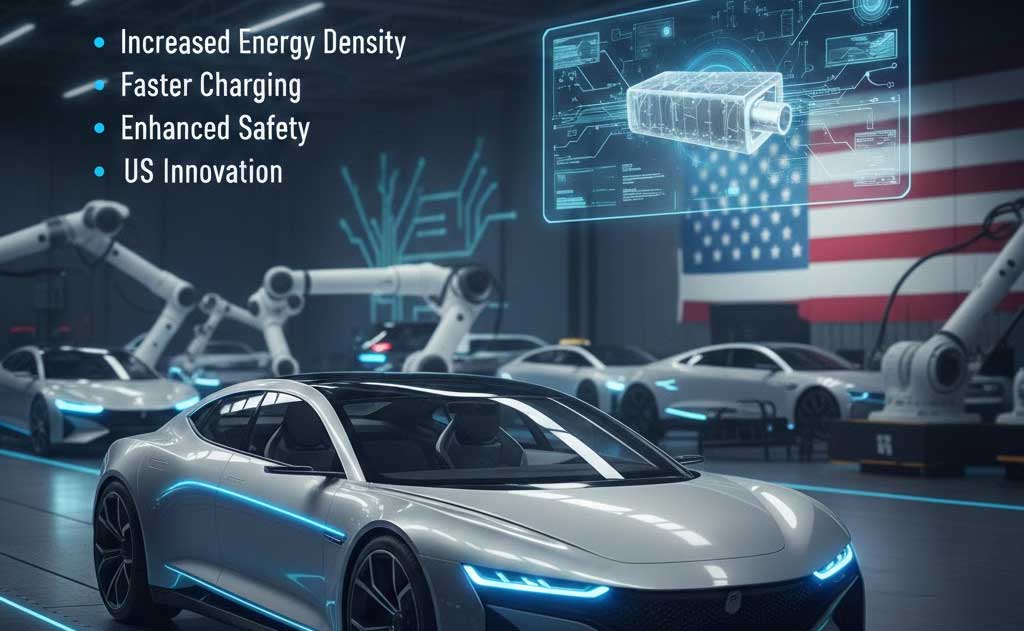
As electric vehicles (EVs) continue to dominate discussions in the automotive industry, one technology stands out as the potential game-changer for the future of mobility: solid-state batteries. These next-generation power sources promise to address many of the limitations of current lithium-ion batteries, including range anxiety, long charging times, and safety concerns. But the big question on everyone’s mind in 2026 is: Are US automakers finally positioned to capitalize on this breakthrough?
For years, solid-state batteries have been hailed as the “holy grail” of EV technology. With higher energy density, faster charging, improved safety, and longer lifespans, they could accelerate mainstream EV adoption across the United States. While Asian giants like Toyota and Chinese manufacturers have led much of the hype, US-based companies and startups—such as QuantumScape, Solid Power, and Factorial Energy—are making significant strides. Partnerships with major players like Ford, BMW (though European, with US ties), Stellantis, and others signal that American innovation is catching up.
In this in-depth article, we’ll explore the current state of solid-state battery technology, its advantages over traditional lithium-ion batteries, key developments in 2025-2026, the role of US automakers, timelines for adoption, challenges ahead, and what this means for the future of EVs in the USA.
What Are Solid-State Batteries?
Traditional lithium-ion batteries use a liquid electrolyte to facilitate ion movement between the anode and cathode. Solid-state batteries replace this liquid with a solid electrolyte—often ceramic, sulfide-based, or polymer materials. This fundamental shift eliminates flammable liquids, enabling safer, more efficient energy storage.
The technology isn’t entirely new; research dates back decades. However, recent breakthroughs in materials science, manufacturing, and scaling have brought it closer to reality. In 2026, we’re seeing pilot productions, real-world testing, and announcements of commercial timelines.
Advantages of Solid-State Batteries Over Lithium-Ion
Solid-state batteries offer compelling benefits that could transform EVs:
- Higher Energy Density — Solid-state designs can achieve 300-500+ Wh/kg (and up to 800+ Wh/L volumetrically in some prototypes), compared to 200-300 Wh/kg for current lithium-ion batteries. This translates to longer ranges—potentially 500-800+ miles per charge—without increasing battery size or weight.
- Faster Charging — Many prototypes support ultra-fast charging, with 10-18 minute times for 80% capacity (e.g., Factorial’s cells charge 15-90% in 18 minutes). This addresses one of the biggest barriers to EV ownership in the US.
- Enhanced Safety — No flammable liquid electrolyte means reduced risk of thermal runaway and fires. Solid-state batteries tolerate higher temperatures and are more stable.
- Longer Lifespan — Improved cycle life (often 1,000+ cycles with minimal degradation) and better performance in extreme conditions.
- Compact Design — Smaller, lighter packs free up space for more passenger room or additional features.
Despite these advantages, solid-state batteries face hurdles like higher production costs ($400-800/kWh vs. ~$115/kWh for lithium-ion in recent years) and manufacturing complexities.
Key Players and Breakthroughs in 2025-2026
The solid-state landscape has accelerated dramatically. While Toyota remains a leader with plans for mass production in 2027-2028, US-focused efforts are gaining momentum.
- QuantumScape (California-based): Backed by Volkswagen’s PowerCo, QuantumScape achieved key milestones in 2025, including equipment installation for higher-volume QSE-5 cell production and demonstrations in vehicles (e.g., Ducati motorcycles). Field testing began in 2026, with energy densities around 844 Wh/L. Commercial scaling targets the late 2020s.
- Solid Power (Colorado): Partners with BMW, Ford, and Samsung SDI. They’ve delivered prototypes and formed alliances for sulfide-based cells compatible with existing manufacturing. BMW tested i7 sedans with Solid Power tech.
- Factorial Energy (Massachusetts): Collaborations with Mercedes-Benz, Stellantis, and POSCO Future M. In 2025-2026, they validated 77Ah cells with 375 Wh/kg density and fast charging. Real-world tests (e.g., Mercedes EQS achieving 749 miles) and demo fleets are planned for 2026. Factorial’s quasi-solid-state approach bridges to full solid-state.
Other US efforts include government funding via the DOE’s Battery500 program and startups pushing pilot lines.
Globally, Mercedes-Benz integrated solid-state in prototypes, and niche applications (e.g., Verge Motorcycles with Donut Lab) show early commercialization in 2026.
US Automakers’ Readiness and Timelines
US automakers are not leading the charge like Toyota but are strategically positioned through partnerships.
- Ford: Invested in Solid Power alongside BMW. Prototypes delivered, with integration into future EVs possible by late 2020s/early 2030s. Ford views solid-state as post-2030 for mass adoption, focusing on incremental lithium-ion improvements meantime.
- General Motors (GM): Involved in solid-state via partnerships (e.g., with Solid Power indirectly through ecosystem). GM’s Ultium platform is adaptable, but no aggressive public timeline—likely late 2020s trials.
- Stellantis (US operations via Chrysler, Jeep, etc.): One of the most proactive. Partnered with Factorial for Charger Daytona demo fleets in 2026. Stellantis aims for early US availability, potentially making it among the first to offer solid-state in American-market vehicles by end-of-decade.
- Tesla: Quiet on solid-state. Focused on 4680 cells and dry-electrode tech. Speculation exists about internal work, but no confirmed adoption timeline—possibly a wildcard for later integration.
The US solid-state market is projected to grow from ~$396 million in 2026 to over $5 billion by 2034 (CAGR ~38%), driven by EV demand, federal incentives, and localized manufacturing to reduce Asia dependence.
Challenges include scaling production, cost reduction, and supply chain issues. Many experts predict limited production by 2027-2028, with mass adoption post-2030.
Challenges and Roadblocks
Despite progress, hurdles remain:
- Manufacturing Scalability — Solid electrolytes are tricky to produce at volume without defects.
- Cost — Initial high prices limit to premium or niche vehicles.
- Material Stability — Issues like dendrite formation in lithium-metal anodes.
- Infrastructure — EVs need ultra-fast chargers for full potential.
Yet, 2025-2026 saw accelerations: pilot lines, partnerships, and real-world tests signal momentum.
The Future: What This Means for US EVs
If US automakers leverage partnerships effectively, solid-state batteries could supercharge EV growth in America. Longer ranges and faster charging align with US driving habits (long distances, road trips). Combined with IRA incentives and domestic production, this could boost competitiveness against imports.
By the early 2030s, expect solid-state in premium models (e.g., electric trucks, SUVs), then mainstream. This breakthrough could make EVs truly dominant, reducing emissions and oil dependence.
In 2026, US automakers aren’t “finally” there yet—but they’re closer than ever. With QuantumScape, Factorial, and Solid Power advancing rapidly, and partnerships with Ford, Stellantis, and others, the breakthrough feels imminent. Watch this space: the solid-state era may redefine American automotive innovation.
For more on future mobility trends, visit vfuturemedia. Stay tuned for updates on EV battery tech and sustainable transport.
I’m Ethan, and I write about the tech that’s actually going to change how we live — not the stuff that just sounds impressive in a press release. I cover AI, EVs, robotics, and future tech for VFuture Media. I was on the ground at CES 2026 in Las Vegas, walking the show floor so I could give you a real read on what matters and what’s just noise. Follow me on X for daily takes.

Leave a Comment