
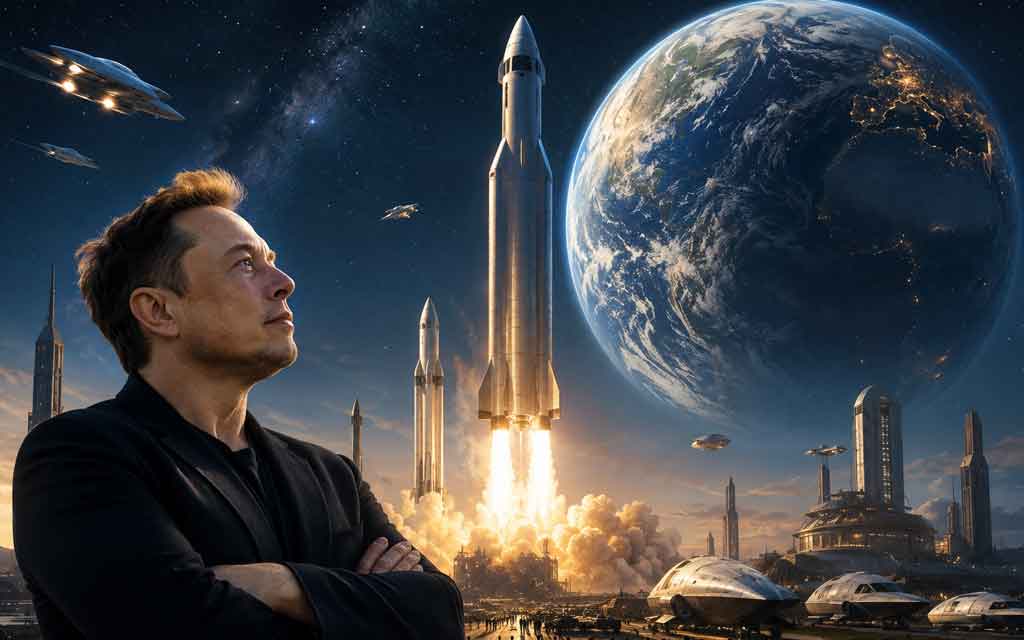
Elon Musk has made yet another bold prediction about the future value of SpaceX, claiming that if the company achieves its long-term objectives, it could eventually be worth more than the entire planet Earth.
The statement, made during a recent discussion about SpaceX’s ambitious roadmap, underscores Musk’s vision of building a multi-planetary civilization and the enormous economic potential he sees in space exploration and settlement.
What Musk Actually Said
In his characteristic style, Musk suggested that a successful SpaceX — one that establishes sustainable cities on Mars and enables large-scale space industrialization — would create so much value that its market capitalization could surpass the total economic value of Earth.
While clearly hyperbolic, the comment reflects Musk’s belief that humanity’s expansion into space represents one of the largest wealth-creation opportunities in history.
Why SpaceX Could Be So Valuable
Musk’s vision for SpaceX goes far beyond launching satellites and astronauts. The company’s long-term goals include:
- Starship Development — Creating a fully reusable spacecraft capable of carrying hundreds of people and massive cargo
- Mars Colonization — Establishing a self-sustaining city on Mars
- Lunar Base — Building a permanent presence on the Moon as a stepping stone
- Space Infrastructure — Satellite internet (Starlink), orbital refueling, and interplanetary transport
- Space Economy — Enabling asteroid mining, space manufacturing, and solar power satellites
If even a fraction of this vision becomes reality, the economic implications would be staggering. A thriving multi-planetary economy could generate trillions (or eventually quadrillions) in value through new resources, technologies, and human expansion.
Breaking Down the “Worth More Than Earth” Claim
Earth’s total “wealth” is difficult to quantify but is often estimated in the range of $500 trillion to several quadrillion dollars when including all assets, infrastructure, and natural resources.
Musk’s point appears to be that a successful spacefaring civilization unlocking the resources of the solar system would dwarf Earth’s current economy. With access to asteroid mining, solar energy at massive scale, and new frontiers for human activity, the potential value creation is theoretically almost unlimited.
Current Reality Check
While the vision is inspiring, SpaceX still faces significant challenges:
- Starship is still in the testing phase
- Mars missions remain extremely complex and expensive
- Regulatory, technical, and biological hurdles for human settlement are enormous
- Timeline predictions have historically been optimistic
However, SpaceX has repeatedly demonstrated its ability to achieve what many once considered impossible, from reusable rockets to the Starlink constellation.
Investor and Industry Implications
For investors and the broader space industry, Musk’s statement reinforces several key themes:
- Space is becoming a major economic frontier
- Companies that achieve reliable, low-cost access to space will have enormous advantages
- Long-term thinking and bold vision can drive extraordinary value creation
SpaceX’s current valuation is already among the highest of any private company. A successful path to Mars and beyond could push it into truly unprecedented territory.
The Bigger Picture
Musk’s comment is about more than just company valuation. It reflects a fundamental belief that humanity’s future depends on becoming multi-planetary — and that the economic rewards of doing so will be immense.
Whether SpaceX ultimately achieves these goals remains uncertain. But the company’s progress to date suggests it is one of the best-positioned organizations in the world to push the boundaries of space exploration.
As we watch the development of Starship and SpaceX’s other initiatives, one thing is clear: the race to space is no longer just about national prestige or scientific discovery. It is becoming one of the biggest business opportunities in human history.
The question isn’t whether space will be valuable. It’s how quickly we can get there — and who will capture that value.



Leave a Comment