
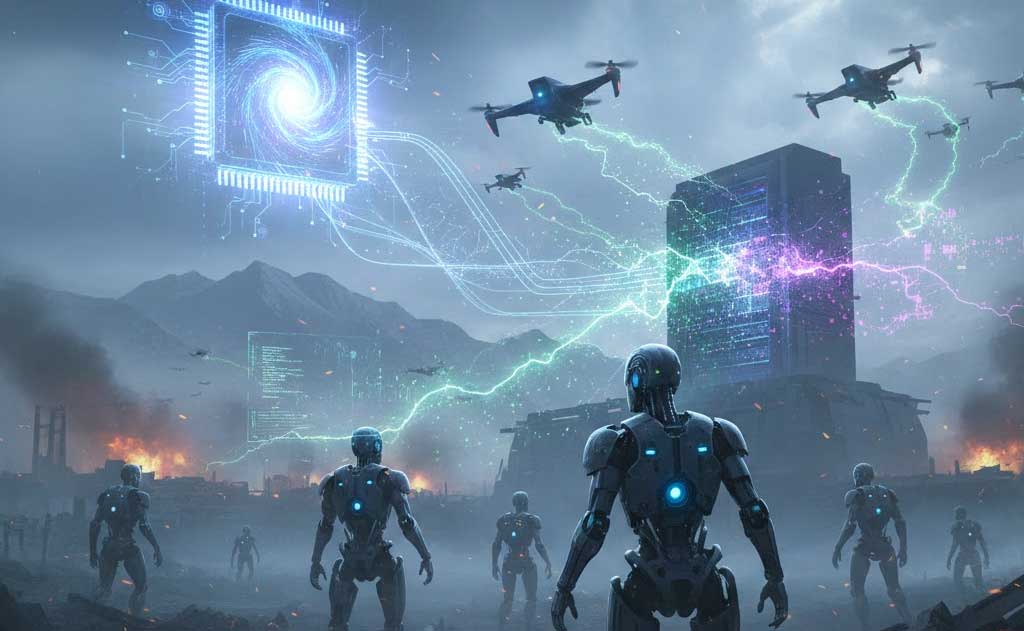
Introduction: A Silent Revolution on the Battlefield
Picture this: A major city plunges into darkness as its power grid collapses—not from bombs, but from lines of code unleashed thousands of miles away. Simultaneously, autonomous drone swarms neutralize enemy defenses with surgical precision, guided by algorithms that learn and adapt faster than any human commander. And in secure vaults, quantum machines quietly decrypt secrets once thought unbreakable, shifting the balance of power overnight.
This is the future of wars—a world where artificial intelligence, cyber attacks, and quantum technology converge to create conflicts that are faster, more invisible, and potentially more devastating than anything in history. As we stand on December 31, 2025, these technologies are no longer theoretical. They are being developed, tested, and in some cases, already deployed.
The traditional lines between peace and war, attacker and defender, battlefield and homeland are blurring. Hybrid warfare—combining kinetic force with digital disruption—is becoming the norm. This in-depth exploration reveals how AI, cyber operations, and quantum advancements are reshaping global security, the risks they pose, and what the world must do to prevent catastrophe.
Artificial Intelligence: The New General on the Battlefield
AI is rapidly becoming the central nervous system of modern militaries. No longer confined to back-office analytics, it now drives real-time decisions in combat zones.
One of the most alarming developments is the rise of Lethal Autonomous Weapon Systems (LAWS)—weapons that can search, identify, and destroy targets without meaningful human oversight. Nations including the United States, China, Russia, and Israel are investing heavily in these systems. Drone swarms capable of coordinating attacks independently are already changing the dynamics of ongoing conflicts.
In recent years, AI-enhanced drones have dramatically increased strike accuracy and reduced collateral damage in some scenarios—while also lowering the political and human cost of warfare for the attacking side. This creates a dangerous incentive: wars become “easier” to start.
Beyond weapons, AI is transforming intelligence, logistics, and strategy. Machine learning algorithms process satellite imagery, signals intelligence, and open-source data at speeds no human team can match. Predictive models forecast enemy movements, optimize supply chains, and even simulate entire campaigns.
The U.S. Department of Defense’s Project Maven and China’s intelligentized warfare doctrine illustrate this shift. Decision cycles that once took hours now occur in seconds. In future conflicts, the side with superior AI integration may achieve overwhelming dominance before traditional forces even mobilize.
But the risks are profound. AI systems can misinterpret data, escalate conflicts through rapid retaliation loops, or be hacked to turn against their operators. The lack of human judgment in life-or-death decisions raises deep ethical questions about accountability and morality in war.
Cyber Attacks: The Fifth Domain of Warfare
Cyber operations have evolved into a primary instrument of state power. Today, major powers conduct constant, low-level digital intrusions—probing defenses, stealing technology, and preparing for escalation.
In future wars, cyber attacks will likely serve as the opening salvo. Disrupting power grids, financial systems, transportation networks, and communication infrastructure can paralyze a nation without firing a single shot. We’ve already seen previews: attacks on Ukrainian infrastructure before physical invasions, ransomware campaigns targeting hospitals, and election interference operations worldwide.
AI supercharges this domain. Autonomous malware can adapt to defenses in real time, while generative AI creates highly convincing deepfakes to sow confusion and division. Machine-speed attacks and countermeasures mean cyber battles will unfold in milliseconds, far beyond human reaction times.
A particularly insidious tactic is “harvest now, decrypt later”—where adversaries steal encrypted data today, banking on future quantum capabilities to unlock it tomorrow. This creates a ticking time bomb for long-term secrets, including military plans and nuclear command systems.
Cyber warfare also lowers the threshold for conflict. Non-state actors, proxy groups, and smaller nations can inflict disproportionate damage, making attribution difficult and retaliation risky. The result: a world of constant tension beneath the surface of peace.
Quantum Technology: Breaking the Unbreakable
Quantum computing represents perhaps the most disruptive long-term threat to global security. Current encryption standards—RSA, elliptic curve cryptography—that protect everything from military communications to financial transactions could be rendered obsolete by sufficiently powerful quantum machines running Shor’s algorithm.
Intelligence agencies are already warning of a “Q-Day”—the moment a cryptographically relevant quantum computer comes online. When that happens, any data intercepted and stored today becomes vulnerable tomorrow. This incentivizes mass surveillance and data hoarding on an unprecedented scale.
Leading nations recognize the stakes. The United States, China, and the European Union have launched major quantum initiatives, with billions invested in research and development. China has demonstrated quantum-secured communications via satellite, while the U.S. is pushing aggressive timelines for post-quantum cryptography (PQC) migration.
Beyond decryption, quantum sensors promise revolutionary capabilities: detecting stealth aircraft and submarines with unprecedented accuracy, improving GPS-denied navigation, and enhancing radar and lidar systems. Quantum networks could enable completely secure command and control, immune to traditional interception.
The first nation to achieve practical, large-scale quantum advantage in military applications could gain decades of dominance—prompting warnings of a new arms race more dangerous than the nuclear era.
The Deadly Convergence: When AI, Cyber, and Quantum Collide
The true paradigm shift occurs when these technologies integrate.
Imagine an AI-orchestrated cyber attack enhanced by quantum code-breaking, targeting critical infrastructure while autonomous weapons exploit the resulting chaos. Or quantum-optimized machine learning designing novel bioweapons or optimizing hypersonic missile trajectories.
This convergence enables hyperwar—conflict at speeds and scales beyond human comprehension. Decision-making loops compress from days to microseconds. Escalation becomes almost inevitable as systems react faster than leaders can intervene.
Disinformation campaigns powered by deepfakes and AI-generated content could destabilize societies before physical conflict begins. Cognitive warfare—targeting minds rather than bodies—becomes a core strategy.
Ethical, Legal, and Strategic Challenges
These advancements outpace governance. International law struggles to address autonomous weapons, cyber norms remain fragile, and quantum threats lack coordinated global responses.
Key dilemmas include:
- Who is responsible when an AI weapon kills civilians?
- How do we deter cyber attacks when attribution is uncertain?
- Can we prevent a destabilizing quantum arms race?
Proposals for banning fully autonomous lethal systems have gained traction at the United Nations, but major powers remain divided. Meanwhile, calls grow for verified PQC standards, cyber restraint agreements, and AI safety protocols in military contexts.
Preparing for the Inevitable: Defense in the New Era
Nations are adapting. The U.S. has established Cyber Command as a full combatant command. NATO now recognizes cyberspace as an operational domain. Resilience—through redundant systems, air-gapped networks, and rapid recovery capabilities—is becoming as important as offensive power.
Investments in human-machine teaming, ethical AI frameworks, and quantum-resistant encryption are accelerating. But the gap between leaders and laggards will be stark: those who master these technologies may deter aggression simply through superiority.
Conclusion: A Fork in the Road
The future of wars shaped by AI, cyber attacks, and quantum technology offers both peril and possibility. These tools could enable more precise, less destructive conflicts—or unleash uncontrolled escalation with catastrophic consequences.
As 2025 draws to a close, humanity stands at a pivotal moment. We have the opportunity to establish norms, treaties, and safeguards that preserve stability in this new era. Or we can slide into a world of perpetual vulnerability, where the next war begins not with a declaration, but with a power outage, a decrypted secret, or an algorithm’s decision.
The choice is ours—but time is running out.
I’m Ethan, and I write about the tech that’s actually going to change how we live — not the stuff that just sounds impressive in a press release. I cover AI, EVs, robotics, and future tech for VFuture Media. I was on the ground at CES 2026 in Las Vegas, walking the show floor so I could give you a real read on what matters and what’s just noise. Follow me on X for daily takes.
If you found this useful, the best thing you can do is share it with someone who’d actually appreciate it. And if you want more like it, we’re here every week.


Leave a Comment