
By VFuture Media Space Desk March 27, 2026
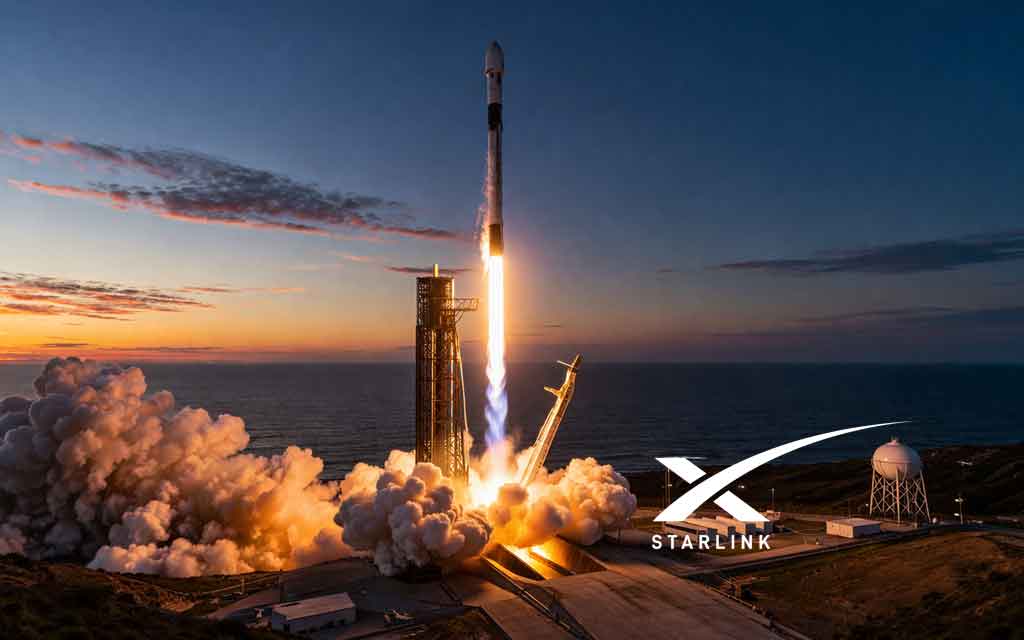
SpaceX successfully launched another batch of its Starlink internet satellites on Thursday, March 26, 2026, with a Falcon 9 rocket lifting off from Vandenberg Space Force Base in California. The mission, designated Starlink Group 17-17, deployed 25 next-generation Starlink V2 Mini satellites into low-Earth orbit, further expanding the company’s growing megaconstellation.
Liftoff occurred from Space Launch Complex 4 East (SLC-4E) at approximately 4:03 p.m. PDT (7:03 p.m. EDT / 23:03 UTC). The Falcon 9 followed a southerly trajectory over the Pacific Ocean as it departed the West Coast launch site.
Mission Highlights
- Payload: 25 Starlink V2 Mini satellites, designed for high-performance broadband internet delivery from space.
- Booster Performance: The first-stage booster (reported in various flights as a veteran vehicle, including one instance of B1071 on its 32nd flight in similar recent missions) successfully separated and landed on the droneship Of Course I Still Love You stationed in the Pacific Ocean. This marked another routine booster recovery for SpaceX’s reusable fleet.
- Deployment: The satellites were released into their initial orbit roughly one hour after liftoff, joining thousands of others already providing global connectivity.
This launch marked the 20th orbital launch from Vandenberg Space Force Base in 2026 and contributed to SpaceX’s rapid cadence of Starlink deployments this year.
Expanding the Starlink Constellation
Starlink continues to grow at an impressive pace. Recent missions, including this one, have helped push the number of operational or in-orbit Starlink satellites toward significant milestones, with earlier 2026 launches reportedly helping reach 10,000 simultaneous satellites in orbit at times. The V2 Mini satellites offer improved bandwidth and coverage compared to earlier versions, supporting SpaceX’s goal of delivering high-speed, low-latency internet to underserved and remote areas worldwide.
Users in California and across the Pacific region may have had opportunities to view the launch as a bright streak in the evening sky, weather permitting. Residents in parts of Santa Barbara, San Luis Obispo, and Ventura counties were advised of possible sonic booms from the returning booster, though actual audibility depends on atmospheric conditions.
Broader Context in SpaceX’s 2026 Operations
SpaceX has maintained a relentless launch schedule in 2026, with frequent Starlink missions from both California’s Vandenberg and Florida’s Cape Canaveral. Vandenberg launches typically target polar or high-inclination orbits, which are ideal for certain Starlink shell configurations that enhance global coverage, particularly at higher latitudes.
The company’s reusable Falcon 9 technology continues to drive down costs and enable this high flight rate. Booster landings have become routine, with hundreds of successful recoveries logged to date.
No anomalies were reported during the Starlink 17-17 mission, and all 25 satellites are expected to maneuver to their operational orbits in the coming days using onboard ion thrusters.
What’s Next for Starlink and SpaceX
SpaceX has multiple Starlink missions on the manifest for the coming weeks, including additional flights from both coasts. The company is also advancing preparations for more ambitious projects, such as Starship development and further constellation optimizations.
For consumers, Starlink’s expansion means improved availability and performance in more regions, with applications ranging from rural broadband to maritime, aviation, and emergency response connectivity.
VFuture Media will continue monitoring SpaceX’s launch activities and Starlink developments. For live views of future missions or constellation tracking, check SpaceX’s official site or Starlink.com.



Leave a Comment