
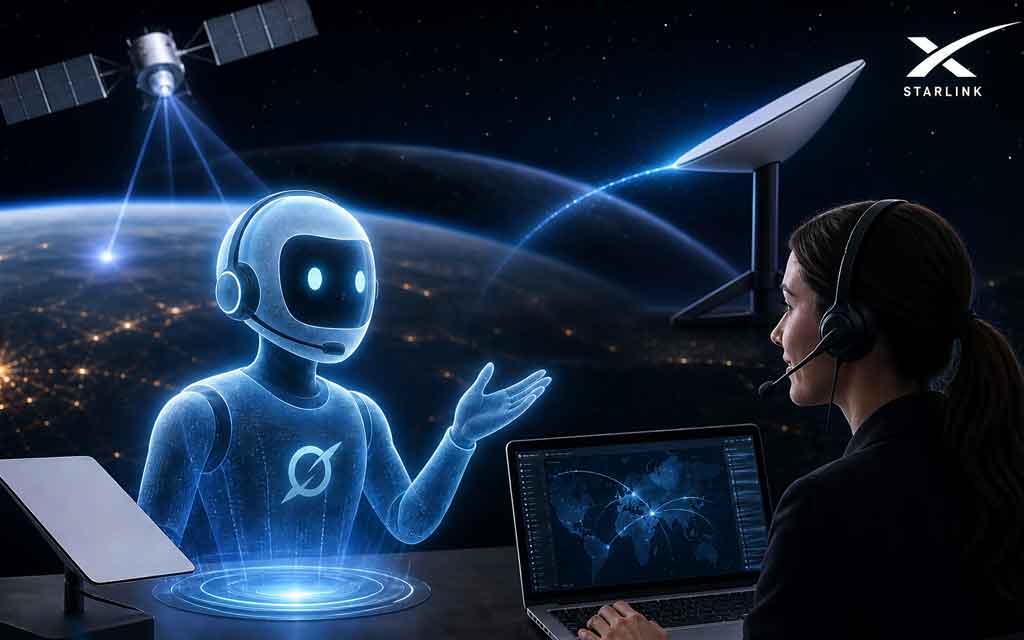
In a seamless integration of Elon Musk’s AI and satellite empires, Grok Voice from xAI is now actively handling customer support calls for Starlink. The advanced voice AI assistant is resolving technical issues, answering sales questions, and even converting inquiries into subscriptions — all without human intervention in many cases.
This deployment marks a significant milestone in the convergence of generative AI and global connectivity infrastructure, potentially transforming how millions of Starlink users receive assistance while showcasing Grok’s real-world capabilities beyond chat interfaces.
Grok Voice on Starlink: How It Works
Starlink customers dialing support now often connect directly to a sophisticated voice-based AI powered by Grok Voice Think Fast 1.0 (or later iterations). The system handles complex, multi-step workflows with snappy, human-like responses and high accuracy.
Key capabilities include:
- Diagnosing and troubleshooting connectivity, hardware, or account issues.
- Providing sales information and guiding users through subscriptions.
- Escalating to human agents when necessary, with seamless handoffs.
- reportedly resolving a high percentage of calls autonomously (early metrics suggest strong performance in benchmarks and real deployments).
Elon Musk confirmed the rollout, highlighting Grok Voice’s top performance on voice benchmarks. The technology builds on xAI’s voice stack, previously integrated into text-based support on the Starlink website and app.
Background: From Text Chatbot to Voice Agent
The integration didn’t happen overnight. Earlier in 2026, SpaceX added a Grok-powered text chatbot to Starlink.com and the mobile app for quick queries. Following SpaceX’s absorption of xAI elements (reported in February 2026), the voice capabilities expanded rapidly.
Grok Voice stands out for its design focused on low-latency, multi-turn conversations and integration with real-time systems — ideal for satellite internet support where users may be in remote or challenging locations.
Why This Matters: Efficiency, Scale, and the AI Future
For Starlink — which serves millions of users across residential, maritime, aviation, and enterprise segments — AI-powered support reduces wait times and operational costs. It allows human agents to focus on complex escalations while maintaining 24/7 availability.
This move aligns with broader industry trends:
- Tech giants using AI to streamline customer service amid workforce optimizations.
- Synergies across Musk’s companies (xAI, SpaceX, Tesla) leveraging shared AI tech.
- Advancing “agentic” AI that doesn’t just chat but acts within business workflows.
Early feedback indicates strong performance, with claims of high resolution rates and positive conversion on sales calls. However, as with any AI rollout, monitoring for accuracy, user satisfaction, and edge cases will be key.
Broader Implications for xAI, SpaceX, and Beyond
The Starlink deployment serves as a high-visibility proving ground for Grok Voice. Success here could accelerate adoption in Tesla vehicles, other SpaceX initiatives, or even third-party licensing of xAI’s voice APIs.
For users, it means faster, more accessible support for one of the world’s fastest-growing satellite networks. For the AI industry, it demonstrates practical deployment of advanced voice models at global scale.
As Grok continues evolving, integrations like this blur the lines between AI assistant and core infrastructure — powering everything from your phone call to your internet connection.
What’s Next? Expect further expansions, custom voice options, and deeper multimodal features. VFuture Media will continue tracking how Grok Voice and similar technologies reshape customer experiences across industries.
Have you interacted with Grok Voice on Starlink yet? Share your experience in the comments. For more on AI infrastructure, xAI developments, and Starlink updates, subscribe to VFuture Media.



Leave a Comment