
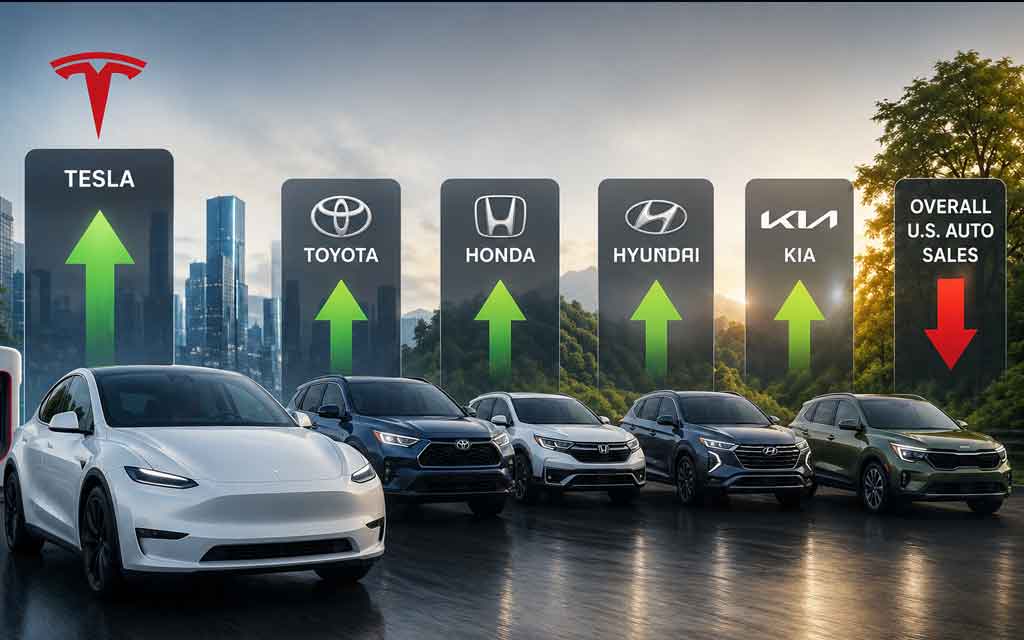
May 2026 brought another month of contrasting trends in the American automotive market. While Tesla continued to dominate the electric vehicle segment, overall new vehicle sales remained under pressure, with several major automakers reporting declines or flat results compared to last year.
Here’s a clear, company-wise breakdown of May 2026 EV sales and overall auto sales in the United States.
Tesla Maintains Strong Lead in EV Sales
Tesla once again proved why it remains the undisputed leader in the U.S. EV market. Despite broader challenges in the EV segment (including softer demand and policy shifts), Tesla delivered strong numbers in May.
Key Highlights – EV Sales (May 2026):
- Tesla remained the clear #1 with the highest volume and market share.
- The Model Y continued to be America’s best-selling EV by a wide margin.
- Other players like Ford, GM (Chevrolet), Hyundai, and Kia saw more modest results.
- Newer entrants such as Rivian showed steady (but smaller) growth in the premium adventure EV segment.
- Overall U.S. EV sales growth has been soft in 2026, with Tesla actually gaining market share as competitors struggled more.
Approximate Company-wise EV Sales Performance (May 2026 trends):
1. Tesla
- Strong EV sales growth and clear market leader in May 2026.
- Model Y continues to dominate sales charts.
- Holds the largest EV market share in the U.S.
2. GM (Chevrolet)
- Modest growth in EV sales.
- Chevrolet Equinox EV is helping expand market presence.
- Maintains the second position among major EV manufacturers.
3. Ford
- Softer EV sales performance compared to competitors.
- Mustang Mach-E and F-150 Lightning experienced slower demand.
- Market share continues to face pressure.
4. Hyundai / Kia
- Stable to slightly growing EV sales.
- Strong combination of hybrid and electric vehicle offerings.
- Gradually increasing market presence.
5. Rivian
- Steady growth in the premium EV segment.
- R1T and R1S remain key products.
- Anticipation building for the upcoming R2 model.
6. Toyota
- EV sales remain relatively low but are improving.
- bZ4X and newer electric models are gaining traction.
- Still holds a small share of the EV market.
Lucid
- Low overall sales volume.
- Focused on the luxury and premium EV segment.
- Remains a niche player in the market.
Key Takeaway: Tesla’s dominance in the U.S. EV market has actually increased in 2026 as many legacy automakers pulled back or faced weaker demand for their electric models.
Overall U.S. Auto Sales – May 2026 Company Breakdown
The broader new vehicle market in May 2026 was mixed. High interest rates, elevated vehicle prices, and shifting consumer preferences toward hybrids (instead of pure EVs) influenced results.
Major Company Performance (May 2026):
Toyota
- Flat to slight decline in May 2026 sales.
- Strong demand for hybrid vehicles and redesigned models helped support results.
- Year-over-year performance: approximately 0% to -1%.
Ford
- Sales declined compared to May 2025.
- Weaker demand for SUVs and pickup trucks weighed on results.
- Year-over-year performance: down approximately 14%.
GM
- Overall sales declined during the month.
- Multiple brands within the company reported lower volumes.
- Year-over-year performance: down approximately 4–5%.
Honda
- Continued sales growth in May 2026.
- Strong hybrid vehicle demand remained a key driver.
- Year-over-year performance: up approximately 10%.
Hyundai / Kia
- Reported positive sales growth.
- Hybrids and strong value positioning attracted buyers.
- Year-over-year performance: positive growth.
Stellantis
- Mixed to soft sales performance.
- Results varied across brands, particularly Jeep and Ram.
- Overall sales remained under pressure.
Notable Points:
- Hybrids continued to be the bright spot for many automakers (especially Toyota, Honda, Hyundai, and Kia).
- Pure EV demand remained softer than expected for most legacy brands.
- Trucks and SUVs still make up the majority of U.S. sales, but growth has slowed.
- Inventory levels and incentive spending remained important factors for many brands.
What’s Driving These Trends in 2026?
Several factors shaped May 2026 results:
- EV Demand Cooling Many buyers are opting for hybrids instead of full electric vehicles due to range anxiety, charging infrastructure concerns, and higher upfront costs (especially after changes to federal incentives).
- Tesla’s Resilience Tesla continues to benefit from brand strength, Supercharger network advantage, software ecosystem, and aggressive pricing.
- Legacy Automakers Struggling with EV Transition Ford and GM have both scaled back some EV ambitions and are focusing more on profitable hybrids and gas vehicles in the short term.
- Hybrids Winning the Transition Japanese and Korean brands are seeing strong results from hybrid powertrains, which offer better fuel economy without requiring charging infrastructure.
Outlook for the Rest of 2026
- Tesla is expected to maintain its dominant position in the U.S. EV market, though competition will intensify with new models from Rivian, GM, and others.
- Overall auto sales are likely to remain soft or slightly down for the year as high prices and economic uncertainty weigh on buyers.
- Hybrids will likely continue gaining share through the rest of 2026.
- Watch for new model launches (especially more affordable EVs) and any changes in interest rates or incentives that could shift momentum.
Bottom Line
May 2026 reinforced a clear trend we’ve seen throughout the year: Tesla remains in a league of its own in the U.S. electric vehicle market, while the broader auto industry is navigating a slower transition with hybrids acting as the bridge for many buyers.
For American consumers, this means more choice than ever — but also more complexity when deciding between gas, hybrid, or full electric.


Leave a Comment