
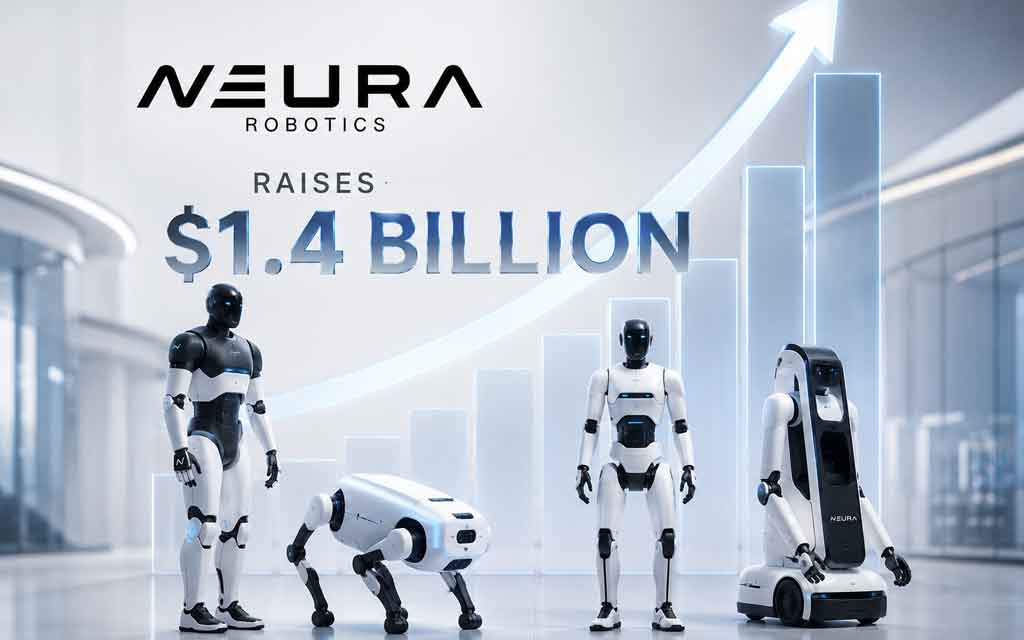
German robotics company Neura Robotics has raised up to $1.4 billion in a Series C funding round, one of the largest ever for a humanoid robotics startup. The round was led by stablecoin issuer Tether and includes participation from major players including Nvidia, Amazon, Qualcomm Technologies, Bosch, Schaeffler, and the European Investment Bank.
The funding values Neura at approximately $7 billion and will accelerate the development and large-scale production of its cognitive humanoid robots and Physical AI platform.
What Neura Robotics Is Building
Founded in 2019 and based in Metzingen, Germany, Neura Robotics focuses on cognitive robots — machines that can learn from real-world interactions and operate with greater autonomy and adaptability than traditional industrial robots.
Its flagship humanoid platform is the 4NE1, designed for complex tasks in manufacturing, logistics, and other environments. The company also develops a broader ecosystem that includes:
- Mobile robots
- Robotic arms
- Sensor kits
- The Neuraverse platform — a shared intelligence system where robots can learn from each other’s experiences
Neura operates NEURA Gyms, specialized training facilities where robots practice real-world tasks to improve their capabilities before deployment.
Why This Funding Round Matters
This $1.4 billion raise stands out for several reasons:
- Scale of capital: It is among the largest single rounds in the humanoid robotics sector, signaling strong investor confidence in European robotics innovation.
- High-profile backers: The involvement of Nvidia (AI chips), Amazon (cloud and robotics expertise), and Tether (crypto/financial infrastructure) shows cross-industry interest in humanoid technology.
- European push: While much of the humanoid robot hype has centered on U.S. companies like Tesla (Optimus) and Figure, Neura’s raise demonstrates that Europe is also attracting major capital for advanced robotics.
The company plans to use the funding to:
- Scale serial production significantly, with ambitions to reach millions of robots by 2030.
- Expand the Neuraverse platform globally.
- Roll out more NEURA Gyms for robot training.
- Accelerate development of its full-stack Physical AI capabilities.
The Global Humanoid Robot Race
Neura’s funding comes at a time of intense competition in humanoid robotics. Major players include:
- Tesla (Optimus)
- Figure AI
- Boston Dynamics
- Chinese companies like UBTech and Fourier Intelligence
Humanoid robots are seen as a potential solution to labor shortages in manufacturing, logistics, eldercare, and hazardous environments. The technology has advanced rapidly thanks to improvements in AI, sensors, and battery technology.
Neura’s focus on cognitive capabilities — robots that can learn and adapt in unstructured environments — positions it as a serious contender in the “Physical AI” space.
Challenges Ahead
Despite the massive funding, Neura faces significant hurdles common to the entire humanoid sector:
- Technical complexity: Achieving reliable, safe, and cost-effective humanoids that can work alongside people remains extremely difficult.
- Production scale: Moving from prototypes to millions of units will require major manufacturing breakthroughs.
- Regulation and safety: Widespread deployment of humanoid robots will require new safety standards and regulatory frameworks.
- Competition: Well-funded U.S. and Asian players are also racing to commercialize similar technology.
Outlook
Neura’s $1.4 billion raise is a strong signal that investors believe humanoid robotics is moving from research and prototypes toward real commercial deployment. The involvement of both traditional industrial players (Bosch, Schaeffler) and tech giants (Nvidia, Amazon) suggests the industry is maturing.
For Europe, the success of companies like Neura could help maintain technological leadership in advanced manufacturing and robotics — areas where the continent has historically been strong.
As Neura and its competitors push toward scaled production in the late 2020s, the next few years will be critical in determining which humanoid platforms gain real traction in factories, warehouses, and beyond.
Do you think humanoid robots will transform manufacturing and daily life in the next decade? Which company do you see leading the space? Share your thoughts in the comments.
Stay updated on robotics, AI, humanoid technology, and the future of automation at vfuturemedia.com.
Tags: Neura Robotics funding, humanoid robots 2026, Physical AI, German robotics startup, Tesla Optimus competition, humanoid robot investment



Leave a Comment