
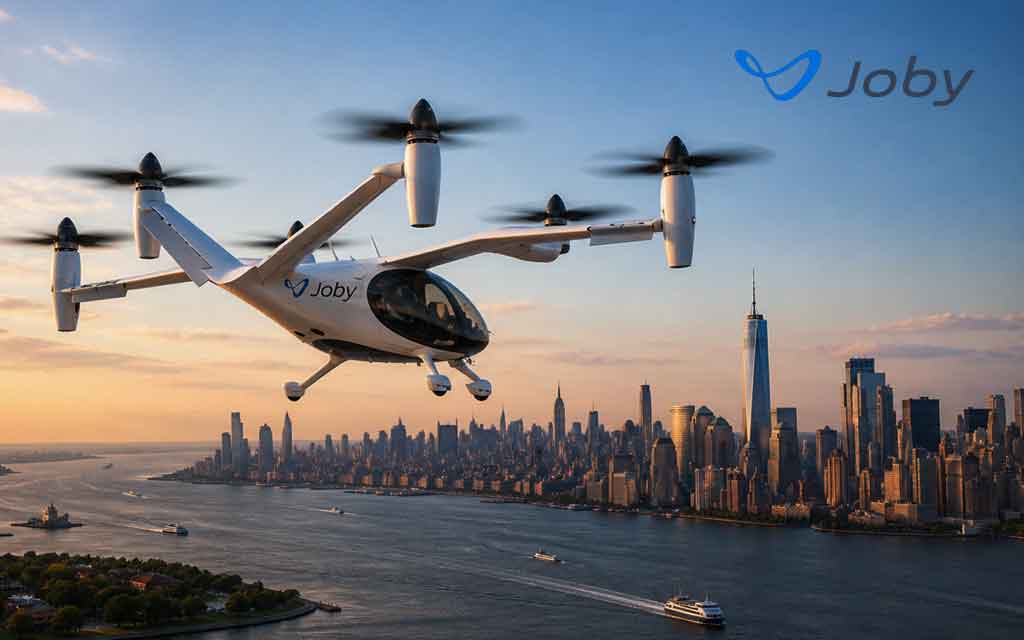
Joby Aviation completed New York City’s first point-to-point eVTOL air taxi demonstration flights in late April 2026. Discover how this quiet, zero-emission gadget-EV hybrid could transform American urban commuting by 2026–2027.
Introduction: The Skies Above Manhattan Just Changed Forever
On April 27, 2026, Joby Aviation made history by completing New York City’s first-ever point-to-point electric vertical takeoff and landing (eVTOL) air taxi demonstration flights. The aircraft flew from John F. Kennedy International Airport (JFK) to Manhattan heliports — including Downtown Skyport, West 30th Street, and East 34th Street — in under 10 minutes. A trip that often takes 45–90 minutes by car in traffic.
This week-long campaign in one of the world’s busiest and most complex airspaces marks a major milestone for urban air mobility in America. As Ethan Brooks at vFutureMedia, I’ve followed eVTOL development closely, and this NYC demo feels like the moment the future arrived.
In this 2000-word deep dive, we’ll explore the technical details of Joby’s aircraft, what the NYC flights mean for US cities, regulatory progress, real-world costs for American riders, competition with ground transport and helicopters, and the roadmap to commercial service in 2026–2027. Whether you’re a New Yorker stuck in traffic, a frequent LA or Chicago traveler, or simply excited about next-gen gadgets, this is your guide to the air taxi revolution.
Joby’s eVTOL Aircraft: Specs That Make It a Game-Changer
Joby’s piloted S4 aircraft is a battery-electric, vertical-takeoff machine designed specifically for urban air mobility.
Key Technical Highlights (2026 Model):
- Seating: 4 passengers + 1 pilot
- Range: 100–150 miles per charge (ideal for city-to-airport and short regional hops)
- Speed: Cruise ~150–200 mph
- Noise Level: Significantly quieter than helicopters — comparable to normal road traffic at a distance
- Emissions: Zero operating emissions
- Propulsion: 6 tilting electric rotors (4 on wings, 2 on tail) for smooth VTOL and efficient forward flight
- Battery Tech: Advanced lithium-ion pack optimized for rapid turnaround and high-cycle use
The aircraft demonstrated seamless transitions between vertical hover and winged flight during the NYC campaign, landing precisely at existing heliports. Passengers reported an incredibly smooth, quiet ride with panoramic views of the Manhattan skyline.
Gadget Angle: The Joby app will let riders book like Uber — select pickup vertiport, destination, and even view real-time flight path with AI-powered weather and traffic integration. It feels more like a premium gadget experience than traditional aviation.
Internal Link: Want to compare with ground EVs? Read our 2026 Rivian R2 Review.
The NYC Demo: What Happened This Week and Why It Matters
From April 27 to May 1, 2026, Joby operated multiple flights connecting JFK to Manhattan heliports in partnership with the Port Authority of New York and New Jersey and NYCEDC. These were piloted demonstration flights using existing infrastructure — a smart strategy to prove viability without building new vertiports from scratch.
Highlights:
- JFK to Downtown Manhattan: ~10 minutes vs. 60+ by car
- Operations in dense Class B airspace near one of the busiest airports in the world
- Public visibility: Flights framed against the iconic NYC skyline for maximum impact
- Focus on acoustics, safety, and integration with current heliport network
This builds on earlier Bay Area demos and positions New York as a key launch market alongside Florida, Texas, and others under the White House-backed eVTOL Integration Pilot Program.
For American cities plagued by congestion, this demo shows a realistic path to relieving ground traffic while cutting emissions.
US Regulatory Progress & 2026–2027 Commercial Timeline
Joby has made strong certification strides:
- Completed Stage 4 of FAA Type Certification (final validation and flight testing phase)
- First conforming aircraft flying in 2026 for Type Inspection Authorization (TIA) with FAA pilots
- Targeting commercial passenger service in the US by late 2026
Partnerships with Delta Air Lines (up to $200M investment) and acquisition of Blade Air Mobility’s passenger business give Joby ready infrastructure and customers. Early operations are planned across 10+ states in 2026.
Americas Focus: FAA rules favor quiet, electric aircraft. Existing heliports in NYC, LA, Chicago, and Miami can be electrified quickly. Federal and local incentives for green aviation add tailwinds.
Challenges remain — full certification, vertiport scaling, and pilot training — but the NYC flights prove operational feasibility in tough environments.
How Air Taxis Will Transform American Commuting
Imagine skipping NYC rush hour, LA freeway gridlock, or Bay Area bridge traffic entirely.
Projected Impacts for US Riders:
- Time Savings: Airport-to-city in 5–15 minutes instead of 45–120+
- Cost: Early estimates ~$3–$7 per mile (comparable to premium Uber Black or slightly above). JFK-Manhattan could start around $150–$300 per seat initially, dropping with scale.
- Accessibility: First premium service, then broader adoption like ride-sharing.
- Environmental Wins: Zero emissions per flight, reduced ground vehicle congestion lowers overall city pollution.
- Economic Boost: New jobs in vertiport operations, maintenance, piloting, and manufacturing (Joby’s California and other US facilities).
Vs. Traditional Options:
- Helicopters: Much louder, higher emissions, more expensive.
- Ground EVs/Tesla Robotaxi: Great for roads but still stuck in traffic.
- Joby Advantage: Direct point-to-point above the congestion.
For business travelers, frequent flyers, and time-poor professionals in major metros, this is a productivity revolution.
Gadget & AI Integration: The Seamless Experience
Joby’s platform blends hardware with smart software:
- AI route optimization considering weather, airspace, and demand
- App-based booking with biometric check-in
- In-flight entertainment and connectivity
- Safety systems with redundant batteries, parachutes (in some configs), and advanced sensors
It’s the ultimate future gadget — quiet, electric, autonomous-leaning (initially piloted), and integrated into daily life like smartphones changed communication.
Future Outlook: When Can Average Americans Fly?
2026: Early commercial flights (likely premium/partnered routes, starting in select cities and international like Dubai). 2027–2028: Network expansion, more vertiports, price reduction. 2030+: Mass adoption potential, competing with short-haul flights and rideshares.
Joby aims for thousands of aircraft in operation globally. US manufacturing and jobs will grow as production scales.
Challenges include infrastructure investment, public acceptance, and equitable access, but the NYC demo builds excitement and data for faster rollout.
Conclusion: The Air Taxi Era Has Begun
Joby’s successful NYC eVTOL flights in April 2026 prove that quiet, electric air taxis are no longer science fiction — they’re here, tested in America’s toughest airspace, and coming to cities near you soon.
This gadget-EV hybrid promises faster, cleaner, and more enjoyable urban travel. For Americans tired of traffic, it’s a breath of fresh (and quiet) air.
What do you think — would you take an air taxi from JFK to Manhattan? Or from LAX to downtown LA? Share in the comments and subscribe to vFutureMedia’s newsletter for weekly updates on EVs, AI, and flying gadgets.
Ready for more? Explore our 2026 EV & Future Mobility Guide or Tesla Robotaxi vs eVTOL Comparison.
Author Bio Ethan Brooks is a senior technology and mobility writer at vFutureMedia.com with over 8 years covering EVs, AI, aerospace innovation, and future gadgets. Based in the US, Ethan delivers in-depth, optimistic-yet-realistic analysis for American readers passionate about sustainable transport.




Leave a Comment