
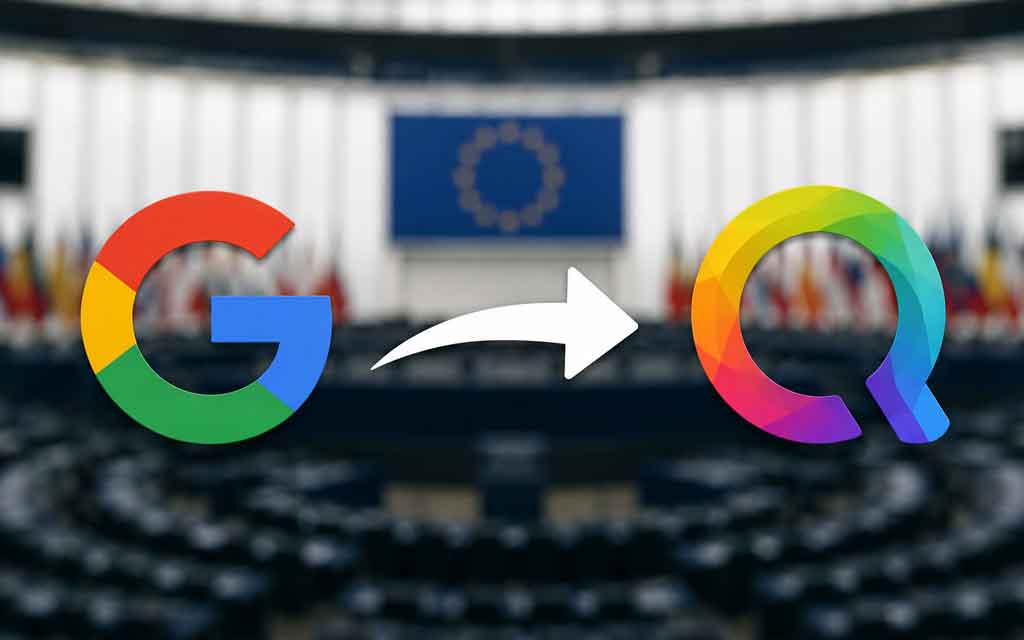
In a clear signal that Europe is serious about reducing its dependence on U.S. technology, the European Parliament has replaced Google with the French search engine Qwant as the default option on its internal computers and browsers.
Effective June 4, 2026, searches made through the address bars of Microsoft Edge and Mozilla Firefox on Parliament-managed devices now route through Qwant by default. The move affects the institution’s 720 lawmakers, thousands of staff, and assistants.
While the immediate practical impact on Google’s revenue is minimal, the symbolic and political weight is significant. It marks one of the most visible steps yet in the EU’s long-running effort to build digital sovereignty and protect European data from foreign tech giants.
Why the European Parliament Made the Switch
According to an internal communication shared with lawmakers and confirmed by Parliament officials, the change aligns with the institution’s commitment to digital sovereignty and stronger protection of users’ personal data.
Qwant, a French search engine founded in 2013, markets itself as a privacy-first alternative. It states that it does not store users’ search history long-term, does not sell personal data, and avoids the extensive tracking that powers Google’s advertising business.
A Parliament spokesperson emphasized that the switch is “part of a larger framework of actions aimed at reducing EP reliance on non-EU digital tools and promoting European-based, privacy-focused services.”
The timing is no coincidence. Just one day earlier, on June 3, the European Commission unveiled a new technological sovereignty package focused on semiconductors, AI, cloud computing, and open-source technologies — part of a broader “Buy and Use European” push.
What Is Qwant and How Does It Compare to Google?
Qwant has built its reputation on privacy. Unlike Google, which builds detailed user profiles for highly targeted advertising, Qwant says it does not track individuals across the web or retain search data in a way that can be linked back to specific users.
Key differences at a glance:
Google vs. Qwant: Privacy and Search Comparison
Search History Storage
- Google: Extensive, tied directly to user accounts.
- Qwant: Minimal to none long-term.
- Winner: Qwant
Personalized Advertising
- Google: Serves as their core business model.
- Qwant: Limited and based on contextual data only.
- Winner: Qwant
Data Sharing with Third Parties
- Google: Extensive, used for targeted advertising and services.
- Qwant: Very limited by design.
- Winner: Qwant
European Data Hosting
- Google: Global infrastructure subject to the U.S. CLOUD Act.
- Qwant: Primarily hosted on European servers.
- Winner: Qwant
Results Source
- Google: Powered by their own massive web index and integrated AI.
- Qwant: Powered by their own index alongside a Bing partnership for some queries.
- Winner: Google (for scale)
User Tracking
- Google: Heavy tracking via cookies, device fingerprinting, and account sync.
- Qwant: Minimal by design to protect user identity.
- Winner: Qwant
Important nuance: Like many European alternatives, Qwant is not 100% independent of U.S. infrastructure. It has long partnered with Microsoft for additional computing power (Azure), some advertising services, and to supplement its own index with Bing results for certain queries (especially images). Critics rightly point out that this creates some data flows to Microsoft (IP address ranges, user-agent, and keywords for supplemented results).
This reality highlights a core challenge for Europe’s sovereignty ambitions: building fully competitive, independent tech stacks at global scale takes time and massive investment.
The Bigger Picture: Europe’s Digital Sovereignty Drive
The Qwant decision is not an isolated move. It fits into a multi-year strategy by EU institutions to reduce strategic dependencies on U.S. (and to a lesser extent Chinese) technology providers.
Key elements of this push include:
- Digital Markets Act (DMA) and Digital Services Act (DSA) — Already forcing changes in how Big Tech operates in Europe.
- AI Act — The world’s first comprehensive AI regulation.
- GAIA-X and new Cloud & AI Development Act proposals — Aiming to create more sovereign European cloud infrastructure.
- Chips Act and semiconductor initiatives — Reducing reliance on foreign chip supply chains.
- Growing political pressure from MEPs to phase out foreign software in sensitive public sector environments.
Many European policymakers view over-reliance on U.S. cloud providers and search giants as a strategic vulnerability — especially given U.S. laws like the CLOUD Act, which can compel American companies to hand over data regardless of where it is stored.
Implications for Google, U.S. Tech, and the Wider Market
For Google (Alphabet), the direct financial hit from losing the European Parliament as a user is negligible. The institution represents a tiny fraction of global search volume.
However, the move carries reputational and political weight. It reinforces the narrative that even core EU institutions are willing to prioritize European alternatives when data protection and sovereignty are at stake.
It also comes at a time when Google faces intense regulatory scrutiny in both Europe and the United States over its search dominance and advertising practices.
For privacy-focused users and organizations, Qwant’s elevation could accelerate interest in European alternatives. Qwant already offers mobile apps and a kid-friendly “Qwant Junior” version. Greater visibility from the Parliament switch may help it gain traction beyond niche privacy circles.
Challenges and Realistic Outlook
Switching defaults on a few thousand institutional computers is relatively easy. Scaling a truly competitive European search engine that can rival Google’s quality across all query types is much harder.
Search quality still depends heavily on having a comprehensive, up-to-date index and sophisticated ranking algorithms. Qwant’s hybrid approach (own index + Bing supplementation) is a pragmatic compromise, but it means Europe has not yet achieved full technological independence in this domain.
The real test will be whether this move inspires more public sector organizations across Europe to follow suit — and whether it accelerates investment in fully sovereign European web indexing projects (such as earlier discussions around a European Search Perspective involving Qwant and Ecosia).
What This Means for the Future of Tech Competition
The European Parliament’s decision to replace Google with Qwant is best understood as both a symbolic victory for digital sovereignty advocates and a practical reminder of how difficult it is to fully escape global tech interdependencies.
It sends a message to U.S. tech companies: Europe is willing to act on its stated desire for greater strategic autonomy, even if the transition is gradual and imperfect.
For American readers and businesses watching EU tech policy, this is another data point in the ongoing story of regulatory pushback, data localization pressures, and the slow emergence of regional technology champions.
Whether Qwant becomes a lasting success story or remains a niche player will depend on continued product improvement, broader public sector adoption, and Europe’s ability to invest seriously in foundational technologies like search indexing and AI.
One thing is clear: the era of unquestioned U.S. tech dominance in every layer of Europe’s digital infrastructure is facing sustained political and regulatory challenge.
FAQs
When did the European Parliament switch to Qwant? The change took effect on June 4, 2026. Qwant became the default search engine in the address bars of Microsoft Edge and Mozilla Firefox on Parliament computers.
Can users still use Google? Yes. Staff and MEPs can manually change the default or use other search engines. The switch only sets Qwant as the initial default.
Is Qwant completely independent of U.S. tech? No. While Qwant emphasizes European hosting and strong privacy protections, it has partnerships with Microsoft (Azure infrastructure and Bing for certain results). This is a common reality for European alternatives today.
Will this hurt Google financially? Unlikely in any meaningful way. The European Parliament’s internal usage represents a very small share of global search volume.
What is driving Europe’s push for digital sovereignty? Concerns over data protection, strategic dependencies, the ability of foreign governments to access European data via domestic laws, and a desire to build a stronger European tech industry.




Leave a Comment