
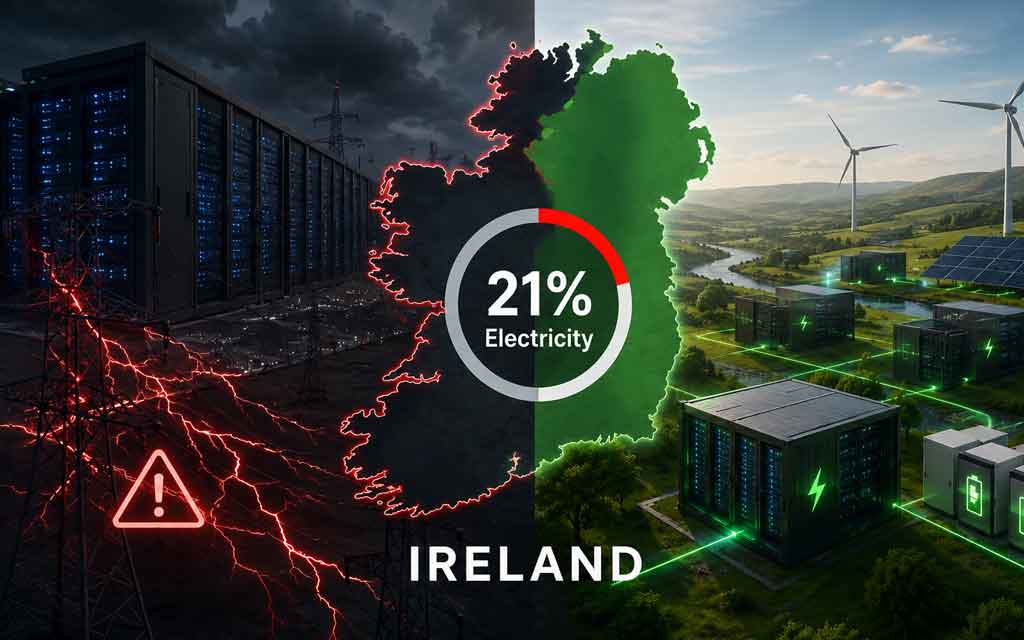
Ireland’s data centers now consume 21% of the country’s entire electricity supply. Projections show this could climb to 31-32% by 2026. Singapore and Amsterdam have already imposed moratoriums on new data center construction because their grids simply cannot handle the load. Meanwhile, the Filecoin network distributes storage and compute demand across thousands of independent providers worldwide — avoiding the dangerous concentration of power draw in any single jurisdiction or grid.
This contrast reveals one of the most urgent infrastructure challenges of the AI era: centralized hyperscale data centers are hitting hard physical limits, while decentralized networks offer a fundamentally different architectural path.
The AI Data Center Energy Crisis Is Real
The explosion of generative AI has supercharged demand for compute and storage. Training and running large models requires enormous clusters of GPUs running 24/7, plus the supporting storage and networking infrastructure.
Traditional cloud and AI providers concentrate this demand in massive, centralized facilities. A single large AI training cluster or inference farm can draw as much power as a small city. When hundreds of these facilities cluster in the same region (as they have in Ireland, Northern Virginia, Singapore, and parts of the Netherlands), local grids become overwhelmed.
Ireland’s situation is the clearest warning sign yet:
- Data centers already account for over 21% of national electricity consumption.
- They are projected to reach nearly one-third of the country’s power use within the next couple of years.
- This has forced EirGrid (Ireland’s transmission operator) to pause or severely restrict new grid connections for large data centers, particularly around Dublin.
Similar pressures have appeared elsewhere. Singapore imposed a multi-year moratorium on new data center builds due to power and land constraints. Amsterdam and parts of the Netherlands introduced restrictions and planning pauses for the same reason — grid congestion and insufficient generation capacity.
These are not isolated local problems. They are symptoms of a structural mismatch: AI workloads are growing exponentially, while centralized infrastructure creates concentrated, hard-to-solve bottlenecks in specific locations.
Why Centralized Data Centers Create Grid Crises
Centralized hyperscale facilities create several problems simultaneously:
- Massive localized demand spikes — A single large campus can require hundreds of megawatts. When many are built near the same substations and transmission lines, upgrades lag far behind.
- Long lead times for new power infrastructure — Building new generation, transmission lines, or substations takes 5–10+ years. Data center construction is much faster.
- Policy and community pushback — When residents see their electricity bills rise or face reliability risks because of data centers serving global tech companies, political resistance grows.
- Single points of failure and regulatory risk — Entire regions can become dependent on (or constrained by) the power needs of a handful of large operators.
Singapore and Amsterdam’s moratoriums were pragmatic responses to these realities. They bought time to reassess how much new capacity their grids and societies could sustainably support.
Filecoin’s Decentralized Model Avoids Concentration
The Filecoin network takes a fundamentally different approach. Instead of building a few enormous data centers that dominate regional power demand, Filecoin incentivizes thousands of independent storage providers around the world to contribute unused hard drive capacity.
Key advantages for grid and infrastructure strain:
- Load is distributed globally — No single country, city, or grid bears a disproportionate share of the demand. Storage and retrieval requests are spread across many jurisdictions and power grids.
- No single point of massive concentrated load — Unlike a hyperscale AI data center that might draw 100+ MW in one location, Filecoin’s demand is granular and geographically dispersed.
- Resilience through distribution — The network doesn’t rely on any one facility, operator, or region staying online. This reduces systemic risk compared to centralized clouds.
- Economic incentives align with distribution — Storage providers earn FIL tokens by proving they are storing data. This naturally encourages participation in locations where power and hardware are available and affordable, rather than forcing everything into a few high-demand hubs.
Filecoin was designed from the ground up as a decentralized physical infrastructure network (DePIN). While it started primarily as a storage network (built on IPFS), upgrades like the Filecoin Virtual Machine (FVM) have expanded its capabilities toward decentralized compute as well. The core architectural principle remains: spread the load instead of concentrating it.
Why This Matters for AI’s Future
AI’s growth is creating unprecedented electricity demand. Centralized data centers are hitting real-world limits in multiple countries. Regulatory responses (moratoriums, connection pauses, stricter efficiency requirements) are becoming more common.
This creates both a problem and an opportunity:
- Problem: Purely centralized approaches to AI infrastructure face increasing friction from power availability, permitting, and local opposition.
- Opportunity: Decentralized networks like Filecoin can complement centralized systems by handling storage, archival, and certain compute workloads in a distributed way that reduces pressure on any single grid.
For AI specifically, decentralized storage offers verifiable, tamper-resistant datasets that can be used for training and evaluation without relying on a single corporate cloud provider. As DePIN projects mature, we may also see more hybrid models where heavy AI training stays in optimized centralized clusters while storage, inference caching, and certain workloads move to distributed networks.
The Path Forward: Hybrid Infrastructure
The most likely future is not “centralized vs decentralized” but intelligent hybridization:
- Hyperscale centralized clusters will continue handling the most intensive, latency-sensitive AI training and inference.
- Decentralized networks like Filecoin will absorb storage-heavy workloads, archival data, and workloads that benefit from geographic distribution and censorship resistance.
- This mixed approach reduces single-jurisdiction grid risk while still delivering the performance centralized systems excel at.
Ireland’s experience, Singapore’s and Amsterdam’s moratoriums, and the rise of distributed networks like Filecoin all point to the same conclusion: the old model of unlimited centralized data center growth in any one location is reaching its physical and political limits.
The networks that succeed in the AI era will be those that can intelligently distribute demand across many locations and many independent operators — rather than concentrating it in a handful of vulnerable grids.
Filecoin demonstrates one working model of how that distribution can be achieved at global scale through economic incentives and cryptographic verification. As AI continues to drive energy demand higher, architectures that avoid putting all the load in one place will become increasingly valuable.




Leave a Comment