
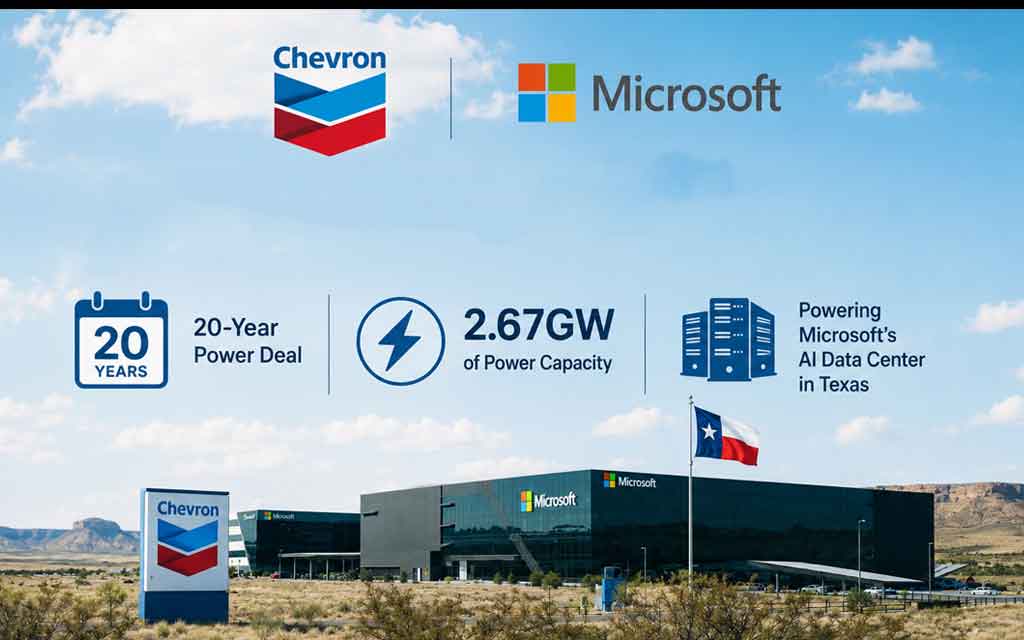
Chevron has signed a major 20-year agreement to supply electricity from a new natural gas power plant to Microsoft’s planned data center campus in West Texas. The deal highlights the growing energy demands of artificial intelligence and the creative partnerships forming between traditional energy companies and tech giants.
Deal Details
Under the agreement, Chevron subsidiary Energy Forge One LLC will develop and operate a co-located natural gas power facility known as Project Kilby. The plant will provide dedicated power directly to Microsoft’s data center campus near Pecos, Texas.
Key features of the project include:
- Capacity: Approximately 2.67 gigawatts (GW) of power generation.
- Technology: Large GE Vernova turbines will provide the majority of the power, with additional capacity from Solar Turbines (a Caterpillar subsidiary).
- Development approach: Built in phases using a modular design, allowing for incremental expansion over time.
- Timeline: First power is expected in 2028.
The project is being developed in partnership with Joulent, an energy company backed by activist investment firm Engine No. 1.
Why This Matters for AI and Data Centers
Microsoft and other hyperscalers are in the midst of an unprecedented buildout of data centers to support the rapid growth of AI applications. These facilities consume enormous amounts of electricity — often equivalent to the power needs of small cities.
Traditional electric grids in many parts of the U.S. are struggling to keep up with this surge in demand. As a result, tech companies are increasingly turning to direct, behind-the-meter power solutions with energy producers.
Chevron’s deal with Microsoft is one of the largest examples of this trend. By using its own natural gas production from the nearby Permian Basin, Chevron can deliver reliable, on-site power without relying on strained transmission infrastructure.
Jeff Gustavson, president of Chevron New Energies, stated that the company is “uniquely positioned to deliver power with certainty, speed and at a competitive cost, leveraging Permian natural gas.”
Broader Energy and Tech Context
This agreement reflects several important shifts:
- AI’s massive energy appetite: Training and running advanced AI models requires vast amounts of computing power, which in turn drives huge electricity demand.
- Natural gas as a bridge fuel: While tech companies have long-term renewable energy goals, natural gas is being used as a reliable, scalable solution to meet near-term power needs.
- Vertical integration in energy: Oil and gas companies are moving downstream into power generation, creating new revenue streams tied to data center growth.
- Co-location trend: Building power plants directly next to data centers reduces transmission losses and speeds up deployment.
Similar arrangements are being explored across the U.S. as hyperscalers race to secure power for their expanding AI infrastructure.
Economic Impact
Project Kilby is expected to create significant economic benefits for West Texas, including:
- Over 2,000 construction and operational jobs
- Substantial tax revenue for local communities
- Long-term economic activity tied to both energy production and data center operations
What Comes Next
Microsoft’s data center campus in the region is expected to be among the largest in the country once fully built out. The 20-year power agreement provides long-term certainty for both companies while helping Microsoft meet its aggressive AI expansion timeline.
For Chevron, the deal represents a strategic move into the high-growth data center power market using its existing natural gas assets in one of the world’s most prolific basins.
As AI continues to drive demand for electricity, more deals between energy producers and technology companies are likely. The Chevron-Microsoft partnership is a clear signal that traditional energy and cutting-edge AI infrastructure are becoming increasingly intertwined.



Leave a Comment