
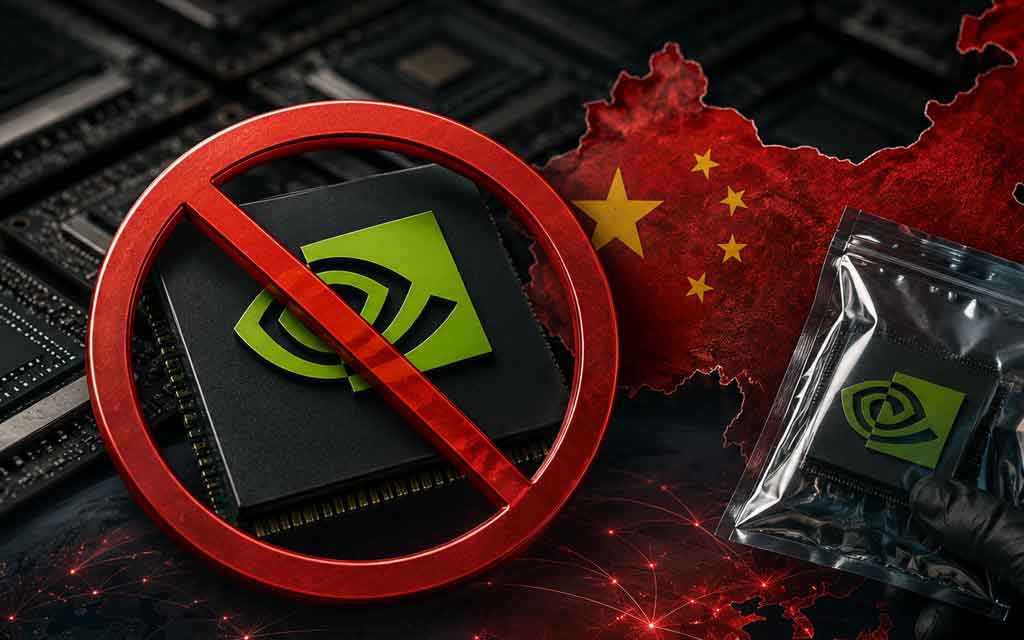
U.S. export controls on Nvidia’s advanced AI chips have driven prices to double on China’s black market, with DGX B300 systems now exceeding $1.1 million. Here’s what it means for the U.S.-China tech war, Nvidia revenue, and global AI development.
Nvidia’s most powerful AI chips, restricted by U.S. export controls, are commanding premium prices on China’s black market. According to the Financial Times, citing multiple Chinese chip traders, systems featuring eight Blackwell Ultra B300 GPUs now sell for over $1.1 million — roughly double the $500,000–$550,000 U.S. retail price.
Individual chips like the RTX 6000 Pro have jumped from around $7,000 to $18,000, reflecting persistent demand despite Washington’s efforts to limit China’s access to cutting-edge semiconductors.
The surge underscores the challenges of enforcing export controls in a high-stakes geopolitical tech race, where China’s AI ambitions continue to drive underground markets even as official channels are blocked.
U.S. Export Controls: The Intended Squeeze
The U.S. has progressively tightened restrictions on advanced AI chips since 2022, targeting Nvidia’s H100, H200, and newer Blackwell series. The goal: Slow China’s progress in training large language models, military applications, and other dual-use technologies that could enhance Beijing’s capabilities in AI-driven warfare, surveillance, and strategic computing.
These controls require licenses for exports to China and have been expanded to close loopholes, including shipments through third countries or subsidiaries. Recent moves under the Trump administration have further narrowed pathways, aiming to maintain U.S. technological superiority.
However, the black market has proven resilient. Smugglers route chips through complex networks involving third countries, falsified documents, and high-risk transactions — driving up costs due to added premiums for evasion.
Black Market Mechanics and Pricing Surge
Chinese buyers — ranging from tech firms, research institutions, and state-linked entities — are willing to pay substantial markups for access to Nvidia’s hardware. Key drivers include:
- Scarcity premium: Official imports are heavily restricted or impossible for the most advanced chips.
- Smuggling risks: Higher costs for logistics, bribes, and potential seizures inflate prices.
- Strong underlying demand: China’s massive AI training push (including models like DeepSeek) requires vast compute resources. Domestic alternatives (e.g., Huawei Ascend) lag in performance and ecosystem maturity.
Traders report DGX B300 servers (packed with Blackwell GPUs) as particularly hot commodities. The doubling of prices reflects not just inflation but the economic value of cutting-edge AI hardware in a market where compute is the new oil.
Implications for Nvidia and the Global Chip Supply Chain
For Nvidia:
- The black market creates indirect revenue opportunities but also compliance headaches and reputational risks.
- Official sales to China are curtailed, pushing the company to pivot toward other markets and develop compliant “China-specific” variants (e.g., H20 chips with reduced performance).
- Long-term: Sustained controls could accelerate China’s push for semiconductor self-sufficiency, potentially eroding Nvidia’s dominance if successful.
For U.S. Policy:
- The price surge highlights enforcement gaps. While controls slow China’s progress, they also create lucrative incentives for evasion.
- Questions remain about effectiveness: How much do black market chips truly advance China’s frontier AI capabilities versus incremental gains?
- Broader decoupling: The U.S. is balancing national security with economic interests, as full isolation risks hurting American firms.
For China:
- Demonstrates determination to acquire Western tech despite barriers.
- Accelerates investment in domestic alternatives (SMIC, Huawei, etc.), though catching up in leading-edge processes remains difficult.
- Gray-zone innovation: Using smuggled chips alongside open-source software and optimized algorithms to maximize limited hardware.
The Geopolitical Tech War Heats Up
This development fits into a larger pattern of U.S.-China technology competition. Export controls on semiconductors are one pillar of a strategy that also includes investment restrictions, talent controls, and alliances like the Chip 4 framework.
Unmanned and autonomous systems (as seen in recent U.S. support for the Philippines) show how AI hardware underpins broader military and strategic capabilities. Black market dynamics reveal the limits of unilateral controls in a globalized supply chain.
Analysts expect continued escalation: tighter U.S. enforcement, Chinese circumvention efforts, and third-country arbitrage. For the AI industry, this fragmentation could slow global progress while spurring innovation in alternative architectures and efficiency.
What Comes Next?
- Enforcement: The U.S. may target smuggling networks more aggressively, including secondary sanctions on facilitators.
- Chinese Response: Accelerated R&D into indigenous chips and software optimizations to reduce reliance on Nvidia.
- Market Impact: Nvidia shares may face volatility from China exposure, while competitors (AMD, Intel, and Chinese firms) position themselves.
- Global Ramifications: Other nations watch closely — export controls could reshape alliances, supply chains, and the pace of AI advancement worldwide.
Nvidia’s banned chips doubling in price on the black market is more than a pricing anomaly. It’s a symptom of deep technological decoupling and a reminder that in the AI era, hardware remains a critical strategic asset — one that adversaries will go to great lengths to obtain.
What do you think? Are U.S. export controls effective in slowing China’s AI rise, or are they primarily driving a profitable black market? How should policymakers balance security with innovation?
Sources: Financial Times reporting (June 23–24, 2026), Reuters, industry analysts, and U.S. Commerce Department statements on export controls. Prices reflect trader reports and are subject to fluctuation.




Leave a Comment