
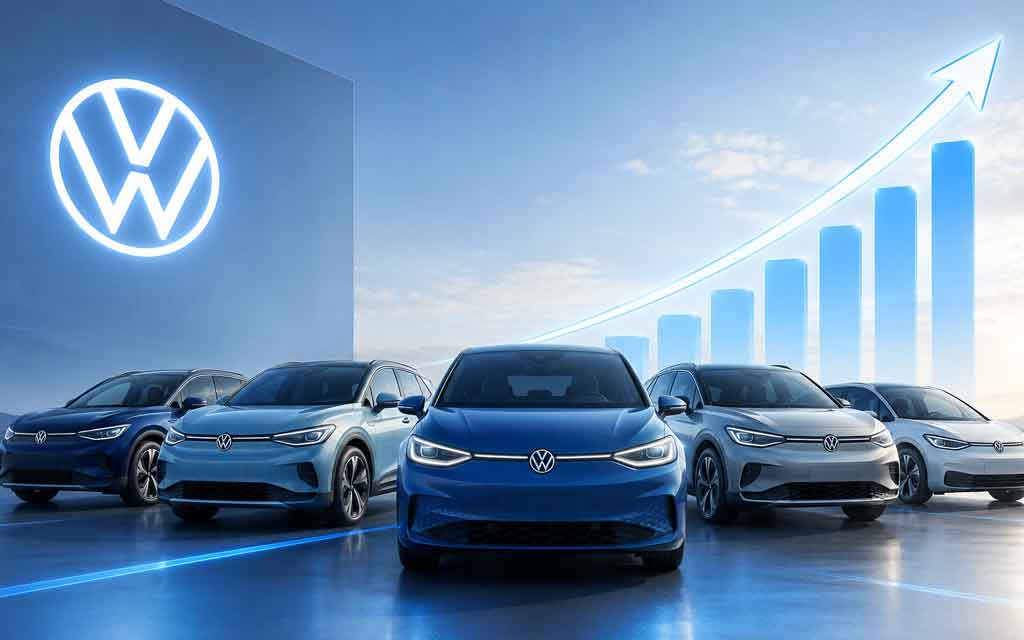
Volkswagen’s ID family of electric vehicles has delivered solid growth in Europe during the first half of 2026, helping the VW brand and Volkswagen Group maintain leadership in the region’s EV market even as overall sales dynamics have become more challenging.
While Tesla posted a headline-grabbing 77% surge in the same period, VW’s more measured but consistent gains across the ID.3, ID.4/ID.5, and ID.7 models underscore how legacy automakers are adapting and capturing meaningful share in a maturing European EV landscape.
VW ID Performance in Context
In the first quarter of 2026, Volkswagen remained Europe’s top-selling EV brand, with the ID.3, ID.4/ID.5, and ID.7 models accounting for a large portion of its electric deliveries. The ID.7 in particular has continued its strong momentum from 2025, when it recorded triple-digit percentage growth in several markets.
The broader ID family has benefited from refreshed variants, competitive pricing in key segments, and improved charging performance. Combined with strong contributions from group siblings like the Škoda Elroq and Enyaq, the Volkswagen Group held approximately 26% of the European EV market in early 2026 — a commanding position.
This performance comes as the overall European EV market has shown more moderate growth compared to previous years. Many legacy brands have faced inventory pressures and softer demand in certain segments, making VW’s ability to grow its ID volume notable.
Key Drivers Behind VW’s ID Growth
Several factors are supporting the ID series’ progress:
- Product maturity and updates — The ID.3 has benefited from ongoing refinements since its launch, while the ID.4/ID.5 and larger ID.7 have established clearer positioning in the compact and mid-size segments. New variants and feature updates have helped sustain buyer interest.
- Pricing and value positioning — VW has used targeted pricing and financing offers to make the ID models competitive against both Tesla and other European rivals. The brand’s strong dealer network and brand trust in Europe also play a role.
- Charging and practicality — Improvements in real-world range and access to the growing public charging network have addressed earlier concerns some buyers had about the MEB platform vehicles.
- Group synergies — Shared technology and platforms across VW, Škoda, and Audi have allowed the group to offer a broad EV lineup that appeals to different buyer segments while controlling development costs.
These elements have helped VW defend and even grow its position as European buyers become more selective about which EVs they purchase.
Comparison with Tesla’s European Surge
Tesla’s 77% growth in the same January–May period highlights the brand’s continued strength, particularly with the Model Y. However, VW’s more moderate but steady gains across multiple ID models show a different path to success.
Tesla has leveraged its software ecosystem, Supercharger network, and brand momentum to drive outsized volume increases. VW, by contrast, is winning through a broader product range, established dealer presence, and competitive offerings in segments where many European buyers still prefer traditional formats (hatchbacks, estates, and compact SUVs).
Both approaches are proving effective. Tesla is expanding the overall EV buyer pool with its technology-forward appeal, while VW is converting more of its existing customer base and capturing share from other legacy brands.
The contrast also reflects different stages of the transition: Tesla as the disruptor continuing to scale, and VW as the incumbent successfully scaling its dedicated EV platform after an earlier learning curve.
Broader Implications for the European EV Market
VW’s ID growth demonstrates that the European EV market is not a zero-sum game between Tesla and everyone else. There remains substantial room for well-executed offerings from established manufacturers, especially when they combine competitive products with strong local brand equity and service networks.
The ID family’s performance also supports the view that demand is becoming more segmented. Buyers are choosing vehicles that best fit their needs rather than defaulting to the most hyped option. This maturation benefits manufacturers that can offer a full lineup rather than relying on one or two hero models.
For the wider industry, VW’s results suggest that legacy automakers who invest consistently in their EV platforms and adapt their go-to-market strategies can remain competitive even as new entrants and Chinese brands increase pressure.
Challenges VW Still Faces
Despite the positive momentum, VW’s ID program is not without challenges:
- Profitability of the MEB platform remains under scrutiny, with the company working to improve margins through scale and cost discipline.
- Competition is intensifying from both premium European rivals and aggressively priced Chinese models.
- The group must continue refreshing the ID lineup and preparing the next generation of more affordable EVs to maintain momentum into 2027 and beyond.
- Execution on software and over-the-air capabilities still lags Tesla in the eyes of many buyers.
VW will need to address these areas while sustaining the volume growth the ID family has shown in 2026.
Outlook for the Second Half of 2026
With several new or updated ID variants expected and continued investment in charging infrastructure across Europe, VW is well positioned to build on its early 2026 performance. The brand’s strong home market in Germany and solid presence across Western Europe provide a stable base.
Longer term, the success of the current ID generation is laying the groundwork for VW’s next wave of electric vehicles, including more affordable models that could significantly expand the addressable market.
Frequently Asked Questions
How does VW’s ID growth compare to Tesla’s in Europe? Tesla posted much higher percentage growth (77%), but VW achieved solid volume gains across a broader range of models while maintaining overall market leadership in the EV segment.
Which ID models are performing best? The ID.7 has shown particularly strong growth, while the ID.3 and ID.4/ID.5 continue to deliver steady volume in high-volume segments.
Is the European EV market still growing overall? Growth has moderated compared to previous years, but remains positive. VW’s ability to grow its ID share in this environment is a positive signal for the brand.
What does this mean for VW’s long-term EV strategy? Strong ID performance validates the MEB platform investment and gives VW breathing room to develop the next generation of more affordable and profitable electric vehicles.
Will VW overtake Tesla in Europe long-term? Tesla remains a formidable competitor, but VW’s broader product range and established presence give it a strong foundation to defend and potentially grow its leadership position.
The Bottom Line
Volkswagen’s ID series has delivered meaningful sales growth in Europe during the first half of 2026, helping the brand maintain its position as the region’s leading EV manufacturer. While Tesla’s percentage surge has captured headlines, VW’s more measured progress across multiple models shows that legacy automakers can successfully scale electric vehicle sales when product, pricing, and market execution align.
The results highlight a maturing European EV market where both disruptors and established players can thrive by offering compelling vehicles and supporting experiences. For VW, the ID family’s momentum provides important validation as the company prepares its next chapter in electrification.
American and European automakers alike are proving that the shift to electric vehicles is not a single-brand story. It is a broad industry transition in which execution and adaptation determine long-term winners.
How do you see the competition between Tesla and traditional European brands like VW evolving in the second half of 2026? Share your perspective in the comments.



Leave a Comment