
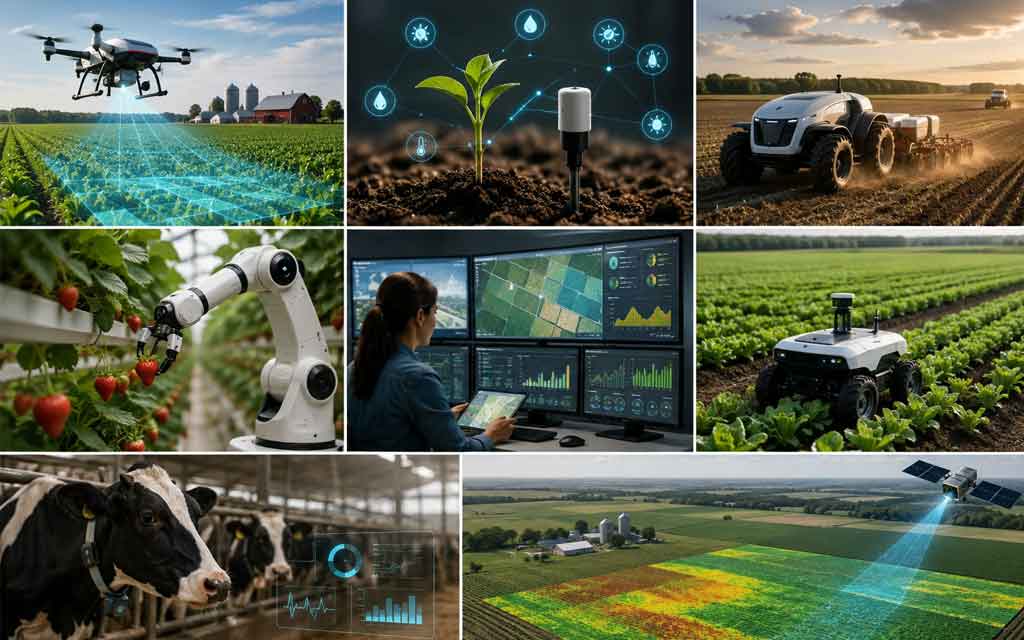
Discover how American farmers are leveraging AI for precision weed control, autonomous tractors, crop monitoring, soil analysis, livestock welfare, and carbon markets. Real examples like John Deere See & Spray deliver major cost savings, yield gains, and sustainability benefits in US agriculture for 2026.
American agriculture remains one of the most productive systems in the world, yet it faces mounting pressures: persistent labor shortages, volatile weather patterns driven by climate change, rising costs for fuel, fertilizer, and chemicals, and growing demands for sustainable practices. Artificial intelligence is emerging as one of the most practical solutions — not as a replacement for farmers, but as a powerful set of tools that help them make faster, more precise decisions and operate more efficiently.
North America currently holds the largest share of the global AI in agriculture market (approximately 36–40%). The technology is moving quickly from pilot projects to mainstream adoption on US farms, particularly in row crops, specialty crops, and livestock operations. The AI in agriculture market is expanding rapidly, with precision tools already demonstrating clear returns through higher yields, lower input costs, and improved environmental outcomes.
Here are 8 key AI use cases that American farmers are actively adopting in 2026, supported by real company examples, field data, and measurable benefits.
1. Precision Weed Control with Computer Vision (John Deere See & Spray)
This is currently one of the most commercially successful AI applications in US agriculture.
How it works: High-resolution cameras mounted on the sprayer boom capture images continuously. Onboard processors running machine learning models identify individual plants in real time and distinguish crops from weeds. The system then activates only the specific nozzles needed to spray herbicide directly onto weeds.
Real-world US results (2024 growing season):
- Applied across more than 1 million acres of corn, soybeans, and cotton.
- Average herbicide savings of 59%, equating to roughly 8 million gallons of product saved.
- Independent Iowa State University trials showed up to 76% product savings and approximately $15.70 per acre in economic benefit.
- Many early adopters reported cutting post-emergence herbicide costs by two-thirds.
Why American farmers are adopting it fast: It directly reduces one of the largest variable costs on row-crop farms while lowering chemical runoff and slowing herbicide resistance. John Deere offers the technology on new sprayers and as retrofits, with flexible pricing models (including guarantees that farmers pay based on actual savings).
2. Drone and Satellite-Based Crop Health Monitoring
AI processes multispectral and hyperspectral imagery from drones or satellites to detect crop stress, nutrient deficiencies, disease, or pest pressure days or weeks before symptoms become visible to the human eye.
US example: California vineyards using drone-based AI monitoring have recorded yield increases of around 20% alongside meaningful reductions in water use by enabling targeted interventions.
Broader adoption: The approach works across Midwest corn and soybean fields, specialty crops in California and the Pacific Northwest, and other regions. The USDA’s own AI strategy highlights the use of computer vision on satellite and drone imagery for monitoring crop and forest health at scale.
Key benefits: Earlier and more precise scouting, reduced blanket applications of crop protection products, and data-driven variable-rate prescriptions that improve both yield and input efficiency.
3. Autonomous and Semi-Autonomous Tractors and Field Machinery
John Deere has taken the lead with its 8R and 9RX autonomous tractor platforms. These machines combine AI-driven computer vision, multiple cameras for 360-degree awareness, high-precision GPS, and obstacle detection systems.
Current status: The technology is in active testing and commercial rollout across at least 18 states. Machines can perform tillage, spraying, and other repetitive field tasks with little or no operator in the cab, supporting extended or 24/7 operation during critical planting and harvest windows.
Farmer advantages: Addresses acute labor shortages, reduces operator fatigue, and improves operational consistency. Data flows directly into platforms like John Deere Operations Center for remote oversight and record-keeping.
While the capital cost is higher than conventional equipment, the return comes through labor savings and the ability to cover more acres with existing teams — especially valuable for larger Midwest grain operations.
4. Advanced Soil Health Analysis Using Genomics and AI
Traditional soil testing provides limited snapshots. Newer AI-enhanced approaches analyze the full soil microbiome.
US company example: Trace Genomics (now part of Miraterra) uses high-definition genomic sequencing combined with AI to detect pathogens, assess biological activity, and deliver precise nutrient and soil health recommendations across dozens of crops.
Complementary platforms: Indigo Ag pairs microbial biological products with data tools that support regenerative practices and quantify improvements in soil health.
Value for farmers: More accurate recommendations than conventional tests, better long-term soil resilience, and reduced risk of over- or under-applying inputs.
5. Predictive Analytics for Yields, Pests, Weather, and Markets
Machine learning models combine historical field data, real-time sensor readings, satellite imagery, weather forecasts, and market signals to generate forecasts and recommendations.
Practical uses: Predicting optimal planting and harvest windows, forecasting pest or disease pressure, estimating yields, and optimizing input timing. The USDA applies similar predictive analytics internally for yield modeling, pest outbreak risk, and resource planning.
US strength: Large volumes of high-quality data generated by precision equipment and centralized platforms enable increasingly accurate, localized models.
6. AI-Optimized Irrigation and Variable-Rate Resource Management
AI integrates data from soil moisture sensors, weather stations, evapotranspiration models, and crop growth stage information to apply water and nutrients at variable rates across a field.
Documented outcomes: Many operations have achieved 20–40% reductions in water use while maintaining or improving yields. The technology is especially relevant in water-limited regions such as California and increasingly important in the Great Plains.
7. Livestock Health and Welfare Monitoring
AI is also delivering value in animal agriculture.
Commercial example: Cargill’s CattleView system uses drones and AI to monitor large feedlot cattle populations for inventory, feed bunk status, and early signs of welfare or health issues — covering hundreds of thousands of animals with far less manual labor.
Additional systems use camera-based computer vision to analyze animal behavior, posture, and activity patterns, detecting illness or stress earlier than traditional observation methods.
Benefits: Improved animal health, lower treatment costs, better feed efficiency, and reduced labor requirements on large-scale operations.
8. Regenerative Agriculture Platforms and Carbon Markets
Data platforms powered by remote sensing and machine learning help verify regenerative practices and quantify soil carbon improvements.
Major US example: Indigo Ag works with farmers on regenerative practices and generates soil carbon credits. The company has executed large-scale agreements, including a multi-year partnership with Microsoft to deliver millions of tonnes of carbon removal credits from American farms.
Farmer benefits: New revenue opportunities through carbon programs, improved soil health and water-holding capacity, and better positioning for sustainability-focused supply chains.
Overall Benefits American Farmers Are Realizing
- Yield improvements of 10–25% in many precision and monitoring applications.
- Significant reductions in herbicide, water, and other input costs (often 30–70% in targeted zones).
- Stronger sustainability metrics, including lower chemical runoff and opportunities to participate in carbon markets.
- Better labor productivity and the ability to make higher-value management decisions instead of repetitive tasks.
Challenges and Practical Realities
The strongest returns today are generally seen on larger operations, although service providers, cooperatives, and new pricing models (subscriptions, pay-per-acre, guarantees) are expanding access. Remaining hurdles include upfront capital requirements, rural connectivity, data ownership and privacy concerns, and the need for training. Many solutions are designed with these realities in mind and include support structures to reduce adoption risk.
The USDA’s FY 2025–2026 AI Strategy focuses on responsible governance, workforce readiness, and applying AI to monitoring, prediction, and decision support — providing a supportive policy backdrop.
Looking Ahead
The trajectory is clear: more edge computing on equipment, tighter integration across platforms, broader autonomy, and AI tools that give farmers clearer, faster recommendations. American farmers and agtech companies are at the forefront of these developments.
AI is not a silver bullet, but it is already proving to be one of the most effective tools available for helping US agriculture remain productive, profitable, and sustainable in the face of 21st-century challenges.
Have you started using any AI or precision tools on your operation? Share your experience in the comments — we’re especially interested in real results from American growers.
For more coverage of US technology, AI innovation, and the future of agriculture, subscribe to vfuturemedia.com and stay informed.
Tags: AI in agriculture, precision farming United States, John Deere See & Spray, autonomous tractors, regenerative agriculture, smart farming 2026, crop monitoring AI, soil health technology



Leave a Comment