
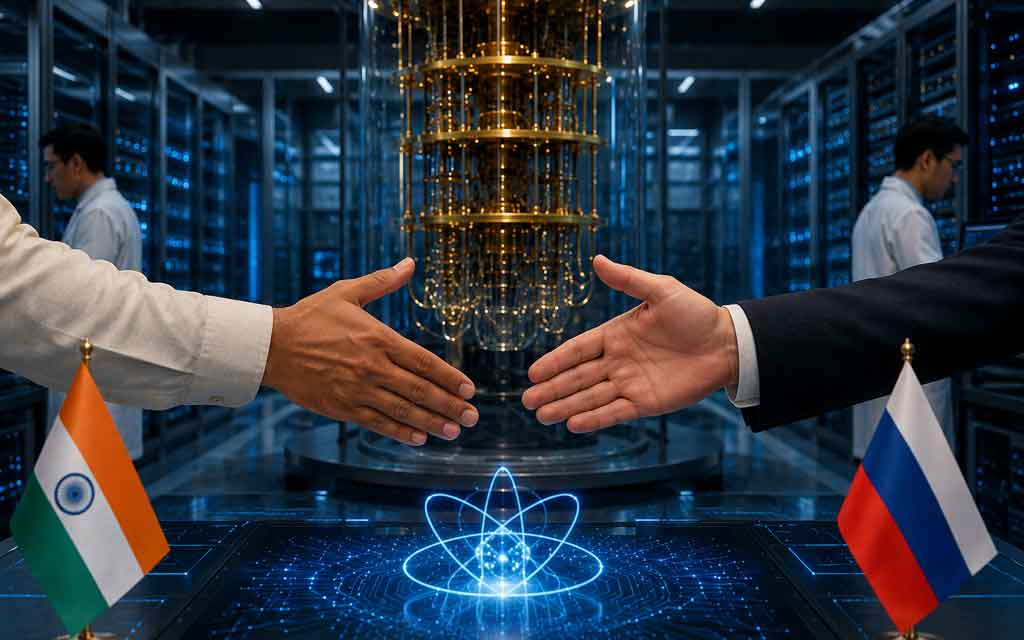
India has proposed a strategic collaboration with Russia in quantum computing to strengthen its National Quantum Mission (NQM) and position itself as a significant player in one of the most transformative technologies of the coming decades. The proposal, announced by Indian Ambassador to Russia Vinay Kumar at the BRICS Quantum Technologies forum in Moscow, underscores growing technology ties within the BRICS grouping and highlights the multipolar nature of the global quantum race.
As the United States and China continue to lead in quantum investment and breakthroughs, India’s move to partner with Russia — a country that already maintains close quantum cooperation with China — could reshape the competitive landscape. With all three nations pursuing ambitious sovereign programs, the world may be heading toward a more distributed quantum ecosystem rather than a strict bipolar contest.
India’s National Quantum Mission: Ambitious Roadmap to 2031
Approved by the Union Cabinet in April 2023, India’s National Quantum Mission is a ₹6,003.65 crore (~$730 million) initiative running from 2023-24 to 2030-31. Overseen by the Department of Science and Technology and the Department of Atomic Energy, the mission aims to build a complete national quantum ecosystem.
Key objectives include:
- Developing intermediate-scale quantum computers with 50 to 1,000 physical qubits across platforms such as superconducting and photonic technologies.
- Establishing satellite-based secure quantum communication networks, including ground stations separated by up to 2,000 km within India and long-distance secure links with other countries.
- Advancing quantum key distribution (QKD), multi-node quantum networks with quantum memories, quantum materials, sensors, and cryptography.
- Creating vibrant research, development, and industrial ecosystems to drive quantum-led economic growth.
India has already made progress through indigenous efforts. Startups like QNu Labs have developed long-range secure quantum communication networks. The mission also supports four technology hubs at premier IITs in Chennai, Mumbai, Delhi, and Bengaluru. These hubs focus on human resource development, researcher training, and international collaboration, including researcher mobility, startup partnerships, and joint innovation projects.
India’s stated goal is to develop domestically produced quantum computers by 2031, targeting high-impact applications such as drug discovery, cybersecurity, artificial intelligence optimization, and climate modeling — areas where quantum systems can deliver exponential advantages over classical computers.
The India-Russia Quantum Proposal
Speaking at the BRICS Quantum Technologies forum, Ambassador Vinay Kumar emphasized India’s openness to international partnerships in advanced computing. He highlighted that the IIT hubs have a clear mandate for global cooperation and that India seeks to take a leadership role through joint research, talent exchange, and innovation partnerships.
The proposal specifically targets quantum computing collaboration to help India meet its NQM milestones. Russia brings established expertise in quantum hardware, particularly in neutral-atom and other platforms, along with a structured national roadmap coordinated by Rosatom.
This outreach fits India’s broader strategy of diversifying technology partnerships while leveraging BRICS platforms for collaboration in emerging technologies.
Russia’s Quantum Capabilities and China Ties
Russia has pursued a sovereign quantum program with clear strategic intent. Public funding for quantum technologies between 2020 and 2024 reached approximately 24 billion rubles (~$311 million), with Rosatom playing a central coordinating role. The country has developed multiple quantum computer prototypes, including a 72-qubit neutral-atom system announced in December 2025 by Moscow State University and the Russian Quantum Centre — marking Russia’s third quantum computer above 70 qubits.
Russia maintains a detailed 2025–2030 Quantum Computing Roadmap focused on moving technologies from laboratory prototypes to industrial applications, beginning with the nuclear energy sector and expanding outward. Facilities such as the Russian Quantum Centre support both hardware development and applied research.
Russia already collaborates closely with China in quantum technologies. In 2023–2024, the two countries successfully tested a quantum communication link spanning 3,800 kilometers using China’s Mozi quantum satellite. This demonstrates practical progress in long-distance quantum-secure communications and reflects deepening technological alignment between Moscow and Beijing.
By engaging with both Russia and potentially leveraging existing Russia-China channels, India could accelerate its own capabilities in hardware, algorithms, and secure communications while contributing Indian strengths in software, applications, and talent development.
The Global Quantum Race: Where Do India, Russia, and BRICS Fit?
The United States and China currently dominate quantum investment and progress. The US leads in several hardware modalities (superconducting, trapped-ion) through companies like Google, IBM, IonQ, and Rigetti, backed by substantial public-private funding. China has made massive state investments and achieved notable milestones in photonic quantum computing, quantum communication networks, and satellite-based QKD.
Russia has established itself among a smaller group of nations with credible sovereign quantum programs (alongside the US, China, Germany, UK, France, and Japan). India, through the NQM, is making a determined entry aimed at building indigenous capacity rather than remaining a technology importer.
The proposed India-Russia collaboration, set against the backdrop of existing Russia-China quantum ties, points toward the emergence of a stronger BRICS quantum bloc. This could complement — and in some areas compete with — Western-led efforts. Quantum technologies carry significant national security implications (cryptography, secure communications, advanced sensing), making technological sovereignty a priority for multiple powers.
At the same time, quantum development remains highly collaborative at the research level. Talent mobility, joint publications, and shared infrastructure have historically accelerated progress across borders. India’s emphasis on international partnerships through its IIT hubs aligns with this reality.
Potential Applications and Economic Impact
Successful quantum computing development could unlock breakthroughs in:
- Drug discovery and materials science — Simulating molecular interactions at unprecedented scale.
- Optimization problems — Logistics, finance, energy grid management, and AI model training.
- Climate modeling — More accurate simulations of complex environmental systems.
- Cybersecurity — Both strengthening encryption (via quantum-resistant algorithms and QKD) and, eventually, challenging current public-key cryptography.
For India, mastering these technologies supports broader goals of self-reliance in critical technologies, job creation in high-skill sectors, and positioning as a global innovation hub. For Russia, deeper ties with India offer access to a large talent pool and growing technology market while advancing its own industrial applications roadmap.
Challenges Ahead
Quantum computing remains technically extremely difficult. Building fault-tolerant, large-scale systems requires major advances in qubit quality, error correction, materials science, and cryogenic or photonic infrastructure. International collaboration can help share risks and expertise but also raises questions around technology transfer, intellectual property, and export controls.
India will need to balance ambitious targets with realistic milestones, continue investing in foundational research and workforce development, and navigate the complex geopolitics of emerging technology partnerships. Russia faces its own constraints, including access to certain advanced components amid international sanctions.
Outlook: A More Multipolar Quantum Future?
The India-Russia quantum proposal is more than a bilateral technology deal — it is a signal that the global quantum landscape is becoming increasingly multipolar. As BRICS nations deepen cooperation in strategic technologies, the dominance of any single bloc may give way to a more distributed ecosystem of capability and innovation.
By 2030–31, if India meets its NQM targets with Russian assistance and continued indigenous efforts, and if Russia advances its own roadmap while maintaining China ties, the combined strength of these three nations could meaningfully influence global standards, applications, and supply chains in quantum technologies.
For observers tracking the future of computing, security, and great-power technological competition, this development deserves close attention. Quantum technologies will not only transform industries but also redefine national power in the digital age.
What are your thoughts on India’s quantum ambitions and this proposed partnership with Russia? Share your perspective in the comments.
Stay updated on breakthrough technologies, global innovation trends, and the future of computing at vfuturemedia.com. Subscribe for more in-depth analysis of emerging tech shaping tomorrow.
Tags: India Russia quantum collaboration, National Quantum Mission India, quantum computing 2026, BRICS quantum technologies, global quantum race, quantum communication, Rosatom quantum, India quantum ambitions




Leave a Comment