

Cognition AI Launches Benchmark to Detect AI’s “Slop Code” – What It Means for Developers
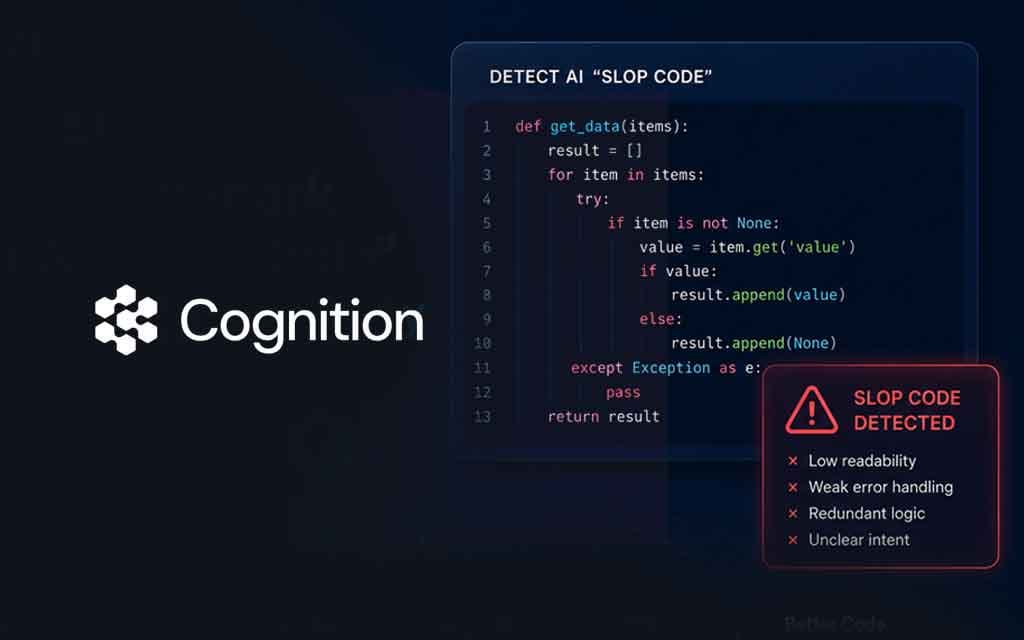
NEXT_PUBLIC_GOOGLE_ADSENSE_ID to enableCognition AI, the company behind the AI software engineer Devin, has launched a new benchmark specifically designed to measure one of the biggest criticisms of AI-generated code: “slop code.”
The term “slop code” refers to code that technically works and passes tests but is poorly structured, hard to read, difficult to maintain, and full of technical debt. While AI coding tools have become incredibly good at producing functional code quickly, many developers complain that the output often lacks quality, clarity, and long-term maintainability.
Cognition AI’s new benchmark aims to change that by creating a standardized way to evaluate not just whether AI can write working code, but whether it can write good code.
What Is “Slop Code”?
“Slop code” has become a popular term in developer communities to describe AI-generated code that:
- Works for the immediate task but uses inefficient or overly complex logic
- Lacks proper structure, modularity, or separation of concerns
- Has minimal or no comments and poor naming conventions
- Creates technical debt that will be expensive to fix later
- Passes unit tests but fails in real-world edge cases or scalability
In short, it’s code that gets the job done today but creates headaches tomorrow.
Many developers using tools like GitHub Copilot, Cursor, or even advanced agents like Devin have encountered this problem. The code looks correct at first glance but becomes a nightmare during code reviews or when the project scales.
Cognition AI’s New Benchmark
Cognition AI’s benchmark goes beyond traditional coding evaluations like HumanEval or SWE-bench. While those tests focus primarily on whether the code solves the problem correctly, the new benchmark adds layers that assess:
- Code maintainability — How easy is it to understand and modify the code later?
- Code quality metrics — Complexity, duplication, adherence to best practices
- Readability and structure — Proper use of design patterns, modularity, and clean architecture
- Long-term robustness — Performance under changing requirements
The goal is to push AI coding systems to produce code that real engineering teams would actually want to work with — not just code that passes automated tests.
This is a significant shift. Until now, most AI coding benchmarks rewarded speed and correctness. Cognition AI is now trying to measure something much harder: quality and maintainability.
Why This Benchmark Matters
The rise of AI coding assistants has been dramatic. Tools can now generate thousands of lines of code in minutes. However, many companies are discovering that the real cost isn’t in writing the code — it’s in maintaining it.
According to industry estimates, 60-80% of software development costs come from maintenance, not initial development. If AI keeps producing “slop code,” it could actually increase long-term costs rather than reduce them.
Cognition AI’s benchmark addresses this by:
- Giving developers and companies a way to evaluate different AI coding tools on maintainability
- Pushing AI labs to optimize for quality, not just speed
- Helping organizations decide which AI tools are truly production-ready
How It Compares to Existing Benchmarks
HumanEval
- Focus: Basic function correctness
- Measures Maintainability: No
- Real-World Relevance: Low
SWE-bench
- Focus: Solving real GitHub issues
- Measures Maintainability: Limited
- Real-World Relevance: Medium
Cognition AI Benchmark
- Focus: Code quality and maintainability
- Measures Maintainability: Yes
- Real-World Relevance: High
This new benchmark is more aligned with what professional software teams actually care about.
What This Means for the Future of AI Coding
Cognition AI’s move signals an important maturation in the AI coding space. The industry is moving from the “can it code?” phase to the “can it code well?” phase.
We can expect to see:
- Other AI companies (OpenAI, Anthropic, Google DeepMind) release their own quality-focused benchmarks
- New metrics around code cleanliness, documentation quality, and architectural soundness
- AI tools that not only write code but also refactor and improve existing codebases
- Greater emphasis on “AI pair programming” rather than “AI code generation”
For developers, this is good news. It means AI tools will likely get better at producing code that senior engineers would actually approve in a code review.
The Bigger Picture
While benchmarks like this are important, they’re only part of the solution. Even the best AI-generated code still requires human oversight, especially for complex systems, security-critical applications, and large-scale architectures.
The most successful teams in 2026 and beyond will likely be those that use AI as a powerful assistant while maintaining strong engineering practices around code quality, testing, and architecture.
Cognition AI’s benchmark is a step toward making AI a true engineering partner rather than just a fast code generator.
Key Takeaways
- Cognition AI launched a new benchmark focused on detecting “slop code”
- The benchmark evaluates maintainability, readability, and long-term code quality
- This addresses one of the biggest criticisms of current AI coding tools
- It signals a shift toward quality-focused AI development benchmarks
- Developers and companies should start evaluating AI tools on maintainability, not just speed
What are your thoughts on “slop code”? Have you encountered AI-generated code that worked but was painful to maintain? Share your experiences in the comments.
For more coverage on AI tools, software engineering trends, and the future of development, subscribe to vfuturemedia.com.
This article is based on Cognition AI’s announcement and industry discussions around AI code quality as of June 2026.
NEXT_PUBLIC_GOOGLE_ADSENSE_ID to enable

