
Published by VFutureMedia | Updated December 3, 2025
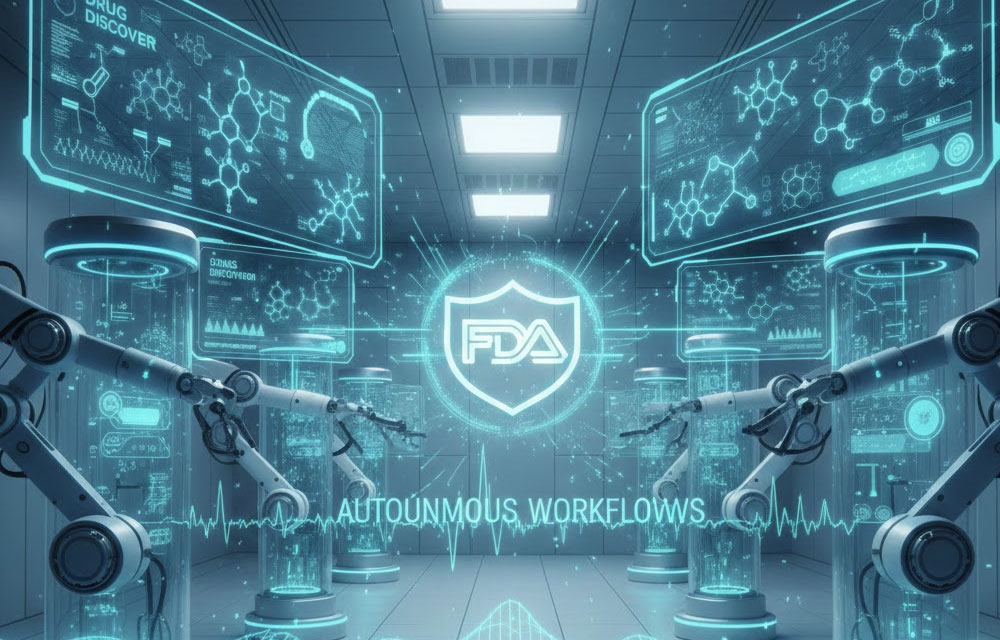
Picture this: It’s a Monday morning at the FDA, and instead of drowning in a sea of paperwork for drug reviews, a reviewer taps into an AI system that doesn’t just answer questions—it anticipates needs, chains together data from multiple sources, and drafts a preliminary safety analysis. All before lunch. Welcome to the era of agentic AI at the U.S. Food and Drug Administration, where cutting-edge tech is turning regulatory drudgery into streamlined efficiency.
On December 1, 2025, the FDA made headlines by rolling out agentic AI capabilities to every one of its 18,000+ employees. This isn’t some basic chatbot upgrade; it’s a leap into autonomous AI agents that plan, reason, and execute multi-step workflows. Think of it as giving your smartest colleague superpowers—without the coffee breaks.
As a tech enthusiast who’s watched AI evolve from hype to hardware-crunching reality, I can’t help but geek out. This move isn’t just about faster approvals; it’s a blueprint for how governments can harness agentic AI in healthcare to keep pace with innovation. Let’s dive into what this means for drug developers, startups, and the future of regulatory tech.
What Exactly Is Agentic AI? A Quick Primer for Tech-Savvy Readers
If you’re knee-deep in LLM architectures or tinkering with multi-agent frameworks like AutoGen, you’ll love this. Traditional AI tools—like the FDA’s earlier Elsa LLM, launched in May 2025 and now used by over 70% of staff—handle single queries with impressive flair. But agentic AI? That’s next-level orchestration.
- Core Mechanics: It chains multiple AI models (e.g., reasoning engines, data retrievers, and decision validators) into autonomous agents. These bad boys break down complex tasks: “Analyze this Phase III trial data, cross-reference adverse events with post-market surveillance, and flag compliance risks.”
- Tech Stack Vibes: Built on secure GovCloud infrastructure, it leverages foundation models fine-tuned for regulatory precision. No training on sensitive industry data—outputs are always human-validated to dodge hallucinations or biases.
- Why “Agentic”? Borrowed from reinforcement learning lingo, it emphasizes agency: the AI doesn’t wait for prompts; it acts with intent, looping back for clarification if needed.
In short, if generative AI is a sketch artist, agentic AI is the full production studio—complete with director’s cuts.
The FDA’s Big Rollout: From Pilot to Agency-Wide Power-Up
Announced via a splashy press release, this deployment builds on Elsa’s success but amps it up for multi-step AI workflows. FDA Commissioner Marty Makary, M.D., M.P.H., didn’t mince words: “There has never been a better moment in agency history to modernize with tools that can radically improve our ability to accelerate more cures and meaningful treatments.”
Key rollout details that have tech Twitter buzzing:
| Feature | Description | Impact on FDA Workflows |
|---|---|---|
| Pre-Market Reviews | AI agents automate data synthesis for INDs and NDAs, spotting patterns in clinical trial results. | Cuts review times by 20–30% for high-volume submissions like oncology drugs. |
| Post-Market Surveillance | Chains pharmacovigilance models to monitor real-world data from FAERS database. | Faster detection of rare side effects, reducing recall risks. |
| Inspections & Compliance | Generates audit trails and simulates inspection scenarios using historical GMP data. | Streamlines field ops for device and biologics teams. |
| Administrative Automation | Handles meeting scheduling, document validation, and resource allocation via integrated APIs. | Frees up 15–20 hours/week per reviewer for high-value analysis. |
Chief AI Officer Jeremy Walsh nailed it: “FDA’s talented reviewers have been creative and proactive in deploying AI capabilities—agentic AI will give them a powerful tool to streamline their work and help them ensure the safety and efficacy of regulated products.”
And the cherry on top? A two-month Agentic AI Challenge kicking off now, where staff pitch custom agents for demo at the January 2026 FDA Scientific Computing Day. Expect wild ideas like AI-driven predictive modeling for supply chain disruptions in vaccine distribution.
Why This Efficiency Boost Feels Like a Game-Changer for Healthcare Tech
Let’s talk real-world wins. The FDA’s drug center has shed over 1,000 staff this year amid budget crunches—yet approval backlogs are shrinking thanks to tools like this. Agentic AI isn’t replacing humans; it’s the ultimate co-pilot, handling the grunt work so experts focus on judgment calls.
- Faster Drug Approvals: Imagine slashing the 10–12 month average for novel therapies. For rare disease drugs or AI-assisted diagnostics, this could mean patients access breakthroughs months earlier.
- Ethical Guardrails Front and Center: Opt-in only, with built-in guidelines for transparency. Every AI output gets a human sign-off—no rogue decisions here. As one X post from a med-tech insider put it: “Humans stay in the driver’s seat. This could reshape how quickly we get new treatments, with oversight and scale.”
- Broader Ripple Effects: Beyond pharma, it’s eyeing food safety inspections and medical device cybersecurity. Tech users, take note: This validates federated learning in regulated environments, where data privacy is non-negotiable.
In a world where AI in drug discovery is exploding (hello, AlphaFold 3 and protein folding sims), the FDA’s embrace signals trust in scalable, secure AI deployment.
The Bigger Picture: Governments Gear Up for an Agentic Future
This isn’t isolated—it’s part of a global sprint. The EU’s EMA is piloting similar autonomous AI agents for EMA workflows, while China’s NMPA experiments with them for TCM approvals. But the FDA’s move? It’s the boldest yet, proving you can infuse AI into bureaucracy without eroding public trust.
For startups in healthcare AI, it’s a neon-green signal: Innovate boldly. Tools that plug into agentic frameworks—like secure APIs for real-time trial monitoring—could fast-track partnerships. Just ensure your stack aligns with FDA’s high-security ethos; think zero-knowledge proofs for data sharing.
Wrapping Up: The Dawn of Smarter Regulation
The FDA’s agentic AI leap on December 1, 2025, isn’t just tech news—it’s a wake-up call for anyone betting on AI-driven healthcare transformation. By chaining models into intelligent workflows, the agency is future-proofing itself against the data deluge of personalized medicine and gene therapies.
As Commissioner Makary said, it’s about accelerating cures. For us tech die-hards, it’s proof that agentic systems can thrive in the high-stakes arena of regulation—human oversight intact, innovation unleashed.
What’s your take? Will this turbocharge the next wave of biotech unicorns, or is it too soon to hand the keys to AI agents? Drop your thoughts in the comments.
Stay wired to the future. Follow VFutureMedia.com for the latest in AI healthcare trends, regulatory tech, and agentic innovations.
Originally published on vfuturemedia
We started VFuture Media because we wanted tech news written by people who actually follow this industry — not content farms chasing keywords. If that resonates, we’d love to have you as a regular reader. Pull up a chair.



Leave a Comment