
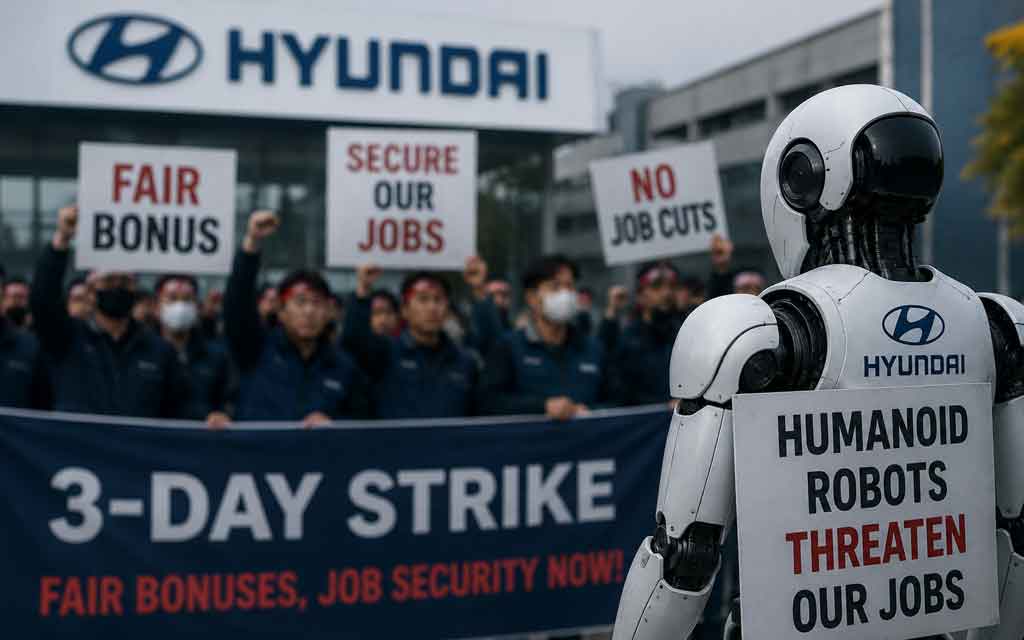
South Korean Hyundai Motor workers have launched a 3-day strike, demanding substantial performance bonuses and stronger job security guarantees as the company accelerates plans to deploy thousands of humanoid robots in its manufacturing facilities.
The Korean Metal Workers’ Union, representing tens of thousands of Hyundai employees, voted overwhelmingly in favor of the action. The strike highlights growing tensions between labor and management over automation in the auto industry, with workers seeking a voice in how humanoid robots — including models from Hyundai subsidiary Boston Dynamics — are introduced.
Strike Details and Union Demands
The union is pushing for:
- A performance bonus equivalent to approximately 30% of Hyundai’s annual net profit — potentially around $27,000 per worker for the company’s roughly 73,000 employees.
- A labor-management agreement giving workers veto power or significant input over automation and robot deployment decisions.
- Stronger protections against job displacement as humanoid robots are rolled out.
Union members have expressed deep concerns about the pace of automation. “We are concerned about job security because of robots,” one member told reporters. News and videos of increasingly dexterous humanoid robots have made workers nervous about their long-term future on the production line.
The strike authorization follows Hyundai’s public roadmap to deploy over 25,000 humanoid robots across its global vehicle manufacturing operations, with initial deployments planned for its Georgia plant in 2028 using Boston Dynamics’ Atlas models.
Hyundai’s Robot Ambitions
Hyundai has been one of the most aggressive automakers in pursuing humanoid robotics:
- Plans to manufacture and deploy tens of thousands of Atlas-style robots.
- Integration of advanced AI and robotics into production lines for tasks ranging from assembly to logistics.
- Vision of robots working alongside humans or eventually handling dangerous, repetitive, or precision tasks.
The company views robotics as essential for maintaining competitiveness, improving safety, and addressing labor shortages. However, the union argues that such a massive technological shift requires negotiated protections for existing workers.
Broader Context: Automation Anxiety in the Auto Industry
Hyundai’s situation reflects a larger trend across the global automotive sector in 2026:
- Major manufacturers are investing heavily in robotics and AI to reduce costs and increase flexibility.
- Labor unions worldwide are pushing back, demanding retraining programs, job guarantees, and profit-sharing from productivity gains.
- The arrival of capable humanoid robots has accelerated these conversations, moving automation fears from theoretical to imminent.
Similar tensions have appeared at other companies, but Hyundai’s high-profile robot plans and strong union have brought the issue into sharp focus.
Potential Impact of the Strike
A 3-day work stoppage at Hyundai could disrupt production and supply chains, particularly given the company’s global scale. Previous Hyundai strikes have cost hundreds of millions in lost output.
For the union, the strike serves as leverage to secure concessions before robot deployment ramps up. For Hyundai, prolonged labor unrest could delay its automation timeline and affect competitiveness against rivals also pursuing robotics.
Both sides have incentives to reach an agreement. The union has successfully avoided full-scale strikes in recent years through late-stage negotiations, but the robot issue has added new urgency.
What This Means for the Future of Work in Manufacturing
The Hyundai strike highlights critical questions about the transition to an automated manufacturing future:
- Job Security vs. Competitiveness — How can companies adopt transformative technologies without sacrificing worker stability?
- Profit Sharing — Should workers receive substantial bonuses when automation drives record profits?
- Retraining and Transition — What role should companies play in preparing employees for a robot-augmented workplace?
- Human-Robot Collaboration — Will robots fully replace workers on lines, or create new hybrid roles?
The outcome at Hyundai could set precedents for other automakers and heavy industries facing similar pressures.
Outlook
As humanoid robots move from research labs to factory floors, labor-management conflicts like this are likely to become more common. Hyundai’s experience will be closely watched by executives, union leaders, policymakers, and technologists worldwide.
The company has signaled willingness to negotiate, but the union’s strong vote for strike action shows workers are prepared to fight for their demands. A resolution that balances innovation with job protections could serve as a model for responsible automation.
In the meantime, the 3-day strike underscores a central tension of the AI and robotics era: technology promises greater efficiency and prosperity, but realizing those gains fairly requires careful negotiation between companies and their workers.
Frequently Asked Questions
Why are Hyundai workers striking? Primarily over demands for a large performance bonus (~$27,000 per worker) and strong job security guarantees before the company deploys thousands of humanoid robots in factories.
When is the strike happening? The union authorized a 3-day strike following an overwhelming vote. Exact start dates depend on mediation outcomes, but the action is imminent as of mid-2026.
What robots is Hyundai planning to use? Boston Dynamics’ Atlas humanoid robots and other advanced systems, with initial deployment at the Georgia plant in 2028 and broader rollout planned.
How many workers are involved? The Korean Metal Workers’ Union represents around 73,000 Hyundai employees. Over 86% voted in favor of strike authorization in recent ballots.
What is the company’s position? Hyundai views robotics as essential for competitiveness, safety, and addressing labor challenges. The company has expressed willingness to negotiate but prioritizes its automation roadmap.
Could this affect car prices or availability? A prolonged strike could disrupt production and supply chains, potentially impacting vehicle availability and costs in affected markets.
Bottom Line Hyundai workers have launched a 3-day strike to secure bonuses and job protections as the company prepares to bring humanoid robots into its factories. The action highlights the growing tension between rapid automation and worker concerns in the auto industry.
As companies like Hyundai push forward with advanced robotics, successful negotiation of these transitions will be critical for maintaining labor peace and ensuring that productivity gains are shared broadly.
For more on AI and robotics in manufacturing, the future of work, and auto industry trends, stay tuned to vfuturemedia.com.




Leave a Comment