
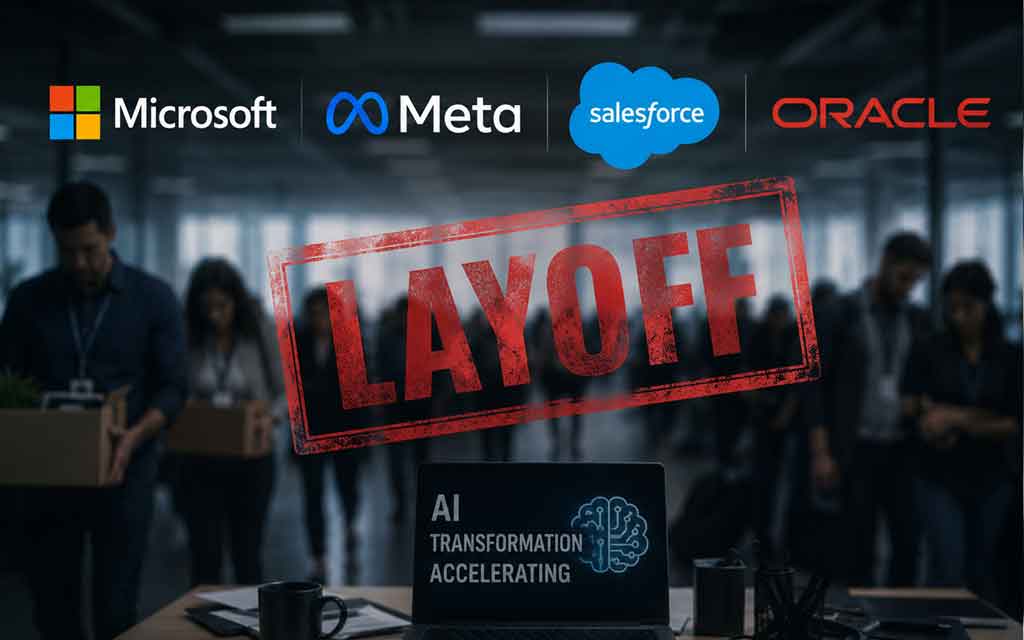
July 2026 opened with another wave of significant job cuts across the software and tech industry. The largest announcement came from Microsoft, which eliminated approximately 4,800 roles (about 2.1% of its global workforce). Other companies including Salesforce and Meta also moved forward with reductions, continuing a year-long trend of AI-driven restructuring and efficiency efforts.
According to trackers such as TrueUp and Layoffs.fyi, 2026 has already seen well over 160,000 tech workers impacted across hundreds of companies. AI and automation remain the most frequently cited reasons, even as companies invest heavily in the technology.
Here’s a detailed look at the major software-related layoffs announced or taking effect in July 2026.
Microsoft: 4,800 Jobs Cut, Xbox Hit Hardest
On July 6, 2026, Microsoft confirmed it had eliminated roughly 4,800 positions. The company stated that the roles “are not being replaced by AI,” but acknowledged that artificial intelligence “is changing how work gets done” and automating many everyday tasks.
Key details:
- Xbox division absorbed the largest share — approximately 3,200 roles are being cut through fiscal year 2027, with about 1,600 people let go on the day of the announcement.
- The cuts form part of Microsoft’s broader company transformation as it pours massive resources into AI infrastructure (part of a multi-year, multi-hundred-billion-dollar push).
- Microsoft has conducted several rounds of layoffs over the past two years while simultaneously expanding its AI capabilities and Azure cloud business.
Xbox chief Asha Sharma publicly addressed the restructuring, noting the need to focus resources. Shortly afterward, she was appointed to a U.S. Federal Reserve task force on productivity and jobs.
These cuts come even as Microsoft continues strong financial performance in cloud and AI services, illustrating the “efficiency paradox” seen across Big Tech: companies grow revenue while reducing headcount.
Salesforce: Targeted Cuts Linked to AI Products
Salesforce carried out a smaller but notable round of layoffs in early July. At least 86 employees in California were affected, with sources indicating additional cuts in Washington state and outside the U.S.
The reductions reportedly touched teams working on:
- Agentforce (Salesforce’s AI agent product)
- Mulesoft (IT integration)
- Marketing Cloud
Salesforce has been aggressively pushing its AI offerings while streamlining other areas. Like many software firms, it is balancing investment in generative and agentic AI with pressure to improve margins and operational efficiency.
Meta: Nearly 5,000 U.S. Layoffs Effective July 22
Meta issued WARN notices covering 4,665 to 4,875 U.S. workers whose positions end on or around July 22, 2026. These cuts stem from the company’s earlier 2026 restructuring (announced in spring), which aimed to eliminate roughly 10% of its global workforce (around 8,000 roles) to free resources for AI priorities.
Affected locations include Menlo Park headquarters and sites in Washington state. The timing has drawn attention because Meta simultaneously filed thousands of H-1B Labor Condition Applications for specialized software engineering roles. While no direct evidence shows H-1B visas replacing laid-off workers, the parallel activity has fueled debate about tech labor practices.
Meta continues to reassign thousands of employees toward AI teams and freeze certain non-AI openings.
Broader Context: Software & Tech Layoffs in 2026
Major Software & Tech Layoffs — July 2026
- Microsoft — 4,800 jobs cut (July 6, 2026)
Reason: AI transformation and Xbox restructuring - Meta — ~4,700–4,900 U.S. jobs (Effective July 22, 2026)
Reason: Earlier AI-focused restructuring - Salesforce — 86+ jobs (California confirmed) (Early July 2026)
Reason: AI product team reorganization and efficiency measures - Oracle — 21,000 cumulative job cuts (Disclosed late June 2026)
Reason: AI infrastructure investment and organizational restructuring - Other Tech Companies (YTD) — 160,000+ total jobs eliminated (Ongoing throughout 2026)
Reason: AI adoption, automation, and cost-control initiatives
YTD picture (as of early July 2026):
- Roughly 160,000–165,000 tech workers impacted.
- AI or automation cited in a majority of major layoff events.
- Software, cloud, gaming, and enterprise software companies have been particularly active.
- Many firms report strong revenue growth while still reducing headcount.
Why Software Companies Are Cutting Jobs Now
Several interconnected factors are driving the July and broader 2026 reductions:
- AI Productivity Gains — Companies report that AI tools allow smaller teams to deliver more. Engineers and knowledge workers are shipping faster, reducing the need for previous headcount levels.
- Massive AI Capital Expenditure — Billions are being redirected from labor budgets into data centers, chips, and AI research (Microsoft, Oracle, Meta, Google, etc.).
- Post-Hiring Boom Rightsizing — Many software firms over-hired during the pandemic and early AI boom and are now optimizing.
- Focus on Core and High-Growth Areas — Non-core teams, middle management, and certain product lines face higher risk, while AI, cloud, and infrastructure roles remain prioritized.
- Economic and Competitive Pressure — Even profitable companies face investor demands for efficiency and higher margins.
Impact on Software Engineers and the Job Market
- Roles most affected: Certain mid-level software engineering positions, product management, support, gaming, and non-AI product teams.
- Roles still in demand: AI/ML engineers, infrastructure specialists, security experts, AI evaluation and safety roles, and cloud architects.
- Geographic impact: U.S. tech hubs (Bay Area, Seattle, etc.) continue to see the highest volumes.
- Career advice emerging: Upskilling in AI tools, agentic systems, and domain expertise is becoming essential for resilience.
Many laid-off workers are finding new opportunities relatively quickly in AI-related companies or startups, though competition remains intense.
Outlook for the Rest of 2026
Analysts expect continued selective restructuring rather than a full industry-wide collapse. Companies that successfully integrate AI into their workflows while maintaining strong product roadmaps are likely to stabilize headcount. Others may announce further targeted cuts later in the year.
Key trends to watch:
- Whether AI-driven productivity fully offsets further headcount reductions.
- Growth in specialized AI safety, evaluation, and governance roles.
- Regulatory and public scrutiny of H-1B practices alongside domestic layoffs.
- The health of the broader software job market for mid-level engineers.
Final Takeaway
July 2026 reinforced that the software industry is in a profound transition. Microsoft’s 4,800-job cut, combined with actions at Salesforce, Meta, and earlier moves by Oracle and others, shows that even highly profitable tech giants are aggressively reshaping their workforces around AI.
For software professionals, the message is clear: adaptability, continuous learning in AI-related skills, and the ability to deliver outsized impact with AI tools will define career success in this new era.
The “super builder” age is here — but it is also an age of ongoing workforce realignment.
Frequently Asked Questions
How many jobs did Microsoft cut in July 2026? Approximately 4,800 roles (2.1% of its global workforce), with the Xbox division seeing the largest impact.
Are these layoffs being caused by AI? Companies often say the specific roles are not being directly replaced by AI, but AI is changing how work is done and allowing greater efficiency, which reduces overall headcount needs. Savings are frequently redirected to AI investments.
What about Meta’s July layoffs? Nearly 5,000 U.S. positions are scheduled to end around July 22 as part of Meta’s earlier 2026 restructuring focused on prioritizing AI.
Is the software job market still strong? It remains highly competitive. Demand is strong in specialized AI, cloud, and infrastructure roles, while broader software engineering positions face more pressure.
Where can I track ongoing tech layoffs? Reliable trackers include Layoffs.fyi, TrueUp.io, and Challenger, Gray & Christmas reports.
Tags: July 2026 tech layoffs, Microsoft layoffs 4800, software job cuts, AI driven layoffs, Salesforce Meta layoffs
CTA:
Have you or someone you know been affected by the July software layoffs? What skills do you believe will be most valuable going forward? Share your thoughts in the comments below. Subscribe for ongoing coverage of tech workforce trends and AI impact.




Leave a Comment