
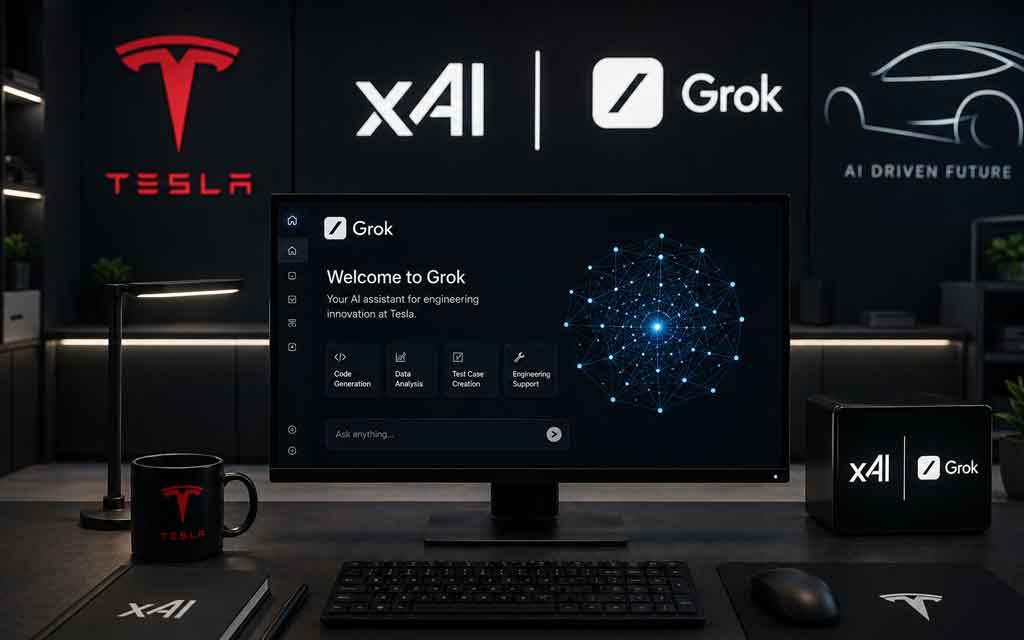
Elon Musk has instructed Tesla employees to transition to using Grok (developed by his AI company xAI) for internal AI-related tasks, according to an internal memo reported by The Information.
The directive comes alongside a new company policy capping employee spending on third-party AI tools at $200 per week, with explicit exceptions for xAI’s Grok and related products. This represents a clear push to integrate xAI technology deeply into Tesla’s operations while controlling external AI costs.
Details of Musk’s Directive
In the memo sent to staff, Musk emphasized Grok 4.5’s significantly lower token costs compared to competing models. He encouraged employees to adopt Grok wherever possible and asked engineers to provide direct feedback on its performance by emailing him.
This move aligns with Musk’s broader strategy of creating synergies across his companies. Tesla, xAI, SpaceX, and X (formerly Twitter) have increasingly shared talent, data, and technology in recent years.
Tesla has already been an early tester for various Grok products, including Grok Build (a developer platform). xAI product lead Andrew Milich has reportedly run feedback sessions with Tesla teams.
Why This Shift Matters
Cost Control The $200 weekly cap on third-party AI tools (such as Anthropic’s Claude, which some Tesla engineers reportedly prefer) is designed to reduce expenses while channeling usage toward Grok. This is part of Tesla’s ongoing efforts to manage AI-related spending amid massive investments in compute infrastructure for Full Self-Driving (FSD), Optimus robots, and other AI initiatives.
Ecosystem Integration By prioritizing Grok, Musk is building a more unified AI stack across his companies. Grok’s real-time knowledge (via X integration) and unique personality could offer advantages for internal Tesla use cases like code generation, data analysis, and engineering workflows.
Productivity Push Musk has long emphasized rapid iteration and high output. Directing staff toward Grok aligns with his vision of “super builders” using AI to dramatically increase productivity, similar to trends reported at other Musk-led companies.
Context: Tesla’s AI Ambitions
Tesla is one of the largest consumers of AI compute in the world due to its ambitious goals:
- Full Self-Driving (FSD) — Training on vast video data from its vehicle fleet.
- Optimus humanoid robots — Requiring advanced multimodal reasoning and control systems.
- Dojo supercomputer — Tesla’s custom AI training infrastructure.
Integrating Grok internally could help Tesla accelerate development while reducing reliance on external AI providers.
Broader Implications for the AI Industry
This directive highlights several emerging trends in 2026:
- Vertical Integration in AI — Tech leaders like Musk are building closed ecosystems where their AI models power their own companies’ operations.
- Cost Discipline Amid AI Boom — Even companies spending billions on AI are looking for ways to control ancillary spending on third-party tools.
- Talent and Tool Preferences — Reports suggest some Tesla engineers prefer Claude for certain tasks. Forcing adoption of Grok could lead to internal friction or productivity trade-offs.
- Competition Among AI Providers — xAI/Grok gaining preferred status at Tesla could pressure other AI companies (OpenAI, Anthropic, Google) in the enterprise space.
Potential Challenges
- Engineer Resistance — If Grok underperforms on specific engineering workflows, productivity could suffer.
- Quality and Security — Internal use of any AI tool requires careful oversight to protect proprietary Tesla data.
- Regulatory Scrutiny — Cross-company integration between Tesla and xAI may attract attention from regulators concerned about conflicts of interest.
Musk’s companies have faced similar issues before, but his track record shows a willingness to push through short-term challenges for long-term strategic alignment.
Outlook: The Musk AI Ecosystem
This move strengthens the interconnected nature of Musk’s empire:
- xAI provides the models (Grok).
- Tesla serves as a major deployment and testing ground.
- X supplies real-time data.
- SpaceX and others may follow similar patterns.
As Grok continues to evolve (with Grok 4.5 already showing strong capabilities), expect deeper integration across Musk’s companies. This could give Tesla a unique AI advantage in autonomous driving, robotics, and energy optimization.
For the broader tech industry, it serves as a case study in how founder-led companies can rapidly redirect internal AI usage to support their preferred platforms.
Frequently Asked Questions
Why is Elon Musk pushing Tesla to use Grok? Primarily for cost savings (lower token prices), strategic alignment across his companies, and to accelerate internal AI-driven development for FSD, Optimus, and other projects.
What is the new spending cap on AI tools? Tesla employees are limited to $200 per week on third-party AI tools, with exceptions for xAI/Grok products.
Have Tesla employees been using other AI tools? Yes. Reports indicate many engineers preferred Anthropic’s Claude for certain tasks before this directive.
How does this affect Tesla’s AI strategy? It deepens integration with xAI, potentially giving Tesla proprietary advantages while controlling external costs.
Is Grok better than other models for Tesla’s needs? Musk clearly believes so, citing lower costs and direct feedback channels. Real-world performance will determine long-term success.
Bottom Line Elon Musk’s directive for Tesla staff to adopt Grok, combined with spending caps on rival tools, marks a significant step toward unifying AI capabilities across his companies. As Grok matures, this internal push could give Tesla a competitive edge in AI-heavy areas while demonstrating Musk’s vision of tightly integrated technology ecosystems.
The move also highlights the growing importance of cost control and platform preference in the 2026 AI landscape.
For more on Elon Musk’s companies, AI integration trends, and the future of autonomous technology, stay tuned to vfuturemedia.com.



Leave a Comment