
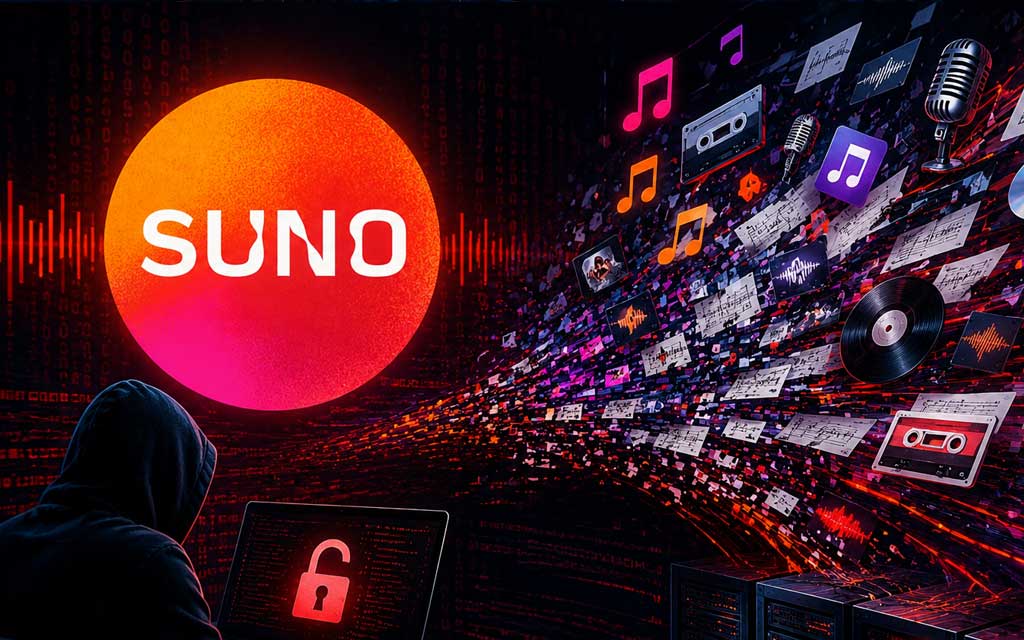
In a major breach that has ignited fresh debates over AI ethics and intellectual property, a hack of Suno — one of the leading AI music generation platforms — has revealed extensive scraping of decades worth of music, lyrics, and podcasts from platforms including YouTube Music, Deezer, Genius, and various stock libraries. The leaked source code and datasets, detailed in a July 15, 2026, report by 404 Media, show Suno pulling millions of audio clips and tens of thousands of hours of content to train its models.
As an American tech reporter at www.vfuturemedia.com focused on AI, EVs, autonomy, and global competition, this story strikes at the heart of U.S. innovation versus creator rights. While Suno represents the exciting potential of generative AI — much like tools transforming filmmaking (as George Lucas recently endorsed) or optimizing vehicle software — the hack underscores ongoing tensions in how American AI companies build their capabilities amid lawsuits from major record labels and growing calls for responsible development.
The Hack: What Was Revealed About Suno’s Training Data
According to the hacker (identified as “ellie.191”), who accessed Suno’s systems via a supply chain attack in late 2025, the leaked materials include source code from 2023–2024 detailing scraping instructions and dataset sizes. Key findings:
- YouTube Music: Over 2 million music clips and approximately 113,879 hours of content. Additional tagged datasets reached 152,162 hours.
- Deezer: Around 12,287 hours of music.
- Genius: 17,615 hours of lyrics and related data.
- Other Sources: Pond5 (62,117 hours), Jamendo, Freesound (410 hours), International Music Score Library Project (IMSLP, 19,514 hours), MuseScore lyrics, and extensive podcast scraping via RSS feeds and tools like PodcastIndex (hundreds of thousands of episodes, aiming for roughly 1 million hours of speech).
The code instructed filters to remove “non-music” content and reportedly used third-party services like Bright Data for scraping. Suno has long acknowledged training on publicly available internet music under fair use arguments, but the hack provides unprecedented transparency into the scale and specific platforms involved.
This comes as Suno faces ongoing lawsuits from the RIAA and major labels (including Warner Music Group), which allege unauthorized use of copyrighted material. The company raised significant funding recently despite these legal battles.
American Perspective: Innovation vs. Intellectual Property in the AI Boom
From a U.S. standpoint, this controversy reflects the double-edged sword of American AI leadership. Companies like Suno, OpenAI, Anthropic, and others are pushing boundaries that could redefine creative industries — similar to how AI is accelerating EV design, battery optimization, and autonomous driving under policies like the Inflation Reduction Act (IRA).
Pros of Generative AI Music:
- Democratizes creation: Anyone can generate tracks, lowering barriers for aspiring artists, advertisers, and game developers.
- Rapid prototyping: Useful for film scoring (tying into George Lucas’s recent pro-AI comments), EV sound design, or personalized in-car entertainment.
- Economic potential: The global AI music market is projected to grow exponentially, creating jobs in prompt engineering, curation, and hybrid human-AI production.
Cons and Creator Concerns:
- Artists and labels argue this constitutes mass copyright infringement, depriving creators of revenue and control.
- The hack also exposed user data vulnerabilities, including customer emails, phone numbers, and payment details — raising privacy issues critical for American consumers.
- It fuels broader debates on fair use in the AI era, potentially influencing U.S. policy and court rulings that could shape everything from music to code and visual media.
This mirrors challenges in other sectors: Just as U.S. automakers navigate supply chain ethics and China’s battery dominance, AI firms must balance rapid scaling with ethical data practices to maintain global trust and leadership.
Ties to Broader AI Landscape: From Music to Mobility and Hollywood
The Suno revelations arrive amid a wave of AI developments we’ve covered at VFutureMedia:
- George Lucas on AI Filmmaking: The Star Wars legend’s call to embrace AI echoes arguments for Suno-like tools in audio post-production.
- Anthropic in India: Localized pricing shows U.S. firms expanding responsibly in emerging markets.
- Apple Intelligence in China: Partnerships with Alibaba and Baidu highlight adaptation to regulations, while Suno faces U.S. legal scrutiny.
- EU Battery Regulation & IRA: Strict standards on data and materials in Europe parallel calls for transparency in AI training datasets.
In the AI-auto-EV convergence, music generation AI has direct applications: Custom soundscapes for autonomous vehicles, voice assistants with natural singing capabilities, or procedural audio for simulations. However, unresolved IP issues could slow adoption if lawsuits escalate.
Legal and Ethical Implications: Fair Use Under Fire
Suno defends its practices by citing fair use, claiming transformative training on public data. Critics, including the RIAA, counter that deliberate scraping (potentially circumventing terms of service) violates the DMCA. The hack strengthens plaintiffs’ cases by providing concrete evidence.
Key Questions for U.S. Policymakers and Courts:
- How should fair use apply to massive-scale AI training?
- What compensation models (e.g., licensing pools) could support creators while enabling innovation?
- How to protect against data breaches that expose both training methods and user info?
This case could set precedents affecting Anthropic, OpenAI, and others, influencing America’s competitive edge against Chinese AI music tools that may operate with fewer constraints.
Impact on Artists, Labels, and the Music Industry
Independent artists have reported discovering their tracks in training data, fueling frustration. Stock libraries and platforms like YouTube (which has its own AI policies) may face increased pressure to tighten scraping defenses.
On the positive side, successful resolution could lead to new revenue streams: Licensing deals for AI training, similar to how some publishers have approached large language models. Hollywood and game studios could benefit from clearer rules for AI-assisted soundtracks.
Technological Context: How Suno Works and Why Data Matters
Suno generates full songs from text prompts, including vocals, instrumentation, and lyrics. High-quality training data enables coherent, genre-diverse outputs. The scraped volumes — equivalent to decades of listening — explain its capabilities but also the controversy.
Future of AI Music:
- Hybrid models: Human-AI collaboration with proper attribution.
- On-device generation for privacy (like Apple Intelligence).
- Blockchain or watermarking for provenance.
For American EV and tech consumers, expect AI-generated music in infotainment systems, podcasts, and virtual experiences.
What Comes Next: Responses and Recommendations
Suno has not yet issued a detailed public response to the hack specifics, but the incident highlights needs for:
- Stronger cybersecurity in AI firms.
- Transparent data practices.
- Industry-wide standards for ethical training.
For Creators: Use tools like AI detectors, watermark content, and advocate for rights. For Companies: Prioritize licensed datasets, opt-in models, or synthetic data. For Policymakers: Update copyright laws for the AI age while preserving U.S. innovation leadership.
This hack serves as a wake-up call similar to earlier AI image generator controversies — progress requires addressing root issues.
SEO Keywords Targeted
Suno AI hack 2026, Suno scraped YouTube Deezer Genius, AI music generator controversy, Suno training data leak, AI music copyright lawsuit, future of AI generated music America.
Conclusion: Balancing Innovation and Integrity in American AI
The Suno hack revealing massive scraping from YouTube, Deezer, Genius, and beyond is a pivotal moment in the AI music wars. It reinforces that while generative tools promise a creative explosion — benefiting filmmaking (per George Lucas), mobility, and beyond — sustainable success demands respect for creators and robust ethics.
America’s edge in AI stems from its entrepreneurial spirit and rule of law. By resolving these challenges thoughtfully — through legislation, licensing, and technology — U.S. companies can lead responsibly, much like IRA incentives build resilient EV supply chains against foreign dominance.
At VFutureMedia, we’ll continue tracking how AI reshapes music, movies, vehicles, and society. The future of sound is being written now — let’s ensure it harmonizes innovation with fairness.
By Ethan Brooks



Leave a Comment