
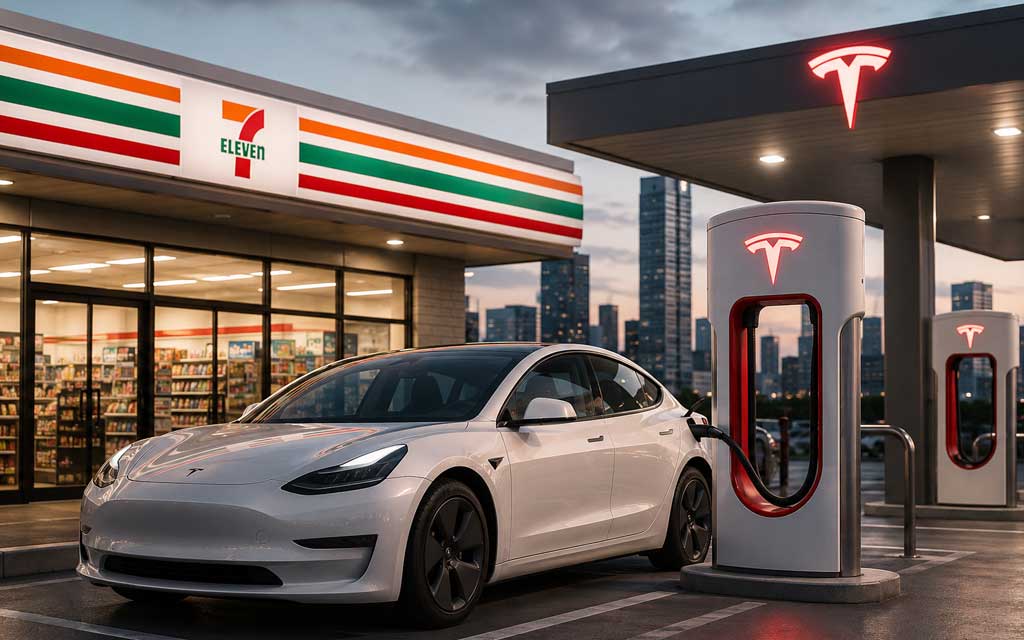
In a strategic move that accelerates Tesla’s expansion in one of the world’s most important automotive markets, Tesla has partnered with 7-Eleven Japan to install high-speed Superchargers at the country’s largest convenience store chain. The partnership launched its first site on July 11, 2026, at a 7-Eleven store in Kawasaki, Kanagawa Prefecture, marking the 150th Supercharger location in Japan.
This development is a significant win for U.S. EV leadership amid intensifying global competition. While China dominates vehicle exports (over 1 million in June 2026) and humanoid robotics, Tesla’s infrastructure play in Japan demonstrates how American innovation in charging networks, software, and energy solutions can open doors even in traditionally hybrid- and hydrogen-focused markets. This ties directly into broader themes of AI-driven autonomy, battery tech under the U.S. Inflation Reduction Act (IRA), and the future of convenient, accessible electrification.
Partnership Details: Superchargers at Konbini Stores
The initial installation at the 7-Eleven Kawasaki Shimokodanaka East Store features four 250 kW Superchargers, enabling rapid charging sessions perfectly timed with quick convenience store stops — a classic Japanese konbini experience.
Key Highlights:
- 7-Eleven Japan plans to roll out Superchargers at approximately 10 additional stores by the end of its fiscal 2026 (February 2027), prioritizing locations with larger parking lots.
- This makes 7-Eleven the second major Japanese convenience chain to partner with Tesla for charging infrastructure.
- The expansion contributes to Tesla’s goal of scaling its Japanese Supercharger network to over 1,000 chargers by 2027, up from around 744 chargers across 150 locations as of mid-2026.
For Japanese drivers, this means convenient, high-speed charging while grabbing onigiri, coffee, or daily essentials — removing one of the biggest barriers to EV ownership: range anxiety and charging inconvenience.
SEO Keywords: Tesla 7-Eleven Japan Superchargers, Tesla Supercharger expansion Japan 2026, Tesla EV charging partnership 7-Eleven.
Why Japan Matters: Strategic Importance for Tesla and U.S. EV Leadership
Japan has been a challenging market for pure battery EVs due to strong hybrid vehicle culture (Toyota dominance), hydrogen initiatives, and dense urban infrastructure. However, Tesla’s persistent investment — including service center expansion and now convenience store charging — is paying off.
This partnership leverages 7-Eleven’s massive footprint: over 21,000 stores across Japan, many in high-traffic urban and suburban areas. It transforms everyday errands into charging opportunities, a model that could inspire similar moves in the U.S. and other markets.
From an American perspective, this is more than retail synergy. It showcases Tesla’s NACS (North American Charging Standard) gaining traction internationally, even as the company faces competition from Chinese EV makers like BYD. Japan’s tech-savvy consumers and rigorous quality standards make it an ideal proving ground for advanced features like AI-optimized charging, vehicle-to-grid capabilities, and seamless app integration.
Broader Implications for Global EV Infrastructure Race
Against Chinese Competition: While China floods global markets with affordable EVs and deploys thousands of humanoid robots in factories, Tesla is building a superior user experience through infrastructure. Superchargers remain the gold standard for reliability, speed, and integration — advantages that complement U.S. strengths in software and AI autonomy.
IRA and U.S. Policy Synergies: Domestic policies like the Inflation Reduction Act are bolstering American battery and EV manufacturing. International wins like this Japan partnership strengthen Tesla’s (and America’s) position in the global supply chain and technology export narrative, countering China’s hardware dominance.
EU Green Deal Context: Europe’s regulatory push for sustainable transport aligns with Japan’s growing EV ambitions. Tesla’s adaptable infrastructure strategy positions it well across regulated markets.
Technological Edge: AI, Autonomy, and Energy Integration
Tesla’s Superchargers are not just plugs — they are part of an intelligent ecosystem:
- AI-Optimized Charging: Predictive algorithms manage load, reduce wait times, and integrate with vehicle software for efficient sessions.
- Future-Proofing: Support for next-gen vehicles, including potential robotaxi integration and energy storage synergies (Megapacks).
- User Experience: App-based navigation, payment, and preconditioning make charging effortless — a stark contrast to fragmented competitor networks.
This infrastructure push supports Tesla’s broader vision of sustainable energy and autonomous mobility. As George Lucas recently urged Hollywood to embrace AI, Tesla is embedding intelligence into every aspect of the EV ownership experience.
Impact on Japanese EV Market and Consumer Behavior
Japan’s EV sales have been growing, but penetration remains lower than in the U.S., Europe, or China. Convenience charging could be a game-changer:
- Encourages impulse adoption among urban drivers.
- Normalizes EVs in daily routines.
- Pressures competitors (Toyota, Honda) to accelerate their own battery EV strategies.
For American observers, this highlights how U.S. companies can export not just vehicles but entire ecosystems — charging, software, and data services — creating recurring revenue and brand loyalty.
Challenges and Opportunities Ahead
Challenges:
- Regulatory hurdles and grid capacity in Japan.
- Competition from local charging providers and hydrogen advocates.
- Broader macroeconomic factors affecting EV demand.
Opportunities:
- Scaling the model to more Asian markets.
- Data collection for improving AI models (real-world charging patterns).
- Cross-promotions with 7-Eleven services, potentially including in-store energy products.
Tesla has also been expanding service centers in Japan, planning to more than double its footprint, showing a comprehensive commitment.
Ties to Larger Tech-Auto Convergence
This news fits seamlessly into the stories we’ve covered at VFutureMedia:
- China’s Humanoid Robots: Factory automation complements Tesla’s own Optimus ambitions and Supercharger reliability.
- Anthropic in India: Localized strategies for high-growth markets.
- Apple Intelligence in China: Pragmatic partnerships in Asia.
- Suno AI and George Lucas: Creative and cultural applications of American AI.
- IBM Stock Lessons: The need for agile adaptation in the AI era — a lesson Tesla exemplifies.
In the EV-AI future, charging infrastructure is the backbone enabling software-defined vehicles, robotaxis, and energy independence.
What This Means for American Investors, Consumers, and Policy
Investors: Positive signal for Tesla’s international growth and recurring energy revenue streams. Infrastructure moats enhance long-term valuation.
Consumers: More proof that EVs are becoming convenient everywhere. U.S. drivers benefit from a stronger global network and technological advancements.
Policymakers: Reinforces the value of supporting U.S. EV tech exports and domestic manufacturing via IRA/CHIPS Act. Friend-shoring and alliances (Japan is a key partner) are critical against concentrated supply chain risks.
Future Outlook: Scaling Convenience Charging Globally
Expect Tesla to replicate this convenience store model elsewhere — think partnerships with major retailers in the U.S., Europe, and Southeast Asia. In Japan, the initial 10+ sites are just the beginning of deeper penetration.
By 2027, Tesla’s Japanese network could exceed 1,000 chargers, significantly boosting sales and market share. This partnership exemplifies how American companies can win through superior execution and customer focus.
Conclusion: Tesla’s Japan Move Strengthens American EV Leadership
The Tesla-7-Eleven Japan Supercharger partnership is a smart, execution-focused step that addresses real consumer pain points while expanding Tesla’s global footprint. In a world where China leads in volume exports and robotics deployment, the U.S. continues to pioneer the infrastructure, software, and user-centric innovations that define the future of mobility.
At VFutureMedia, we see this as another chapter in America’s tech-auto-EV renaissance. From IRA-supported battery factories to AI-enhanced charging networks and autonomous ambitions, U.S. ingenuity remains the driving force.
Whether you’re an investor, EV enthusiast, or policymaker, this development underscores a clear message: Infrastructure wins markets. Tesla is building the network that will power the electrified, intelligent future — one convenient stop at a time.
Stay tuned for more on how these advancements intersect with AI, robotics, and energy solutions shaping our world.

Leave a Comment