The Future of Artificial Intelligence Through 2030
What the data says about AI through 2030: compute and capability trends, agent progress, energy and chip limits, expert forecasts and the risks to watch.
Nobody knows exactly where AI will be in 2030, and anyone who claims certainty is selling something. What we can say is that the measurable trends are steep: training compute has grown about 4x per year [3], the length of software tasks AI agents can complete has doubled roughly every seven months [4], and adoption is spreading faster than the PC or the internet did [1]. Whether those trends continue depends on power, chips, data and money, and on how society chooses to govern the technology.
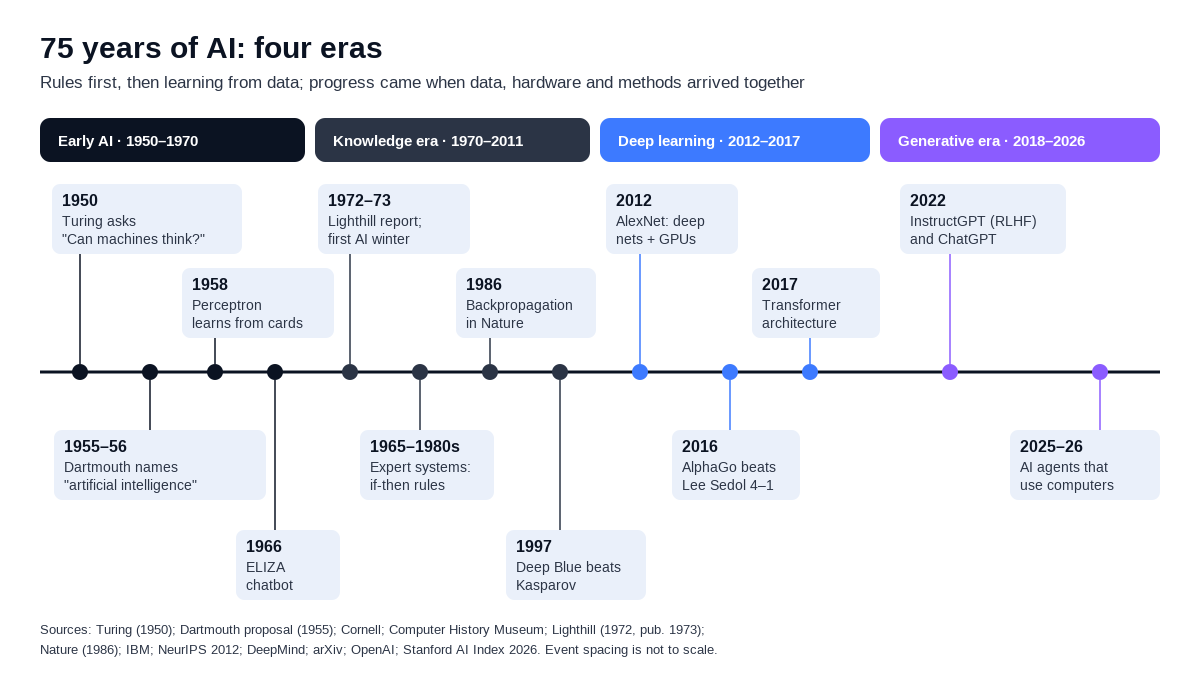
This analysis separates what is measured from what is forecast, and labels every prediction with who is making it. For how we got here, see our history and evolution of artificial intelligence.
Where AI stands at the end of 2026
Stanford's 2026 AI Index, an annual data-driven report on the field, finds that AI capability "is not plateauing" [1]. Key measurements:
- Capability. Several frontier models now meet or exceed human baselines on PhD-level science questions, multimodal reasoning and competition mathematics [1].
- Coding. Performance on the SWE-bench Verified benchmark rose from 60% to near 100% in a single year [1].
- Agents. Task success on OSWorld, which tests agents on real computer tasks, jumped from 12% to about 66%, though agents still fail roughly one in three attempts on structured benchmarks [1].
- Adoption. Organizational adoption of AI reached 88%, and generative AI reached 53% population adoption within three years [1].
- Competition. The U.S.-China performance gap "has effectively closed"; as of March 2026, Anthropic's top model led by just 2.7% [1].
- Investment. U.S. private AI investment reached $285.9 billion in 2025 [1].
The same report describes a "jagged frontier." A model won a gold medal at the International Mathematical Olympiad, yet the best model reads analog clocks correctly only 50.1% of the time [1]. Uneven ability will shape how AI is used through 2030.
The trends that drive forecasts
Compute
Epoch AI estimates training compute for frontier models has grown about 4x per year, faster than the peak growth of mobile phone adoption or solar installation [3]. In a 2024 analysis it concluded that training runs of 2e29 FLOP "will likely be feasible by the end of this decade," enough to exceed GPT-4 in scale "to the same degree that GPT-4 exceeds GPT-2" [3]. Epoch is careful to say that feasible is not the same as certain: whether developers actually spend that much is a separate question [3].
Task length
METR measures AI progress by the length of tasks, in terms of how long they take humans, that AI agents can complete. It found this metric has grown exponentially for six years, doubling about every seven months [4]. METR's extrapolation: "in under a decade, we will see AI agents that can independently complete a large fraction of software tasks that currently take humans days or weeks" [4]. That is a trend projection, not a guarantee. METR's January 2026 methodology update, Time Horizon 1.1, kept the long-run doubling time at about seven months (196 days) but estimated a faster doubling of about 131 days since 2023, and about 89 days since 2024 [8].
Cost
Capability is getting cheaper. The cost of running a system at GPT-3.5's level fell more than 280-fold between November 2022 and October 2024, according to the 2025 AI Index, while hardware costs fell about 30% a year and energy efficiency improved about 40% a year [2]. If similar declines continue, which is our extrapolation rather than a forecast from the Index, today's frontier abilities could be cheap, widely available features by 2030.
What the forecasters say
Forecasts differ sharply depending on who is asked.
Who | Forecast | Source |
|---|---|---|
Dario Amodei, Anthropic CEO | "Powerful AI" could come "as early as 2026, though there are also ways it could take much longer" | Essay, October 2024 [6] |
2,778 published AI researchers | 50% chance machines outperform humans at every possible task by 2047; 10% by 2027 | Survey published 2024 [5] |
Same researchers | At least 50% chance by 2028 of milestones such as AI autonomously building a payment-processing site from scratch | [5] |
Same researchers | 50% chance all human occupations are fully automatable by 2116 | [5] |
METR | Agents completing a large fraction of software tasks that take humans days or weeks "in under a decade" if trends hold | Blog post, March 2025 [4] |
Epoch AI | 2e29 FLOP training runs likely feasible by 2030 | [3] |
Two patterns stand out. In this sample, the lab leader expects faster progress than the broad research community. And researchers expect individual tasks to fall long before whole jobs do: the survey's gap between "every task" (2047) and "all occupations" (2116) is about 70 years [5]. For the debate over human-level AI specifically, see Narrow AI vs General AI vs Superintelligence and our piece on whether AGI is coming soon.
The constraints that could slow things down
Power
Epoch lists electric power first among the constraints on scaling [3]. In the U.S., the Department of Energy reported that data centers used about 4.4% of electricity in 2023 and could reach 6.7% to 12% by 2028, with consumption rising from 176 TWh to between 325 and 580 TWh [7]. Epoch expects power to be the constraint that binds first, followed by chip manufacturing capacity [3], so power may set the pace of AI growth in some regions.
Chips
Leading AI chips depend on a narrow supply chain. The 2026 AI Index notes that TSMC fabricates almost every leading AI chip, though a TSMC U.S. expansion began operations in 2025 [1]. Epoch also names chip manufacturing capacity as a scaling constraint [3]. For how this hardware works, see What Is GPU Computing for AI?.
Data and the "latency wall"
Epoch's other two constraints are data scarcity and a "latency wall," a speed limit set by unavoidable delays in very large training runs [3]. Epoch notes that image and video data, and possibly synthetic data, could ease the first; it puts the latency cap at roughly 3e30 to 1e32 FLOP, beyond its 2e29 FLOP projection for 2030 [3].
Trust and governance
Responsible AI "is not keeping pace with AI capability," the AI Index concludes: reporting on safety benchmarks remains spotty and reported AI incidents rose to 362 in 2025 from 233 in 2024 [1]. Public opinion is also split. In the AI Index survey data, 73% of experts expect AI to improve how people do their jobs, versus 23% of the public, and the U.S. reported the lowest trust among surveyed countries in its own government to regulate AI, at 31% [1]. Regulation could speed adoption by building trust or slow it by adding cost. For the current U.S. approach, see AI Regulation in the United States.
Developments likely by 2030
These are informed expectations based on the trends above, not certainties.
- Agents doing longer tasks. If METR's doubling trend holds, agents will handle progressively longer software tasks, moving toward the days-or-weeks work METR's own extrapolation describes [4][8]. Expect agents to handle more multi-step office work, with humans approving consequential actions. See our guide to the future of autonomous AI agents.
- Cheap capability everywhere. Continued cost declines [2] mean strong models running on phones, laptops and embedded devices, not only in data centers.
- AI in science. The 2026 AI Index added a new chapter on AI's expanding role across biology, chemistry, physics and astronomy [1]. Amodei's essay guesses that powerful AI could give us "the next 50-100 years of biological progress in 5-10 years" [6]; that remains a vision, not a consensus forecast.
- Jagged performance persists. Systems will likely keep surprising us with superhuman skill in some areas and basic failures in others [1], so human oversight remains necessary.
- Infrastructure strain. Data center energy demand will be a central policy issue in the U.S. [7].
- More competition. With U.S. and Chinese models trading the lead [1] and open-weight models closing the gap [2], no single company is likely to dominate every use case.
Three scenarios for 2030
Scenario | What it looks like | Signs it is happening |
|---|---|---|
Acceleration | Compute keeps growing ~4x a year [3]; agents handle multi-day tasks [4]; AI materially speeds science | Benchmarks saturate quickly; agent task lengths keep doubling; large new data centers come online on schedule |
Steady diffusion | Capability gains slow but costs keep falling [2]; value comes from integration into existing work | Adoption deepens [1] while headline benchmarks plateau; spending shifts to deployment |
Constrained | Power, chips or regulation limit scaling [3][7]; incidents erode trust [1] | Grid delays, chip export or supply shocks, high-profile failures, restrictive rules |
Elements of all three can happen at once in different sectors and countries.
How to plan for an uncertain AI future
- Plan for falling costs. A task too expensive to automate today may be cheap in two years [2].
- Build for oversight. Keep humans approving high-stakes actions, because the frontier stays jagged [1].
- Measure, don't assume. Test AI on your own tasks instead of relying on benchmark headlines.
- Watch the leading indicators: agent task length [4][8], inference prices [2], data center power additions [7] and incident reports [1].
- Invest in skills that complement AI, such as judgment, domain expertise and the ability to check AI output.
Frequently asked questions
Will AI reach human-level intelligence by 2030?
Opinions diverge widely. Anthropic's CEO has said powerful AI could arrive as early as 2026 [6], while a survey of 2,778 AI researchers gave only a 10% chance of machines outperforming humans at every task by 2027 and 50% by 2047 [5].
Will AI take most jobs by 2030?
The same researchers expect tasks to be automated long before whole occupations, putting a 50% chance of full automation of all occupations as late as 2116 [5]. Expect task-level change in many jobs rather than wholesale replacement by 2030.
What could stop AI progress?
Epoch AI identifies power availability, chip manufacturing capacity, data scarcity and latency as the main constraints on scaling [3]. Governance choices and public trust could also slow adoption [1].
How fast is AI improving right now?
On many benchmarks, very fast. SWE-bench Verified scores rose from 60% to near 100% in one year, and agent success on OSWorld rose from 12% to about 66% [1].
Will AI get cheaper?
The trend says yes. Running a GPT-3.5-level system became more than 280 times cheaper between late 2022 and late 2024 [2].
Sources
- Stanford HAI, "The 2026 AI Index Report." https://hai.stanford.edu/ai-index/2026-ai-index-report
- Stanford HAI, "The 2025 AI Index Report." https://hai.stanford.edu/ai-index/2025-ai-index-report
- Epoch AI, "Can AI scaling continue through 2030?" (August 2024). https://epoch.ai/blog/can-ai-scaling-continue-through-2030
- METR, "Measuring AI Ability to Complete Long Software Tasks" (March 2025). https://metr.org/blog/2025-03-19-measuring-ai-ability-to-complete-long-tasks/
- Grace et al., "Thousands of AI Authors on the Future of AI," arXiv:2401.02843. https://arxiv.org/abs/2401.02843
- Dario Amodei, "Machines of Loving Grace" (October 2024). https://www.darioamodei.com/essay/machines-of-loving-grace
- U.S. Department of Energy, "DOE Releases New Report Evaluating Increase in Electricity Demand from Data Centers" (December 20, 2024). https://www.energy.gov/articles/doe-releases-new-report-evaluating-increase-electricity-demand-data-centers
- METR, "Time Horizon 1.1" (January 29, 2026). https://metr.org/blog/2026-01-29-time-horizon-1-1/