History and Evolution of Artificial Intelligence
How AI evolved from Turing's 1950 question and the 1956 Dartmouth project through AI winters, expert systems and deep learning to today's frontier models.
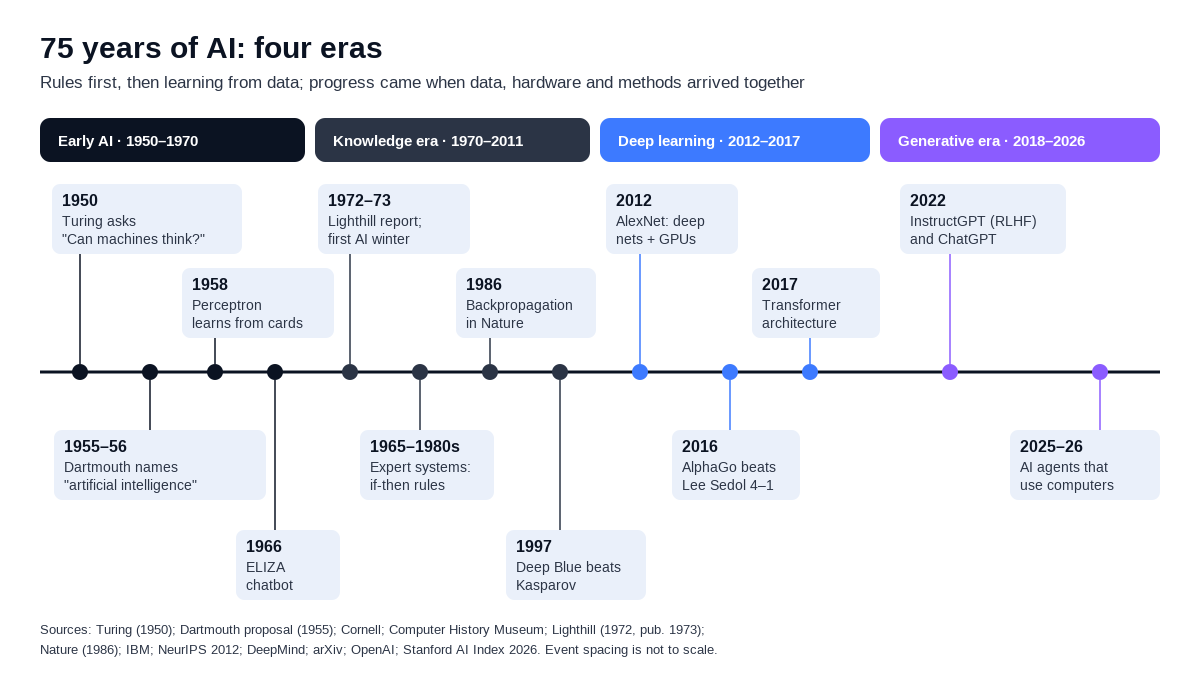
Artificial intelligence began as a 1950s research bet that "every aspect of learning" could be described precisely enough for a machine to simulate it [2]. For four decades the field swung between bold promises and funding winters, mostly building systems from hand-written rules. What changed everything was not one invention but three ingredients arriving together after 2010: much more data, much faster parallel hardware and learning methods that scale. That combination produced deep learning, then the Transformer, then the chatbots and agents of the 2020s.
This guide walks through that evolution era by era and pulls out the lessons that still matter. For what AI is today, start with our complete guide to artificial intelligence.
Before the name: Turing's question (1950)
In 1950 Alan Turing opened a paper in the journal Mind with the line "I propose to consider the question, 'Can machines think?'" [1]. Rather than argue about definitions, he replaced the question with a test he called the "imitation game": could a machine hold up its end of a text conversation well enough that an interrogator could not reliably tell it from a person [1]?
The paper mattered less for the test itself than for its framing. Turing treated intelligence as observable behavior, something you could measure from the outside. That idea still runs through how AI is evaluated today, from benchmarks to chatbot comparisons.
The founding bet: Dartmouth (1955–1956)
The term "artificial intelligence" comes from a funding proposal. On August 31, 1955, John McCarthy, Marvin Minsky, Nathaniel Rochester and Claude Shannon proposed "a 2 month, 10 man study of artificial intelligence" for the summer of 1956 at Dartmouth College [2]. Their working assumption was ambitious:
"every aspect of learning or any other feature of intelligence can in principle be so precisely described that a machine can be made to simulate it" [2].
The proposal listed goals that still read like a modern roadmap: making machines "use language, form abstractions and concepts, solve kinds of problems now reserved for humans, and improve themselves" [2].
Two schools from the start: rules and learning (1956–1970)
Early AI split into two approaches that would trade places for decades.
Symbolic AI wrote knowledge and reasoning steps directly into programs. Joseph Weizenbaum's ELIZA (1966) mimicked a psychotherapist in its best-known mode, DOCTOR, and some users believed they were talking to a person [4]. SRI's Shakey (1970) became the first mobile robot controlled by AI, planning its moves with a problem-solving program called STRIPS [4].
Learning machines tried to get behavior from data instead. In July 1958 the U.S. Office of Naval Research demonstrated Frank Rosenblatt's perceptron: an IBM 704 that, after 50 trials, taught itself to tell punch cards marked on the left from cards marked on the right [3]. Rosenblatt predicted "a machine capable of perceiving, recognizing and identifying its surroundings" [3]. He was right in the long run, but as Cornell later put it, it took half a century to prove [3].
Disappointment and the first AI winter (1970s)
By the early 1970s, results lagged far behind the headlines. In a survey dated July 1972 and published by the UK's Science Research Council early in 1973 [5][15], the mathematician Sir James Lighthill wrote that researchers had entered the field "with high hopes that are very far from having been realised," and that "in no part of the field have the discoveries made so far produced the major impact that was then promised" [5].
He singled out one cause: the "combinatorial explosion" [5]. Methods that worked on toy problems collapsed as the number of possibilities grew. He also pointed to machine translation, where "enormous sums have been spent with very little useful result" [5]. Reports like this fed a period of reduced enthusiasm and funding now known as an AI winter; in the UK, the report "provoked a massive loss of confidence in AI" that lasted almost a decade [15].
The knowledge era: expert systems (1965–1990)
The next wave narrowed the goal. Instead of general intelligence, "expert systems" captured the know-how of specialists in a single domain. Stanford's DENDRAL, begun in 1965, is described by the Computer History Museum as the first expert system: it applied "a battery of 'if-then' rules" to identify the molecular structure of organic compounds [4].
Expert systems worked when the domain was narrow and the rules were stable. They struggled with everything else. Every rule had to be written and maintained by hand, and the systems were brittle when they met cases their authors had not anticipated. That maintenance burden is one reason the field turned back to learning from data.
Learning makes a comeback (1986–2011)
Backpropagation
In 1986, David Rumelhart, Geoffrey Hinton and Ronald Williams published "Learning representations by back-propagating errors" in Nature [6]. Backpropagation gave multi-layer neural networks a practical way to learn their internal weights from examples. Our explainer on neural networks shows how it works.
Search beats a champion
In May 1997, IBM's Deep Blue defeated reigning world chess champion Garry Kasparov in a six-game match under standard tournament controls [7]. Deep Blue did not learn chess the way a person does. It relied on brute force: 32 processors evaluating about 200 million positions per second [7]. The win showed what raw computation could do on a well-defined problem.
Machines that answer questions and drive
In 2005, Stanford's autonomous vehicle "Stanley" won the DARPA Grand Challenge, driving itself over a 175-mile off-road desert course [4]. In 2011, IBM's Watson defeated former Jeopardy! champions Ken Jennings and Brad Rutter in a televised match [4]. Both were milestones in combining many techniques, but neither generalized far beyond its task.
The deep learning breakthrough (2012–2017)
AlexNet: data, GPUs and depth
In 2012, Alex Krizhevsky, Ilya Sutskever and Geoffrey Hinton trained "a large, deep convolutional neural network" on more than a million ImageNet images across 1,000 classes [8]. Their 60-million-parameter network posted error rates "considerably better than the previous state-of-the-art" [8].
AlexNet is the clearest example of the three ingredients coming together: a large labeled dataset, graphics processors repurposed for neural-network math, and a deeper network trained with backpropagation. For how GPUs became AI's workhorse, see What Is GPU Computing for AI?.
AlphaGo
Go had long been considered too complex for brute-force search. In March 2016, DeepMind's AlphaGo beat Lee Sedol, winner of 18 world titles, 4–1 in Seoul, a match watched by more than 200 million people [9]. AlphaGo combined neural networks with reinforcement learning, improving by playing against itself and "learning from its mistakes" [9].
The Transformer
In 2017, a team of Google researchers proposed the Transformer, "a new simple network architecture... based solely on attention mechanisms, dispensing with recurrence and convolutions entirely" [10]. Because it was "more parallelizable," it could be trained faster on modern hardware [10]. The Transformer became the foundation of today's large language models. Our guide to how Transformer models work explains attention step by step.
The generative era (2018–2026)
From big models to useful assistants
Scaling Transformers on internet-scale text produced models that could write fluently, but they did not reliably follow instructions. OpenAI's 2022 InstructGPT work fine-tuned GPT-3 on human-written demonstrations, then used rankings of model outputs in "reinforcement learning from human feedback" [11]. In human evaluations, outputs from a 1.3-billion-parameter InstructGPT model were preferred to those from the 175-billion-parameter GPT-3 [11]. Alignment, not just size, made models useful.
On November 30, 2022, OpenAI released ChatGPT as a free research preview, a sibling of InstructGPT trained to interact "in a conversational way" [12]. It put a large language model in front of the general public. Our complete technical guide to ChatGPT covers how it works under the hood.
Cheaper, faster, everywhere
Progress since then has been fast. Stanford's AI Index found that the cost of running a system at GPT-3.5's level dropped more than 280-fold between November 2022 and October 2024, and that 78% of organizations reported using AI in 2024, up from 55% the year before [13].
The 2026 edition reports that industry produced more than 90% of notable frontier models in 2025, that performance on the SWE-bench Verified coding benchmark rose from 60% to near 100% in a single year, and that generative AI reached 53% population adoption within three years, faster than the PC or the internet [14]. AI agents that operate computers improved from 12% to about 66% task success on the OSWorld benchmark [14].
A jagged frontier
The same report captures a pattern seen throughout AI history. A model earned a gold medal at the International Mathematical Olympiad, yet the top model reads analog clocks correctly only 50.1% of the time [14]. Documented AI incidents rose to 362 in 2025, up from 233 in 2024 [14].
Timeline at a glance
Year | Milestone | Why it mattered |
|---|---|---|
1950 | Turing's "Computing Machinery and Intelligence" [1] | Framed machine intelligence as testable behavior |
1955–56 | Dartmouth proposal and summer study [2] | Named the field and set its agenda |
1958 | Rosenblatt's perceptron demonstrated [3] | Early proof that machines can learn from examples |
1965 | DENDRAL begins [4] | First expert system; knowledge as if-then rules |
1966 | ELIZA [4] | Showed how easily people attribute understanding to software |
1972–73 | Lighthill report [5][15] | Diagnosed the combinatorial explosion; fed the first AI winter |
1986 | Backpropagation paper [6] | Practical training for multi-layer neural networks |
1997 | Deep Blue beats Kasparov [7] | Brute-force search wins at chess |
2012 | AlexNet [8] | Deep learning plus GPUs leaps ahead in vision |
2016 | AlphaGo beats Lee Sedol [9] | Learning plus search conquers Go |
2017 | Transformer [10] | Architecture behind modern language models |
2022 | InstructGPT and ChatGPT [11][12] | Human feedback makes models useful; AI goes mainstream |
2025–26 | Computer-use agents, near-saturated coding benchmarks [14] | AI moves from answering to acting |
Five lessons from 75 years of AI
- Hype cycles are the norm. Lighthill's critique of "inflated predictions" [5] could describe several later moments. Treat confident timelines with caution, including today's.
- General methods that scale tend to win. Hand-coded rules (expert systems) gave way to learning from data once data and compute became abundant [4][8].
- Hardware shapes the field. Deep Blue's 32 parallel processors [7] and AlexNet's GPUs [8] each opened doors that algorithms alone could not.
- Benchmarks get beaten; real-world reliability lags. The jagged frontier [14] is the modern form of an old gap between demos and dependable systems.
- Usefulness needs alignment. InstructGPT showed that training a model to follow intent can matter more than raw scale [11].
What comes next
Where AI goes from here is contested, and forecasts differ widely. We weigh those forecasts in The Future of Artificial Intelligence Through 2030, and the debate over human-level AI in our piece on whether AGI is coming soon.
Frequently asked questions
Who invented artificial intelligence?
No single person. Alan Turing posed the core question in 1950 [1], and John McCarthy, Marvin Minsky, Nathaniel Rochester and Claude Shannon coined the term in their 1955 Dartmouth proposal [2]. Many researchers built the field from there.
When did AI start?
Most histories date the field to the 1956 Dartmouth summer study, proposed in 1955 [2]. Turing's 1950 paper is the key intellectual precursor [1].
What was the AI winter?
It describes periods when results fell short of promises and enthusiasm and funding dropped. The Lighthill report for the UK Science Research Council (written in 1972, published in 1973) is the best-known critique from the first such period; it blamed the "combinatorial explosion" and inflated predictions [5].
Why did deep learning take off in 2012?
Large labeled datasets, GPUs fast enough to train big networks and better training practice arrived together. AlexNet's results on ImageNet made the gap obvious [8].
Is ChatGPT the first chatbot?
No. ELIZA dates to 1966 [4]. ChatGPT, released in 2022, was different because it ran on a large language model trained with human feedback [11][12].
Is AI still getting better?
By most measured benchmarks, yes. Stanford's 2026 AI Index reports rapid gains in coding and computer-use tasks, alongside persistent weaknesses on some simple tasks [14].
Sources
- A. M. Turing, "Computing Machinery and Intelligence," Mind 59, no. 236 (October 1950): 433–460. https://courses.cs.umbc.edu/471/papers/turing.pdf
- McCarthy, Minsky, Rochester and Shannon, "A Proposal for the Dartmouth Summer Research Project on Artificial Intelligence" (1955). http://jmc.stanford.edu/articles/dartmouth/dartmouth.pdf
- Cornell Chronicle, "Professor's perceptron paved the way for AI – 60 years too soon" (2019). https://news.cornell.edu/stories/2019/09/professors-perceptron-paved-way-ai-60-years-too-soon
- Computer History Museum, "Timeline of Computer History: AI & Robotics." https://www.computerhistory.org/timeline/ai-robotics/
- Sir James Lighthill, "Artificial Intelligence: A General Survey" (dated July 1972; published 1973). https://www.aiai.ed.ac.uk/events/lighthill1973/lighthill.pdf
- Rumelhart, Hinton and Williams, "Learning representations by back-propagating errors," Nature 323 (1986). https://www.nature.com/articles/323533a0
- IBM Heritage, "Deep Blue." https://www.ibm.com/history/deep-blue
- Krizhevsky, Sutskever and Hinton, "ImageNet Classification with Deep Convolutional Neural Networks," NeurIPS 2012. https://papers.nips.cc/paper_files/paper/2012/hash/c399862d3b9d6b76c8436e924a68c45b-Abstract.html
- Google DeepMind, "AlphaGo." https://deepmind.google/research/breakthroughs/alphago/
- Vaswani et al., "Attention Is All You Need," arXiv:1706.03762. https://arxiv.org/abs/1706.03762
- Ouyang et al., "Training language models to follow instructions with human feedback," arXiv:2203.02155. https://arxiv.org/abs/2203.02155
- OpenAI, "Introducing ChatGPT" (November 30, 2022). https://openai.com/index/chatgpt/
- Stanford HAI, "The 2025 AI Index Report." https://hai.stanford.edu/ai-index/2025-ai-index-report
- Stanford HAI, "The 2026 AI Index Report." https://hai.stanford.edu/ai-index/2026-ai-index-report
- Chilton Computing, "Lighthill Report: Overview." http://www.chilton-computing.org.uk/inf/literature/reports/lighthill_report/overview.htm