What Is Artificial Intelligence? Complete Guide
What artificial intelligence is, how machine learning and deep learning fit in, where AI is used today, its real risks, and how US and EU rules treat it.
Artificial intelligence (AI) is software that takes in data and works out for itself how to produce useful outputs, such as predictions, recommendations, generated text or images, or decisions. Unlike a conventional program, where a developer writes every rule, most modern AI learns its behavior from examples. That is why the same basic technology can filter spam, transcribe speech, spot tumors in scans and hold a conversation.
A working definition
There is no single legal definition, but the one most governments now borrow comes from the OECD. In its version updated in late 2023, an AI system is "a machine-based system that, for explicit or implicit objectives, infers, from the input it receives, how to generate outputs such as predictions, content, recommendations, or decisions that can influence physical or virtual environments" [1]. The OECD adds that "different AI systems vary in their levels of autonomy and adaptiveness after deployment" [1].
The US National Institute of Standards and Technology (NIST) uses a closely adapted wording in its AI Risk Management Framework, describing an AI system as "an engineered or machine-based system" that generates outputs "influencing real or virtual environments" [2].
Two words in those definitions do most of the work:
- Infer. The system is not looking up a stored answer. It derives an output from patterns it has learned.
- Objectives. The goal can be explicit, such as "flag fraudulent transactions," or implicit, absorbed during training, as with a chatbot whose aims are learned partly from human-written text and feedback [1]. Either way, the system works out how to meet it.
Where the idea came from
The term "artificial intelligence" was coined in a 1955 research proposal by John McCarthy, Marvin Minsky, Nathaniel Rochester and Claude Shannon. They proposed a summer study at Dartmouth College in 1956 "on the basis of the conjecture that every aspect of learning or any other feature of intelligence can in principle be so precisely described that a machine can be made to simulate it" [4]. Their wish list included making machines "use language, form abstractions and concepts, solve kinds of problems now reserved for humans, and improve themselves" [4].
Seventy years on, that list still reads like a description of current research. What changed is the method. Early AI relied heavily on hand-written logic and rules. Today's systems are dominated by machine learning, which became practical at scale once large datasets and fast parallel hardware were widely available.
How AI works: rules, learning and deep learning
It helps to think of AI as nested circles.
AI is the outer circle: any machine-based system that infers outputs toward an objective.
Machine learning (ML) sits inside it. Google's developer course defines ML as "the process of training a piece of software, called a model, to make useful predictions or generate content" [5]. Instead of writing rules, engineers feed the model examples and adjust its internal numbers (parameters) until its outputs match the examples well.
Deep learning sits inside ML. It uses neural networks with many layers, loosely inspired by neurons, where each layer transforms the data into a slightly more useful representation. Image recognition, speech recognition and modern language models all rely on deep learning.
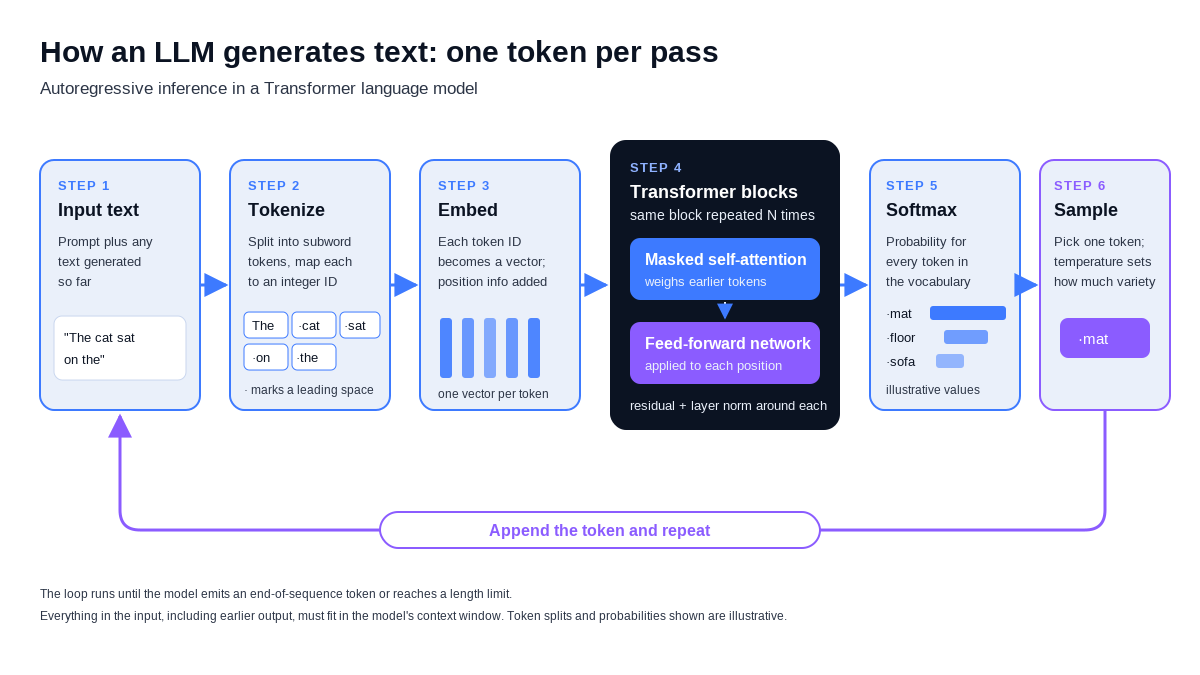
Generative AI is a branch of deep learning that produces new content. A major turning point was the Transformer architecture, introduced in 2017 in the paper "Attention Is All You Need," which dropped older recurrent designs in favor of a mechanism called attention and proved much faster to train [6]. Transformers now underpin most large language models. Our explainers on generative AI and on how large language models work go deeper.
The main ways a model learns
Google's course groups ML systems into four broad types [5]:
Learning style | What the model gets | Typical use |
|---|---|---|
Supervised learning | Examples paired with the correct answer | Spam filtering, credit risk scoring, medical image classification |
Unsupervised learning | Data with no answers; it finds groupings or patterns | Customer segmentation, anomaly detection |
Reinforcement learning | Rewards or penalties for its actions | Game-playing, robotics control, tuning chatbot behavior |
Generative AI | Large amounts of example content | Writing, image, audio and video generation |
In practice, large systems mix these. A chatbot is typically pretrained on a vast text corpus, then refined with human examples and feedback.
Training versus inference
Every AI system has two phases. Training is the expensive, one-time (or periodic) process of learning parameters from data. Inference is what happens each time you use the trained model: data goes in, an output comes out. When you ask a chatbot a question, you are running inference. The cost of inference has fallen steeply. Stanford's 2025 AI Index found that the price of querying a model performing at the level of GPT-3.5 dropped more than 280-fold between November 2022 and October 2024 [7].
Types of AI
People slice AI into "types" in two different ways, which causes confusion.
By capability:
- Narrow AI does one kind of task, such as translating text or recommending videos. By the usual definition, every AI system in use today is narrow in this sense, even very general-seeming chatbots, because none matches human competence across the board.
- Artificial general intelligence (AGI) would match or exceed humans across most cognitive tasks. It does not exist yet, and researchers disagree sharply about when, or whether, it will. We cover that debate in What Is AGI?
- Superintelligence is a hypothetical system far beyond human ability in nearly every domain.
By function:
- Predictive AI scores or classifies: is this transaction fraud, will this part fail.
- Generative AI creates content: text, code, images, audio, video.
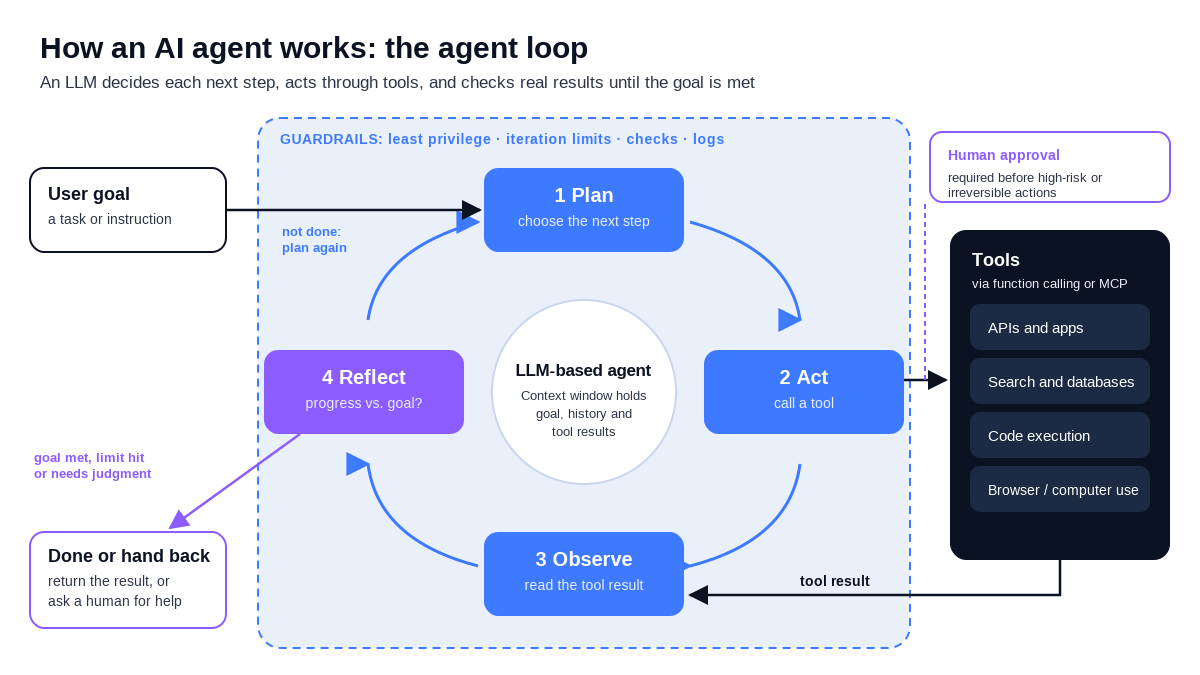
- Agentic AI takes actions toward a goal, calling tools and software on its own. Anthropic, for example, distinguishes fixed "workflows" from "agents" in which models "dynamically direct their own processes and tool usage" [12]. Our guides to agentic AI and to AI agents versus AI assistants explain the difference.
Where AI is used today
Some documented examples, with figures from Stanford's AI Index:
- Healthcare. The US Food and Drug Administration approved 223 AI-enabled medical devices in 2023, up from six in 2015 [7]. The 2026 Index reports physicians using AI note-taking tools spent up to 83% less time writing notes, while cautioning that only 5% of reviewed clinical AI studies used real clinical data [8].
- Transportation. Waymo was providing more than 150,000 autonomous rides each week, according to the 2025 Index [7].
- Business. 78% of organizations surveyed reported using AI in 2024, up from 55% a year earlier [7].
- Software and IT. AI coding and operations tools are now routine. AI agents' success rate on the Terminal-Bench benchmark of real-world computer tasks rose to 77.3%, according to the 2026 Index [8].
- Security. Defenders use ML to flag anomalies and triage alerts, while attackers use the same tools. See AI in cybersecurity.
- Workplace computing. AI is being built into virtual desktops and enterprise IT, covered in AI in VDI.
Benefits
- Scale. A trained model can review millions of records or images at a cost no human team could match.
- Pattern-finding. ML picks up statistical signals that rules-based systems miss, which is why it works well for fraud detection and image analysis.
- Natural-language interfaces. Generative AI lets non-programmers query data, draft documents and write simple code in plain English.
- Falling cost. Cheaper inference and hardware make it practical to embed AI in more products [7].
Limitations and risks
NIST's AI Risk Management Framework lists the qualities of trustworthy AI: "valid and reliable, safe, secure and resilient, accountable and transparent, explainable and interpretable, privacy-enhanced, and fair with harmful bias managed" [2]. Each is a place where real systems fall short.
- Errors stated with confidence. Generative models can produce "confidently stated but erroneous or false content," which NIST calls confabulation and most people call hallucination [11].
- Bias. Models learn from historical data and can amplify the biases in it [11].
- Opacity. Deep networks are hard to explain, which matters when AI influences lending, hiring or medical decisions.
- Privacy and security. Training data can leak, and AI systems introduce new attack routes [11].
- Over-reliance. NIST warns about automation bias and people trusting AI output more than they should [11].
- Environmental cost. Large data centers consume significant power. The 2026 AI Index puts AI data center power capacity at 29.6 GW [8].
- Weak transparency. The 2026 Index found the average score on the Foundation Model Transparency Index fell from 58 to 40 [8].
How AI is regulated (as of November 2026)
United States. There is no single federal AI law. The main federal reference for organizations is NIST's voluntary AI Risk Management Framework, released January 26, 2023, built around four functions: Govern, Map, Measure and Manage [2][3]. NIST published a companion Generative AI Profile on July 26, 2024 [3], and says the framework is being revised as part of the White House AI Action Plan [3]. That plan, published July 23, 2025, rests on three pillars: accelerating innovation, building American AI infrastructure, and leading in international diplomacy and security [9]. Sector regulators such as the FDA and a growing number of state laws apply on top.
European Union (global note). The EU AI Act entered into force on August 1, 2024 and sorts AI by risk: unacceptable (banned), high, transparency and minimal [10]. Rules for general-purpose AI models applied from August 2, 2025, and most of the Act became applicable on August 2, 2026 [10]. Under the "AI Omnibus" amendments, which entered into force on July 27, 2026, obligations for high-risk uses such as employment and education now apply from December 2, 2027, and for AI embedded in regulated products from August 2, 2028 [10]. US companies selling into Europe need to track these dates.
How to think about AI claims
When a product says it "uses AI," four questions cut through the marketing:
- What is the objective? What output is the system producing, and who decided the goal?
- What was it trained on? Data quality and coverage set the ceiling on performance.
- How is it checked? Look for evaluation on real-world data, not only benchmarks.
- Who is accountable when it is wrong? Good deployments keep a human responsible for consequential decisions.
Outlook
Stanford's 2026 AI Index frames the current moment plainly: capabilities are still accelerating, while the ability to measure and govern them lags [8]. Global corporate AI investment reached $581.7 billion in 2025, according to the Index [8]. Expect the near-term story to focus less on raw model size and more on agents that take actions, cheaper inference, and the rules and evaluation methods needed to trust them. Whether any of this leads to general intelligence remains an open, contested question.
Frequently asked questions
Is AI the same as machine learning?
No. Machine learning is the dominant way of building AI today, but AI is the broader category. Some AI systems, such as older expert systems, follow hand-written rules instead of learned patterns.
Does AI actually understand what it says?
Not in the way people do. Language models learn statistical relationships between words and concepts from huge amounts of text, which lets them produce fluent, often correct answers. They can also state false things with full confidence, which is a sign they are not checking facts the way a person would.
What is the difference between AI and generative AI?
Generative AI is the subset of AI that creates new content, such as text, images or code. Much AI in daily use is predictive instead, for example scoring a loan application or flagging a suspicious login.
Is AGI here yet?
No. Current systems are powerful but narrow in the technical sense: they still fail at tasks humans find simple. The 2026 AI Index notes, for instance, that robots succeed at only 12% of real household tasks [8].
Is AI regulated in the US?
Partly. There is no comprehensive federal AI statute as of November 2026. Organizations rely on NIST's voluntary framework, existing consumer protection, civil rights and sector laws, and a patchwork of state rules.
Sources
- OECD.AI, "Updates to the OECD's definition of an AI system explained." https://oecd.ai/en/wonk/ai-system-definition-update
- NIST, "Artificial Intelligence Risk Management Framework (AI RMF 1.0)," NIST AI 100-1. https://nvlpubs.nist.gov/nistpubs/ai/NIST.AI.100-1.pdf
- NIST, "AI Risk Management Framework." https://www.nist.gov/itl/ai-risk-management-framework
- McCarthy, Minsky, Rochester, Shannon, "A Proposal for the Dartmouth Summer Research Project on Artificial Intelligence" (1955). http://www-formal.stanford.edu/jmc/history/dartmouth/dartmouth.html
- Google for Developers, "What is machine learning?" https://developers.google.com/machine-learning/intro-to-ml/what-is-ml
- Vaswani et al., "Attention Is All You Need," arXiv:1706.03762. https://arxiv.org/abs/1706.03762
- Stanford HAI, "The 2025 AI Index Report." https://hai.stanford.edu/ai-index/2025-ai-index-report
- Stanford HAI, "Inside the AI Index: 12 Takeaways from the 2026 Report." https://hai.stanford.edu/news/inside-the-ai-index-12-takeaways-from-the-2026-report
- The White House, "White House Unveils America's AI Action Plan" (July 23, 2025). https://www.whitehouse.gov/articles/2025/07/white-house-unveils-americas-ai-action-plan/
- European Commission, "AI Act: Regulatory framework for AI." https://digital-strategy.ec.europa.eu/en/policies/regulatory-framework-ai
- NIST, "Generative Artificial Intelligence Profile," NIST AI 600-1. https://nvlpubs.nist.gov/nistpubs/ai/NIST.AI.600-1.pdf
- Anthropic, "Building effective agents." https://www.anthropic.com/engineering/building-effective-agents