

What Is Agentic AI? Complete Guide
Agentic AI explained: how AI agents plan, call tools, observe results and adjust, the key patterns and protocols like MCP, real risks, and when to use one.
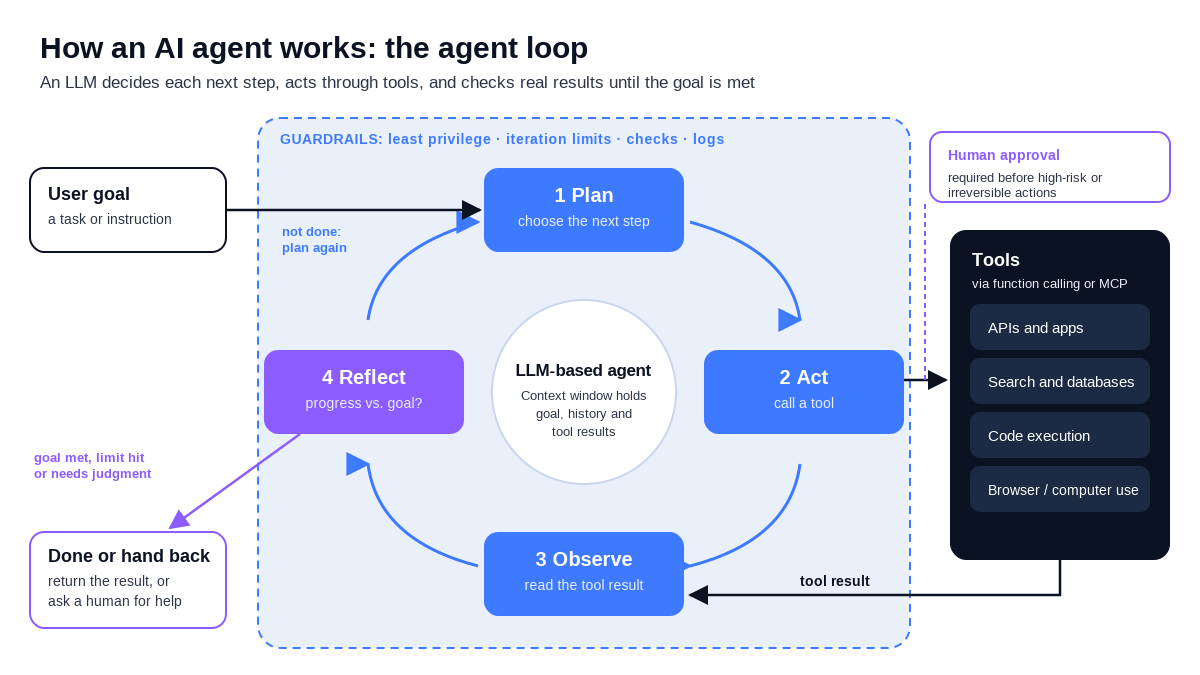
Agentic AI describes AI systems that pursue a goal by deciding their own next steps, using software tools to act, and checking the results, instead of producing a single answer to a single prompt. An AI agent typically runs a loop: plan a step, call a tool, observe what happened, reflect on progress, and repeat until the task is done or it needs a human. The intelligence usually comes from a large language model; the "agentic" part comes from giving it tools, memory and the freedom to choose what to do next.
What makes AI "agentic"
The industry's leading developers define agents in similar terms.
- OpenAI: "Agents are systems that independently accomplish tasks on your behalf" [2]. Its guide stresses that applications which use an LLM but don't let it control workflow execution, such as "simple chatbots, single-turn LLMs, or sentiment classifiers," are not agents [2].
- Anthropic: uses "agentic systems" as an umbrella term and separates two kinds. In workflows, "LLMs and tools are orchestrated through predefined code paths." In agents, "LLMs dynamically direct their own processes and tool usage, maintaining control over how they accomplish tasks" [1].
- Google Cloud: "AI agents are software systems that use AI to pursue goals and complete tasks on behalf of users," showing "reasoning, planning, and memory" and "a level of autonomy to make decisions, learn, and adapt" [4].
The common thread is control over the path. A chatbot answers. A workflow follows a script a developer wrote. An agent decides, step by step, what to do next.
Agency is a spectrum, not a switch. A system that only picks which of two prompts to run is barely agentic. One that browses the web, writes and runs code, and edits files for an hour without supervision is very agentic. Anthropic's advice is to move along that spectrum only when it pays off: "finding the simplest solution possible, and only increasing complexity when needed" [1].
How AI agents work: the agent loop
The diagram shows the loop at the heart of most agents. Here is what each stage does.
1. Goal
A person, or another system, gives the agent an objective: "Find why last night's deployment failed and propose a fix," or "Reconcile these invoices against the purchase orders." Anthropic notes agents begin "with either a command from, or interactive discussion with, the human user" [1].
2. Plan
The LLM reasons about the goal and picks the next step. It may write out a plan, break the task into parts, or simply choose one tool call. The 2022 ReAct paper showed the value of interleaving "reasoning traces and task-specific actions," where reasoning helps the model "induce, track, and update action plans" and actions let it gather new information [3].
3. Act with tools
The agent acts through tools: functions the application exposes, such as search, a database query, sending an email, running code or controlling a browser. In Anthropic's API, the model returns a structured tool_use request and stops; the application executes it and returns a tool_result [5]. OpenAI's guide lists tools as one of three core agent components, alongside the model and instructions [2]. Some tools go further: Anthropic's "computer use," introduced in October 2024, lets a model operate a desktop by "looking at a screen, moving a cursor, clicking buttons, and typing text" [8].
4. Observe
The tool result goes back into the model's context. This is the agent's contact with reality. Anthropic stresses that agents must gain "ground truth" from the environment at each step, such as tool results or code execution, to assess progress [1].
5. Reflect
The model compares what happened with the goal. Did the test pass? Did the search return what was needed? If not, it revises the plan. OpenAI describes an agent that "recognizes when a workflow is complete and can proactively correct its actions if needed" [2].
6. Repeat, finish or hand back
The loop continues until the goal is met, a stopping condition triggers (Anthropic suggests limits such as "a maximum number of iterations" [1]), or the agent needs a person. OpenAI recommends returning control to a human when the agent exceeds failure thresholds or before high-risk actions that are "sensitive, irreversible, or have high stakes" [2].
The building blocks
Component | What it does | Example |
|---|---|---|
Model | Reasons, plans and decides on the next action [2] | A frontier LLM, often with a "thinking" mode |
Instructions | Define the role, rules and guardrails [2] | System prompt describing the job and limits |
Tools | Let the agent read data and take actions [2][5] | APIs, search, code execution, browser control |
Memory and context | Hold the task state and history [1][4] | The context window, plus files or databases for long tasks |
Orchestration | Runs the loop, enforces limits, routes to humans | Application code or an agent framework |
Guardrails | Filter inputs, outputs and risky actions [2] | PII filters, tool-approval rules, output validation |
Memory deserves a note. An LLM only "remembers" what is in its context window, which Anthropic calls the model's "working memory" [11]. Long-running agents fill that window quickly with tool results, and Anthropic warns that recall degrades as token count grows, a problem it calls context rot [11]. Production agents therefore summarize, trim or store state outside the model.
Common patterns: from workflows to agents
Anthropic's widely cited guide describes five workflow patterns that sit between a single prompt and a fully autonomous agent [1]:
- Prompt chaining: split a task into fixed sequential steps, with checks in between.
- Routing: classify an input and send it to a specialized prompt or model.
- Parallelization: run subtasks at once, or run the same task several times and vote.
- Orchestrator-workers: a central LLM breaks down the task and delegates to worker LLMs.
- Evaluator-optimizer: one model drafts, another critiques, in a loop.
Single agent vs multi-agent. OpenAI recommends to "maximize a single agent's capabilities first" before splitting work across several agents [2]. When multiple agents are warranted, it describes two patterns: a manager agent that calls specialists as tools, and a decentralized setup where agents hand tasks to one another [2].
The protocols connecting agents
Two open protocols are shaping how agents plug into software and into each other.
- Model Context Protocol (MCP). An open protocol for connecting LLM applications to "external data sources and tools" [6]. It uses JSON-RPC 2.0 messages between hosts (the AI application), clients and servers. Servers can expose resources (data), prompts (templates) and tools (functions the model can execute) [6]. Among its key security principles, the specification says that "tools represent arbitrary code execution and must be treated with appropriate caution," and that hosts "must obtain explicit user consent before invoking any tool" [6].
- Agent2Agent (A2A). Announced by Google in April 2025 as a protocol that "complements" MCP: MCP connects an agent to tools and context, while A2A lets agents discover each other through an "Agent Card," hand off tasks and exchange results [7].
Where agentic AI is used
Documented uses cluster in areas with clear tools and checkable outcomes:
- Software engineering: agents that read code, run tests and propose fixes. Anthropic describes building a coding agent for the SWE-bench benchmark, where the model made mistakes with tools that used relative file paths until the tool was changed to require absolute paths [1].
- IT and terminal work: Stanford's 2026 AI Index reports that agents' success rate on Terminal-Bench, a benchmark of real-world computer tasks, rose from 20% to 77.3% [12].
- Cybersecurity: the same report says agents solved 93% of cybersecurity problems in its tracked benchmark, up from 15% in 2024 [12].
- Customer service and back-office operations: OpenAI points to workflows involving complex decision-making, hard-to-maintain rules, or heavy reliance on unstructured data as the best candidates [2].
- Enterprise software: vendors are embedding agents into SaaS and productivity suites. We track this in AI in SaaS 2026 and Microsoft Copilot's agentic updates.
Benchmarks are not deployments. The same AI Index notes robots succeed at only 12% of real household tasks [12], a reminder that progress is uneven.
Benefits
- Handles open-ended tasks. Agents suit problems "where it's difficult or impossible to predict the required number of steps" [1].
- Uses existing software. Through APIs and computer use, agents can work with systems that were never built for AI.
- Self-correction. Observing real results lets an agent catch and fix its own mistakes in a way a one-shot answer cannot [1][3].
- Automates what rules couldn't. OpenAI suggests prioritizing "workflows that have previously resisted automation" [2].
Risks and limitations
Giving a model the ability to act turns wrong answers into wrong actions. The main risks:
- Compounding errors and cost. Anthropic warns that agent autonomy means "higher costs, and the potential for compounding errors," and recommends "extensive testing in sandboxed environments" [1].
- Excessive agency. OWASP lists it among the top LLM application risks: damaging actions taken in response to "unexpected, ambiguous or manipulated" model outputs, rooted in "excessive functionality," "excessive permissions" or "excessive autonomy" [9].
- Prompt injection. Agents read web pages, emails and files. OWASP ranks prompt injection first in its 2025 list and highlights indirect injection, where instructions hidden in external content alter the model's behavior [10].
- Confabulation in action. NIST's generative AI profile defines confabulation as "confidently stated but erroneous or false content" [13]. In an agent, a confabulated file name or account number can trigger a real operation.
- Over-reliance. NIST flags automation bias and over-reliance as human-AI risks [13], which grow as agents run with less oversight.
- Reliability of computer use. Anthropic called its first computer-use release "still experimental—at times cumbersome and error-prone" [8].
Controls that matter
- Least privilege: grant tools only "the minimum necessary" permissions [9].
- Human approval for high-impact actions: OWASP recommends "human-in-the-loop control" for consequential steps [9]; OpenAI makes the same point [2].
- Authorization outside the model: enforce permissions in downstream systems instead of trusting the LLM to decide [9].
- Layered guardrails: relevance and safety classifiers, PII filtering, tool safeguards and output validation [2].
- Stopping conditions and logs: cap iterations and record every action [1].
How to decide whether you need an agent
If your task... | Use |
|---|---|
Has one step and a clear answer | A single LLM call, maybe with retrieval |
Has known, fixed steps | A workflow (prompt chaining or routing) [1] |
Needs judgment over unstructured inputs, with steps you can't predict | An agent [1][2] |
Touches money, customer data or irreversible changes | An agent only with human approval and tight permissions [2][9] |
OpenAI's guide puts the threshold bluntly: if a use case doesn't clearly meet the criteria, "a deterministic solution may suffice" [2].
Outlook
Expect agents to get longer leashes in narrow, checkable domains such as coding, IT operations and data work, where results can be verified automatically. Interoperability standards such as MCP and A2A should make it easier to connect agents to business systems, which also widens the attack surface. Governance, permissions and evaluation are likely to decide adoption as much as model capability. For a wider look at where autonomy is heading, see Agentic AI in 2026.
Frequently asked questions
Is agentic AI the same as an AI agent?
They are closely related. "AI agent" usually refers to a specific system that acts toward a goal. "Agentic AI" is the broader category, and Anthropic uses "agentic systems" to cover both scripted LLM workflows and fully autonomous agents [1].
Is ChatGPT an AI agent?
A plain chat exchange is not, by OpenAI's own definition, because the LLM is not controlling a multi-step workflow [2]. Chat products become agentic when they are allowed to use tools, browse, run code or take actions across several steps on their own.
Do AI agents learn over time?
Not usually in the sense of retraining themselves. Most agents use a fixed model and "learn" within a task by observing tool results, sometimes saving notes or memories to files or databases for later sessions. Google Cloud notes that some agents use machine learning to adapt over time [4].
What is MCP and why does it matter for agents?
MCP is an open protocol that standardizes how AI applications connect to tools and data sources [6]. It means a tool built once as an MCP server can work with many AI applications, instead of a custom integration for each.
Are AI agents safe to use at work?
They can be, with controls. Limit permissions, require human approval for consequential actions, keep agents away from untrusted content where possible, and log everything [2][9][10]. Start with low-risk, reversible tasks, as Anthropic advised for its computer-use feature [8].
Sources
- Anthropic, "Building effective agents." https://www.anthropic.com/engineering/building-effective-agents
- OpenAI, "A practical guide to building agents." https://openai.com/business/guides-and-resources/a-practical-guide-to-building-ai-agents/
- Yao et al., "ReAct: Synergizing Reasoning and Acting in Language Models," arXiv:2210.03629. https://arxiv.org/abs/2210.03629
- Google Cloud, "What is an AI agent?" https://cloud.google.com/discover/what-are-ai-agents
- Anthropic, "Tool use with Claude." https://platform.claude.com/docs/en/agents-and-tools/tool-use/overview
- Model Context Protocol, "Specification (2026-07-28)." https://modelcontextprotocol.io/specification/2026-07-28
- Google for Developers Blog, "Announcing the Agent2Agent Protocol (A2A)" (April 9, 2025). https://developers.googleblog.com/en/a2a-a-new-era-of-agent-interoperability/
- Anthropic, "Introducing computer use, a new Claude 3.5 Sonnet, and Claude 3.5 Haiku" (October 22, 2024). https://www.anthropic.com/news/3-5-models-and-computer-use
- OWASP GenAI Security Project, "LLM06:2025 Excessive Agency." https://genai.owasp.org/llmrisk/llm062025-excessive-agency/
- OWASP GenAI Security Project, "LLM01:2025 Prompt Injection." https://genai.owasp.org/llmrisk/llm01-prompt-injection/
- Anthropic, "Context windows." https://platform.claude.com/docs/en/build-with-claude/context-windows
- Stanford HAI, "Inside the AI Index: 12 Takeaways from the 2026 Report." https://hai.stanford.edu/news/inside-the-ai-index-12-takeaways-from-the-2026-report
- NIST, "Generative Artificial Intelligence Profile," NIST AI 600-1. https://nvlpubs.nist.gov/nistpubs/ai/NIST.AI.600-1.pdf