Generative AI Explained for Beginners
A beginner's guide to generative AI: how text and image models are trained, what they do well, where they fail, and what US copyright law says.
Generative AI is a type of artificial intelligence that creates new content, such as text, images, audio, video or computer code, in response to a request. It works by learning the statistical patterns in enormous collections of existing examples, then producing fresh output that fits those patterns. Chatbots that write emails and tools that turn a sentence into a picture are both generative AI.
The one-sentence idea
Most older AI answered a narrow question about data you already had: is this email spam, is this transaction fraud. Generative AI makes something that did not exist before. Google's developer course puts it simply: generative AI "is a class of models that creates content from user input," and it "can take a variety of inputs and create a variety of outputs, like text, images, audio, and video" [2].
US government documents use a more formal definition. NIST's Generative AI Profile quotes a 2023 executive order (Executive Order 14110, since revoked in January 2025) describing generative AI as "the class of AI models that emulate the structure and characteristics of input data in order to generate derived synthetic content," including "images, videos, audio, text, and other digital content" [1].
The key word is emulate. A generative model does not store a library of answers to copy from. It learns what typical content looks like, closely enough to produce new examples.
How generative AI learns
Think of a student who has read millions of recipes. Ask for a new one using leeks and lentils, and they can write something plausible, with sensible quantities and steps, even though that exact recipe was never in what they read. They may also confidently invent a cooking time that is wrong. That is a fair picture of both the strength and weakness of generative AI.
Technically, building a generative model happens in stages.
1. Pretraining on huge datasets
The model starts with billions of adjustable numbers, called parameters, set randomly. It is then shown vast amounts of data and repeatedly asked to fill in what comes next or what is missing. Each time it is wrong, its parameters are nudged slightly. For text models, the task is predicting the next word, or more precisely the next token (a word or word fragment). OpenAI describes GPT-4 as "a Transformer-based model pre-trained to predict the next token in a document" [7].
Anthropic notes that a model fresh from pretraining is "not inherently good at answering questions or following instructions" [9]. It has learned language, but not how to be helpful.
2. Fine-tuning and human feedback
To turn a raw model into a useful assistant, developers train it further on examples of good answers, then on human judgments. In a widely cited 2022 study, OpenAI researchers fine-tuned GPT-3 on demonstrations written by people, trained a "reward model" on human rankings of outputs, and then used reinforcement learning from human feedback (RLHF) to tune the model further [8]. Human evaluators preferred answers from the resulting 1.3-billion-parameter model over those from the original 175-billion-parameter GPT-3 [8]. Teaching the model what people actually want mattered more than sheer size.
3. Generating on request
When you type a prompt, the trained model runs once per step, producing output a piece at a time. A text model predicts a likely next token, adds it, and repeats. A setting called temperature controls how adventurous those choices are: lower values stick to the most probable wording, higher values allow more variety [9]. That is why the same prompt can give different answers.
The main model families
Different kinds of content suit different designs. Four matter most for beginners.
Model family | Core idea | Best known for | Introduced |
|---|---|---|---|
Transformers (large language models) | "Attention" lets each word weigh the other words in its context | Chatbots, writing, coding, translation | 2017 [4] |
Diffusion models | Learn to remove noise step by step, turning static into an image | High-quality image synthesis | 2020 breakthrough (DDPM) [5] |
Latent diffusion | Runs diffusion in a compressed space, steered by text via cross-attention | Efficient high-resolution image generation | 2021 [6] |
Generative adversarial networks (GANs) | A generator tries to fool a discriminator that spots fakes | Early realistic image synthesis | 2014 [3] |
Transformers. The 2017 paper "Attention Is All You Need" introduced an architecture "based solely on attention mechanisms" that trained much faster than earlier designs [4]. Nearly every major text model since builds on it. See our explainer on how large language models work for the mechanics.
Diffusion. A diffusion model is trained by taking real images, gradually adding random noise, and learning to reverse each step [5]. To generate, it starts from pure noise and removes it bit by bit until an image appears. Latent diffusion made this far cheaper by working in a compressed representation of the image, and added cross-attention layers so text prompts could steer the result [6].
GANs. Proposed in 2014, a GAN pits two networks against each other in what the authors called "a minimax two-player game": one generates samples, the other tries to tell them from real data [3]. GANs drove much of the early progress in realistic image synthesis. The 2020 diffusion paper reported sample quality on a standard image benchmark comparable to a leading GAN of the time [5].
Multimodal models blend these ideas, accepting or producing more than one type of content. GPT-4, for example, was described in 2023 as accepting image and text inputs and producing text [7].
What people use it for
- Writing and editing: drafting emails, reports, summaries and marketing copy.
- Software development: generating, explaining and reviewing code. We cover how big tech companies report AI writing a growing share of their code in Generative AI transforms software development.
- Search and research: answering questions in plain language, often combined with retrieval of live documents, a technique called retrieval-augmented generation (RAG), which Anthropic describes as grounding responses in documents "passed into the context window" [9].
- Images, audio and video: concept art, product mockups, voiceovers and short video clips.
- Education: Stanford's 2026 AI Index reports that four in five US high school and college students use AI for schoolwork, while only 6% of teachers say their school's AI policies are clear [14].
- Healthcare documentation: the same report notes physicians using AI documentation tools reported up to 83% less time writing notes [14].
Adoption has been fast. The 2026 AI Index says generative AI reached 53% population adoption within three years, though US adoption, at 28.3%, ranks 24th globally [14].
Benefits
- Speed on first drafts. It turns a blank page into something to edit.
- Plain-English interfaces. People can ask for analysis, code or designs without specialist tools.
- Breadth. One general model can handle translation, summarization, brainstorming and coding.
- Accessibility. Text-to-speech, captioning and simplification help people with disabilities and non-native speakers.
Limitations and risks
NIST's Generative AI Profile lists 12 risks that generative AI creates or makes worse [1]. The ones beginners meet most often:
- Confabulation (hallucination). NIST defines it as "the production of confidently stated but erroneous or false content" [1]. OpenAI researchers argue models hallucinate partly because "standard training and evaluation procedures reward guessing over acknowledging uncertainty" [10]. Always verify facts, quotes, citations and numbers.
- Harmful bias and homogenization. Models can amplify biases in their training data and flatten outputs toward the same styles and views [1].
- Data privacy. Sensitive information can leak through training data or through what users paste into prompts [1].
- Information integrity. Cheap, convincing fake text, images and voices make disinformation easier [1].
- Intellectual property. Models can reproduce copyrighted or trademarked material [1].
- Over-reliance. NIST flags "automation bias" and "over-reliance" as risks in how people interact with these systems [1].
- Environmental impact. Training and running large models uses significant energy [1].
For a closer look at the legal fights and deepfake rules, see Generative AI's ethical frontier.
Copyright and provenance: the US position (as of November 2026)
The US Copyright Office has published a three-part report on copyright and AI: digital replicas (July 2024), copyrightability (January 2025) and generative AI training (pre-publication version, May 2025) [11]. On copyrightability, the Office concluded that AI-generated output can be protected only where a human author has "determined sufficient expressive elements," and that this does not include "the mere provision of prompts" [12]. Using AI as a tool, or including AI-generated material in a larger human-authored work, "does not bar copyrightability" [12].
To help people tell what is synthetic, many companies back Content Credentials from the C2PA, "an open technical standard for publishers, creators and consumers to establish the origin and edits of digital content" [13]. Provenance labels help, but they only work when tools attach them and platforms preserve them.
How to use generative AI well
- Give context. Say who the output is for, the format you want and what to avoid.
- Treat it as a draft. Check every factual claim against a reliable source.
- Keep secrets out. Don't paste confidential, personal or regulated data into consumer tools unless your organization has approved them.
- Know the rights. If you plan to publish or sell output, understand the copyright position and the tool's terms.
- Disclose where it matters. Many publishers, schools and employers require it.
Outlook
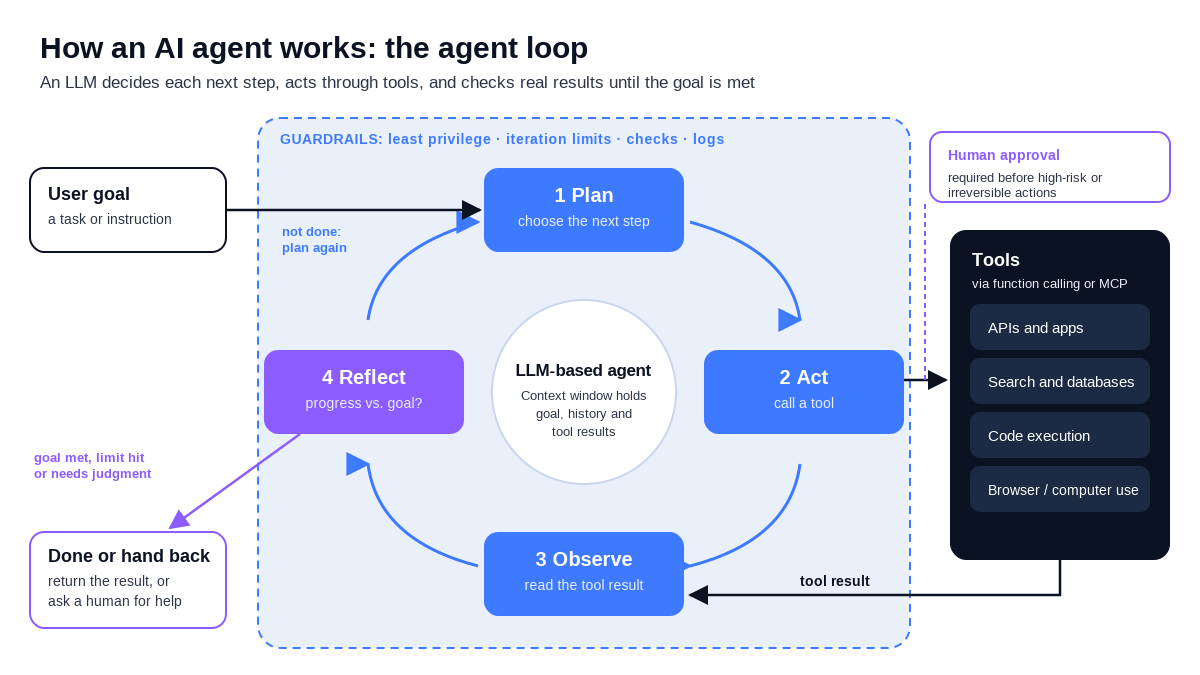
Expect generative AI to shift from answering prompts to completing tasks: models that browse, run code and use software on your behalf. That shift, called agentic AI, raises the stakes for reliability, because errors become actions rather than words. Stanford's 2026 AI Index also reports that transparency among foundation model developers is falling, with the average Foundation Model Transparency Index score dropping from 58 to 40 [14], which makes independent testing more important.
Frequently asked questions
Is ChatGPT the same thing as generative AI?
ChatGPT is one product built on generative AI. Generative AI is the broader technology, which also includes image generators, voice-cloning tools, music models and coding assistants from many companies.
Does generative AI copy from its training data?
It mostly generates new combinations of learned patterns rather than retrieving stored documents. It can, however, sometimes reproduce passages or images closely, which is one reason intellectual property is on NIST's list of generative AI risks [1].
Why does generative AI make things up?
Text models are trained to produce likely-sounding continuations, not to check facts. OpenAI researchers also point to evaluations that reward confident guesses over admitting uncertainty [10]. Connecting a model to trusted documents through retrieval reduces, but does not eliminate, the problem.
Can I copyright something I made with AI?
In the US, only the human-authored parts. The Copyright Office says prompts alone are not enough, but your own creative selection, arrangement or modification of AI output can be protected [12].
Is generative AI the same as AGI?
No. Generative AI describes what a system does (create content). Artificial general intelligence describes a hypothetical level of broad, human-like capability that no current system has reached.
Sources
- NIST, "Artificial Intelligence Risk Management Framework: Generative Artificial Intelligence Profile," NIST AI 600-1. https://nvlpubs.nist.gov/nistpubs/ai/NIST.AI.600-1.pdf
- Google for Developers, "What is machine learning?" https://developers.google.com/machine-learning/intro-to-ml/what-is-ml
- Goodfellow et al., "Generative Adversarial Networks," arXiv:1406.2661. https://arxiv.org/abs/1406.2661
- Vaswani et al., "Attention Is All You Need," arXiv:1706.03762. https://arxiv.org/abs/1706.03762
- Ho, Jain, Abbeel, "Denoising Diffusion Probabilistic Models," arXiv:2006.11239. https://arxiv.org/abs/2006.11239
- Rombach et al., "High-Resolution Image Synthesis with Latent Diffusion Models," arXiv:2112.10752. https://arxiv.org/abs/2112.10752
- OpenAI, "GPT-4 Technical Report," arXiv:2303.08774. https://arxiv.org/abs/2303.08774
- Ouyang et al., "Training language models to follow instructions with human feedback," arXiv:2203.02155. https://arxiv.org/abs/2203.02155
- Anthropic, "Glossary." https://platform.claude.com/docs/en/about-claude/glossary
- OpenAI, "Why language models hallucinate" (September 5, 2025). https://openai.com/index/why-language-models-hallucinate/
- U.S. Copyright Office, "Copyright and Artificial Intelligence." https://www.copyright.gov/ai/
- U.S. Copyright Office, "Copyright Office Releases Part 2 of Artificial Intelligence Report." https://www.copyright.gov/newsnet/2025/1060.html
- C2PA, "Coalition for Content Provenance and Authenticity." https://c2pa.org/
- Stanford HAI, "Inside the AI Index: 12 Takeaways from the 2026 Report." https://hai.stanford.edu/news/inside-the-ai-index-12-takeaways-from-the-2026-report