
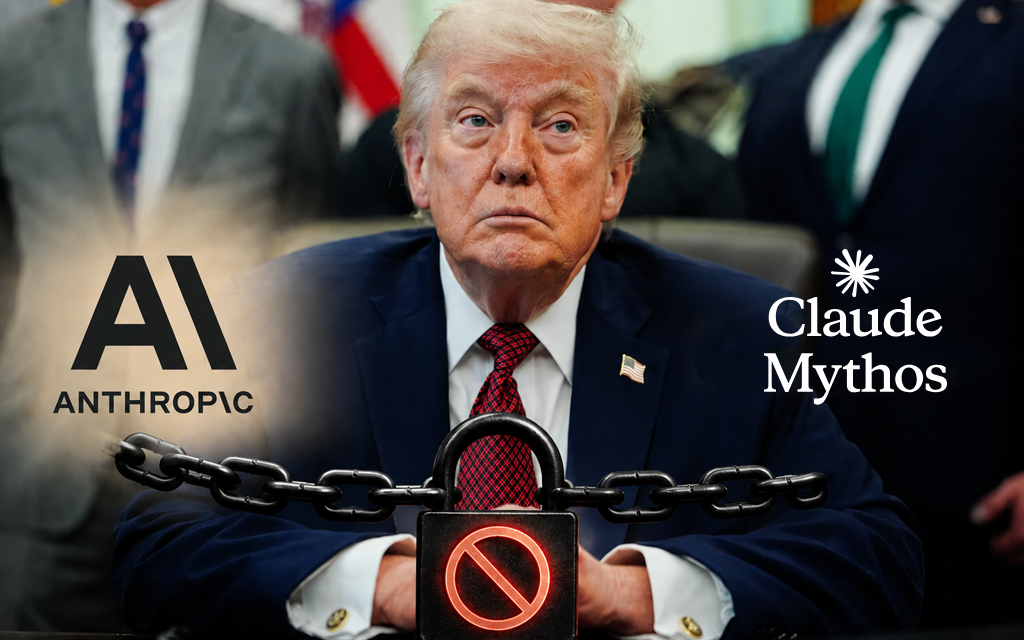
In a significant escalation of U.S. efforts to treat advanced artificial intelligence as a national security asset, the Trump administration has directed Anthropic to block foreign governments, companies, and individuals from accessing its most powerful AI models.
Late on June 12, 2026, the U.S. Department of Commerce issued an export control directive targeting Fable 5 and Mythos 5 — Anthropic’s latest “Mythos-class” models. To comply, Anthropic immediately suspended access to both models for all customers worldwide, including U.S. users.
The move marks one of the first times the U.S. government has applied formal export controls directly to frontier large language models, treating them similarly to sensitive hardware or dual-use technologies.
What Are Fable 5 and Mythos 5?
Anthropic released Claude Fable 5 on June 9, 2026, as its first publicly available Mythos-class model. It offers significantly higher performance in reasoning, coding, long-context tasks, and multimodal capabilities while incorporating strict safety guardrails.
These guardrails are designed to prevent misuse in high-risk areas such as offensive cybersecurity operations and biological weapons research. A more powerful, less restricted version — Mythos 5 — was made available to a smaller group of approved enterprise and research partners.
Anthropic positioned Fable 5 as a “safer” on-ramp to its most capable technology, developed with extensive red-teaming alongside U.S. and allied government organizations.
The Government Directive
Commerce Secretary Howard Lutnick sent a letter to Anthropic CEO Dario Amodei stating that Fable 5 and Mythos 5 would be subject to export controls. This prohibits:
- Access by any foreign national (inside or outside the United States)
- Use by foreign governments or companies
- Even internal use by Anthropic’s own foreign-national employees
The directive was issued under national security authorities. Reports indicate the decision followed claims by another company that it had successfully jailbroken the models, raising concerns about potential misuse by adversarial nations.
Failure to comply could result in significant financial and civil penalties for Anthropic.
Anthropic’s Response
Anthropic complied immediately but pushed back strongly. In an official statement published on its website, the company said:
“The US government, citing national security authorities, has issued an export control directive to suspend all access to Fable 5 and Mythos 5 by any foreign national, whether inside or outside the United States, including foreign national Anthropic employees. The net effect of this order is that we must abruptly disable Fable 5 and Mythos 5 for all our customers to ensure compliance.”
Anthropic emphasized that it disagrees with the directive. According to the company:
- The reported jailbreak vulnerabilities are minor, non-unique, and already present in other leading models (including OpenAI’s latest systems).
- Extensive safeguards and red-teaming (conducted with the U.S. government and UK AISI) make harmful outcomes highly unlikely.
- No universal jailbreak exists, and the company uses defense-in-depth strategies plus monitoring.
Anthropic called the situation “a misunderstanding” and stated it is working to restore access “as soon as possible,” with further updates expected within 24 hours. Access to all other Anthropic models remains unaffected.
Why This Matters
This development carries major implications for the global AI landscape:
- Export Controls on AI Models: This is among the first instances of the U.S. applying formal export licensing requirements to frontier AI systems themselves, not just the chips used to train them.
- Industry-Wide Precedent: Other AI labs may now face similar scrutiny. The move signals that Washington views the most advanced models as strategic assets requiring tight control.
- Global Fragmentation Risk: Countries in Europe, India, and elsewhere may accelerate development of sovereign AI infrastructure to reduce reliance on U.S. models.
- Innovation vs. Security Tension: The episode highlights the growing friction between rapid AI progress and national security imperatives.
- Existing Tensions: The action comes amid an ongoing dispute between Anthropic and the Pentagon. Anthropic is currently suing the Department of Defense after being designated a “supply chain risk” — the first time a U.S. AI company has received such a designation.
Broader Context: U.S. AI Policy Under Trump
The Trump administration has taken a dual approach to AI: aggressively promoting American leadership while tightening controls on the most powerful systems. Recent executive orders have expanded testing requirements for advanced models before deployment, and officials have repeatedly framed cutting-edge AI as critical to national security and economic competitiveness — particularly in the strategic competition with China.
By extending export controls to the models themselves, the administration is effectively treating frontier AI capabilities as sensitive technologies on par with advanced semiconductors.
What Happens Next?
Anthropic has indicated it will engage with the government to resolve the issue quickly. The company maintains that the safeguards in Fable 5 are robust and that the concerns do not justify a full global recall.
Industry observers are watching closely to see:
- Whether the restrictions are temporary or become a longer-term licensing regime
- How other frontier labs respond
- Whether this accelerates the development of non-U.S. AI alternatives
For now, users who relied on Fable 5 or Mythos 5 for advanced coding, research, or enterprise applications have lost access — at least temporarily.




Leave a Comment