
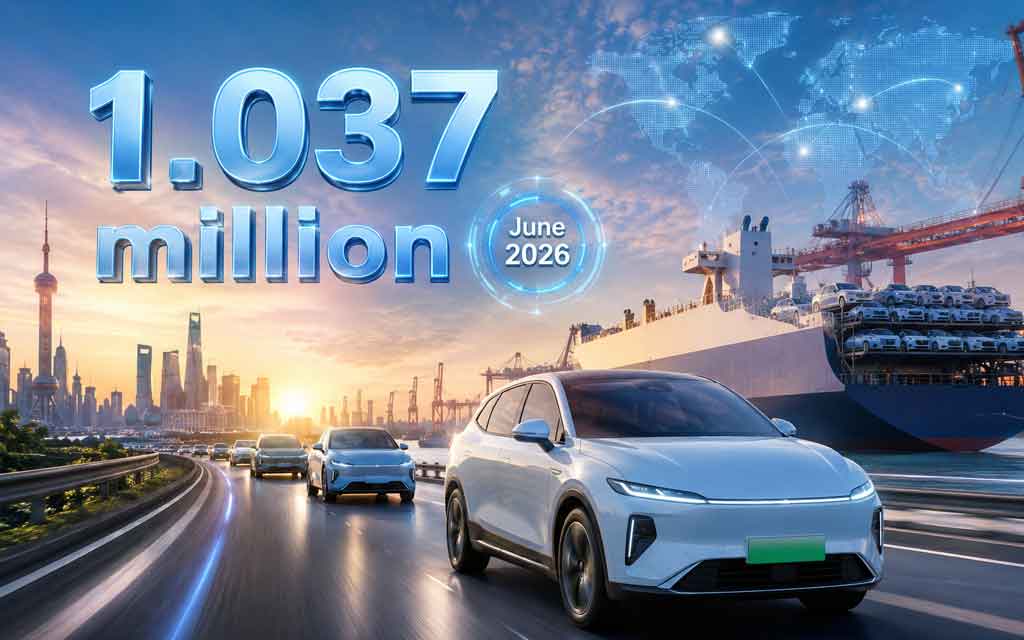
In a stunning milestone that underscores China’s accelerating dominance in the global automotive sector, the country exported a record 1.037 million vehicles in June 2026 — the first time monthly vehicle exports have ever surpassed the 1 million mark. This surge, up 11.6% month-over-month and a massive 75.1% year-over-year, highlights a seismic shift in the auto industry, particularly in electric vehicles (EVs) and new energy vehicles (NEVs).
As an American tech and auto reporter focused on the intersection of innovation, geopolitics, and economic reality, this news isn’t just another export statistic. It’s a wake-up call for U.S. policymakers, automakers, and consumers. While American ingenuity still leads in areas like AI-driven autonomy and software-defined vehicles, China’s manufacturing machine — fueled by state subsidies, vertical integration, and aggressive global expansion — is reshaping the battlefield. For www.vfuturemedia.com, this story is about the future of mobility: who will build the cars of tomorrow, and what does it mean for American jobs, technology leadership, and energy independence?
The Numbers Behind China’s Export Explosion
According to data from the China Association of Automobile Manufacturers (CAAM), June 2026 marked a historic turning point. NEVs, which include battery electric vehicles (BEVs), plug-in hybrids (PHEVs), and other electrified models, accounted for over 50% of these exports for the first time, with 523,000 units shipped abroad — a 1.6-fold increase year-on-year.
Leading the charge:
- BYD reported record overseas sales of approximately 175,349 units in June, representing over 43% of its total sales that month.
- Geely Auto achieved a milestone of its own, exporting 102,874 vehicles — its first time surpassing 100,000 in a single month, with a staggering 157% year-on-year growth.
Other players like Chery, SAIC, Great Wall Motor, and even Tesla’s Shanghai operations contributed significantly. This isn’t a one-off; in the first half of 2026, NEV exports reached 2.355 million units, up 120% year-on-year.
From an American perspective, these figures are both impressive and alarming. U.S. automakers like GM, Ford, and Stellantis are still ramping up EV production, but they face intense pressure from high domestic labor costs, regulatory hurdles, and slower scaling compared to China’s ecosystem.
Why This Milestone Matters: Scale, Speed, and Subsidies
China’s auto industry has transformed from a domestic player into a global powerhouse in under two decades. Government policies, including massive subsidies for NEVs, infrastructure investments in battery production, and incentives for exports, have created an unbeatable cost advantage. Chinese EVs often retail for $10,000–$20,000 less than comparable Western models, making them irresistible in price-sensitive markets across Southeast Asia, Latin America, Europe, and Africa.
This June record aligns with a broader export boom: China’s overall exports hit $412.4 billion in June, up 27% year-over-year, with vehicles playing a key role alongside AI-related products and chips.
For Americans, the implications ripple through the economy. The U.S. auto sector employs millions directly and indirectly. A flood of cheap Chinese vehicles could erode market share not just at home (where high tariffs currently limit direct imports) but in key export markets where American brands compete.
The EV Angle: China’s Battery and Tech Edge
The dominance of NEVs in these exports signals China’s lead in the electrification wave. Chinese companies control a huge portion of the global battery supply chain — from lithium processing to cell manufacturing. Companies like BYD, CATL, and others have vertically integrated operations that American firms are still trying to replicate through the Inflation Reduction Act (IRA) incentives.
From a tech reporter’s lens, this goes beyond hardware. Chinese EVs are increasingly incorporating advanced driver-assistance systems (ADAS), over-the-air (OTA) updates, and AI features that rival or surpass early U.S. offerings. While Tesla remains a leader in full self-driving (FSD) technology and data advantage, the volume game favors China.
SEO Note for Readers Searching: If you’re looking for “China EV export impact on US,” “BYD vs Tesla 2026,” or “global EV market share,” this milestone accelerates the conversation around supply chain security and technological sovereignty.
American Perspective: Threats, Opportunities, and the Tariff Wall
As Americans, we pride ourselves on innovation and free markets, but we also recognize the need for strategic protectionism in critical industries. Successive U.S. administrations — from Trump to Biden and beyond — have imposed steep tariffs on Chinese EVs, currently at 100% or higher in many cases, to shield domestic manufacturers.
These tariffs have largely kept finished Chinese vehicles out of the U.S. market for now, but challenges persist:
- Indirect Routes: Concerns about Chinese brands routing through Mexico or Canada under USMCA to bypass tariffs.
- Parts and Components: China’s growing role in auto parts supply chains affects U.S. production costs and resilience.
- Third-Market Competition: U.S. exports to Europe and elsewhere face stiff competition from affordable Chinese models, potentially hurting American jobs.
Yet, this isn’t purely negative. Competition spurs innovation. U.S. strengths in software, AI, semiconductors, and autonomous driving (think Waymo, Cruise, and Tesla’s ecosystem) position America well for the next phase of mobility — software-defined vehicles where the car is a rolling computer.
The June export record should galvanize U.S. investment in:
- Domestic battery gigafactories.
- AI and robotics for manufacturing efficiency.
- Energy infrastructure to support EV adoption and data centers.
Experts and industry voices warn that without bold action, the U.S. risks losing not just market share but technological leadership in a sector pivotal to national security and economic power.
Broader Geopolitical and Economic Context
This vehicle export boom coincides with China’s push in AI, chips, and renewables — areas where the U.S. maintains edges but faces relentless competition. The widening trade surplus ($125.6 billion in June) gives Beijing leverage, while U.S. consumers benefit from lower global prices but at the cost of domestic manufacturing erosion.
In Europe, similar dynamics are playing out with EU tariffs and local production pushes. Southeast Asia and Latin America are becoming battlegrounds where Chinese brands are gaining rapid footholds.
For American families, cheaper EVs globally could accelerate the transition away from fossil fuels, aiding climate goals. However, dependency on foreign supply chains for critical minerals and batteries raises energy security questions.
What’s Next? Projections and Strategic Responses
Analysts project China could export 5–6 million vehicles or more in 2026, with NEVs leading. BYD alone aims for massive overseas growth, targeting markets hungry for affordable electrification.
U.S. responses could include:
- Strengthening “friend-shoring” with allies.
- Enhancing IRA and CHIPS Act incentives.
- Investing in next-gen technologies like solid-state batteries, hydrogen (for heavy duty), and advanced AI autonomy.
- Workforce development to address manufacturing skills gaps.
From Detroit to Silicon Valley, the message is clear: adapt or risk obsolescence. American automakers are fighting back with models like the Ford F-150 Lightning, Chevy Silverado EV, and Tesla’s Cybertruck, emphasizing ruggedness, range, and ecosystem integration that appeal to U.S. buyers.
Innovation at the Intersection: AI, Autonomy, and the Road Ahead
As a reporter covering AI, auto, and EVs, I see this milestone as part of a larger tech convergence. China excels at hardware scale; America excels at frontier software and intelligence.
Future winners will blend both: vehicles with seamless AI copilots, predictive maintenance, personalized experiences, and Level 4+ autonomy. U.S. companies lead in data collection and algorithm refinement, but China’s vast fleet provides enormous real-world training data.
Opportunities for collaboration (under strict controls) or healthy rivalry could drive breakthroughs benefiting global consumers — safer roads, lower emissions, and more accessible mobility.
Conclusion: America’s Wake-Up Call and Path Forward
China’s first 1-million-vehicle export month is a testament to its industrial might and a direct challenge to Western auto dominance. For Americans, it reinforces the need for strategic vigilance: protect key industries, double down on innovation, and ensure the future of transportation is built with American ingenuity at its core.
At VFutureMedia, we believe the auto revolution isn’t just about cars — it’s about economic power, technological leadership, and national resilience in the AI age. Policymakers, CEOs, and investors must act decisively. The vehicles rolling out of Chinese ports today could define market realities tomorrow unless the U.S. accelerates its own manufacturing renaissance.
This isn’t the end of American auto leadership — it’s a pivotal chapter demanding bold vision. Stay tuned as we track every development in EVs, AI autonomy, and the global auto wars.


Leave a Comment