
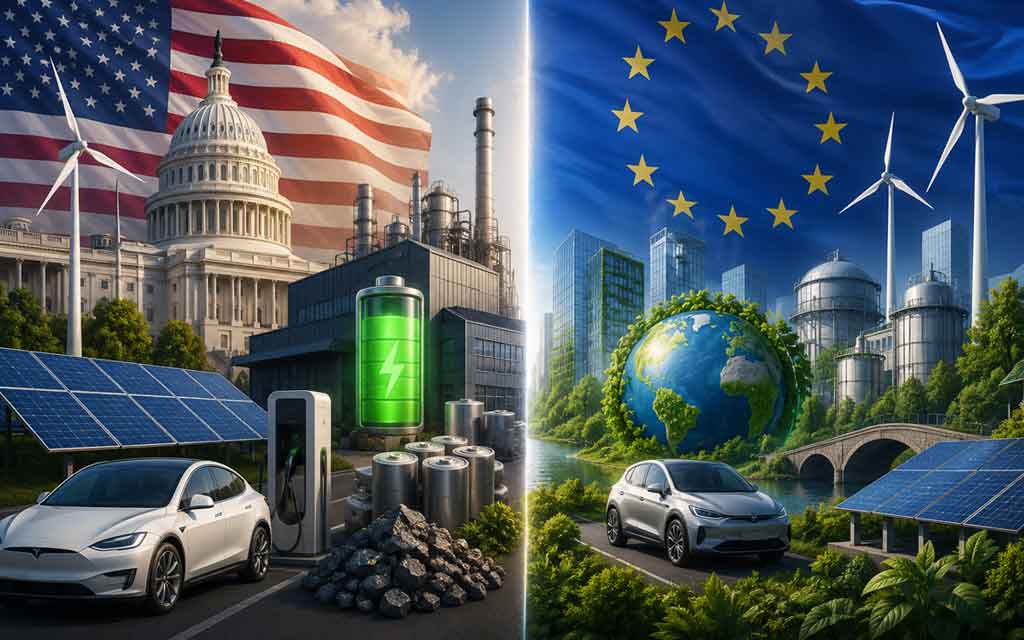
In the global race for clean energy dominance — especially amid China’s record 1.037 million vehicle exports in June 2026 — the US Inflation Reduction Act (IRA, 2022) and the EU Green Deal (2019 onward, with Green Deal Industrial Plan additions) represent two major Western strategies. Both aim to decarbonize economies, boost EV adoption, and secure battery supply chains, but they differ significantly in approach, scale, mechanisms, and outcomes.
Here’s a detailed, balanced comparison from an American tech/auto perspective focused on batteries, EVs, and industrial policy.
1. Core Objectives and Scope
- US IRA: Primarily an industrial policy and competitiveness bill disguised as climate/inflation reduction. It allocates ~$370+ billion (over 10 years) in incentives for clean energy manufacturing, with heavy emphasis on supply-side (factories, tax credits for production) and demand-side (consumer EV credits, though largely phased out by late 2025). Strong focus on reshoring and reducing China dependency via “Buy American”/North American content rules.
- EU Green Deal: A broader regulatory and sustainability framework targeting climate neutrality by 2050. It combines ambitious emissions reductions, biodiversity, and circular economy goals with the Green Deal Industrial Plan (2023) as a direct response to the IRA. More emphasis on regulation, carbon pricing (ETS), and harmonized EU-wide standards alongside targeted subsidies.
Winner for Speed in Manufacturing: IRA — it has triggered faster gigafactory announcements and investments in the US.
2. Battery and EV Manufacturing Incentives
- IRA Battery Provisions:
- 45X Advanced Manufacturing Production Tax Credit: Lucrative per-kWh credits for cells, modules, and critical minerals.
- Investment Tax Credits + Domestic Content Bonuses (10% adder for meeting steel/iron and manufactured products thresholds, escalating over time).
- EV Consumer Credits (up to $7,500 historically): Tied to North American assembly and battery sourcing; phased out post-Sept 2025 but manufacturing credits persist.
- Impact: Massive boom — 200+ GWh battery capacity pipeline. Attracted foreign investment while enforcing localization. Potential for US costs to compete with or beat China when credits apply.
- EU Green Deal / Net-Zero Industry Act:
- European Battery Regulation and Critical Raw Materials Act: Focus on recycling, traceability, and sustainable sourcing rather than massive production subsidies.
- State Aid Relaxations and targeted funds (e.g., Innovation Fund, Just Transition Fund). Countries like Germany, France, and Hungary offer national incentives.
- Carbon Border Adjustment Mechanism (CBAM): “Stick” approach taxing high-carbon imports.
- Impact: Slower scaling; Europe lags in attracting battery investments compared to the US post-IRA. Many European firms have eyed or moved projects to the US for better incentives.
Key Difference: IRA uses carrots (direct tax credits, easier to monetize). EU relies more on regulations + sticks (mandates, carbon taxes) plus smaller, fragmented national subsidies.
3. Approach to China and Supply Chain Security
- IRA: Explicitly discriminatory — “foreign entity of concern” exclusions target China-linked suppliers. Promotes friend-shoring (USMCA partners) and domestic content. Pairs with high EV tariffs (100%+ on Chinese vehicles).
- EU Green Deal: More multilateral but protective via tariffs on Chinese EVs (up to 35%+), Battery Regulation requiring due diligence, and CBAM. Less aggressive “Buy European” than IRA’s North American focus; emphasizes strategic autonomy.
Both address over-reliance on China (which dominates battery production), but the IRA has been more effective at catalyzing onshoring to date.
4. Scale, Funding, and Economic Impact
- IRA: Massive, targeted federal spending power. Drove record clean tech manufacturing announcements. Boosted US competitiveness but sparked transatlantic tensions (later eased via negotiations).
- EU Green Deal: Larger overall budget across multiple programs (hundreds of billions via EU and national budgets), but more diffuse. Stronger on deployment (higher EV adoption in some markets) but weaker on pure manufacturing scale versus the US post-IRA.
Consumer vs. Producer Focus: IRA initially strong on both but shifted; EU maintains broader social/climate justice elements (e.g., Just Transition).
5. Strengths and Weaknesses
IRA Strengths:
- Rapid investment attraction.
- Clear price signals for manufacturers.
- Synergies with CHIPS Act for tech edge (AI, semiconductors in vehicles).
IRA Weaknesses:
- Policy uncertainty (e.g., OBBBA changes).
- Higher upfront fiscal cost.
- Potential trade frictions.
EU Green Deal Strengths:
- Comprehensive, long-term regulatory certainty.
- Leadership in circular economy and sustainability standards.
- Coordinated across 27 nations (when aligned).
EU Weaknesses:
- Slower decision-making and fragmented implementation.
- Less competitive subsidies vs. US/China.
- Risk of deindustrialization as firms relocate.
Implications for Global Auto/EV Race
Against China’s export surge, the IRA has given the US a stronger manufacturing foothold in batteries, helping counter volume advantages from BYD, Geely, etc. The EU Green Deal excels at setting high environmental bars and market signals but struggles with execution speed in the face of subsidized Chinese competition.
Hybrid Lesson for America: The US can learn from EU regulations on recycling and standards, while Europe could adopt more aggressive, IRA-style tax incentives.
In 2026, the IRA appears more impactful for building battery muscle quickly, essential for competing in the electrified future. However, true success depends on sustained implementation, innovation in next-gen tech (solid-state, AI integration), and avoiding over-reliance on any single policy.
This comparison highlights complementary rather than zero-sum approaches between allies. For the latest developments, monitor IRS/EU Commission updates and industry reports.

Leave a Comment