
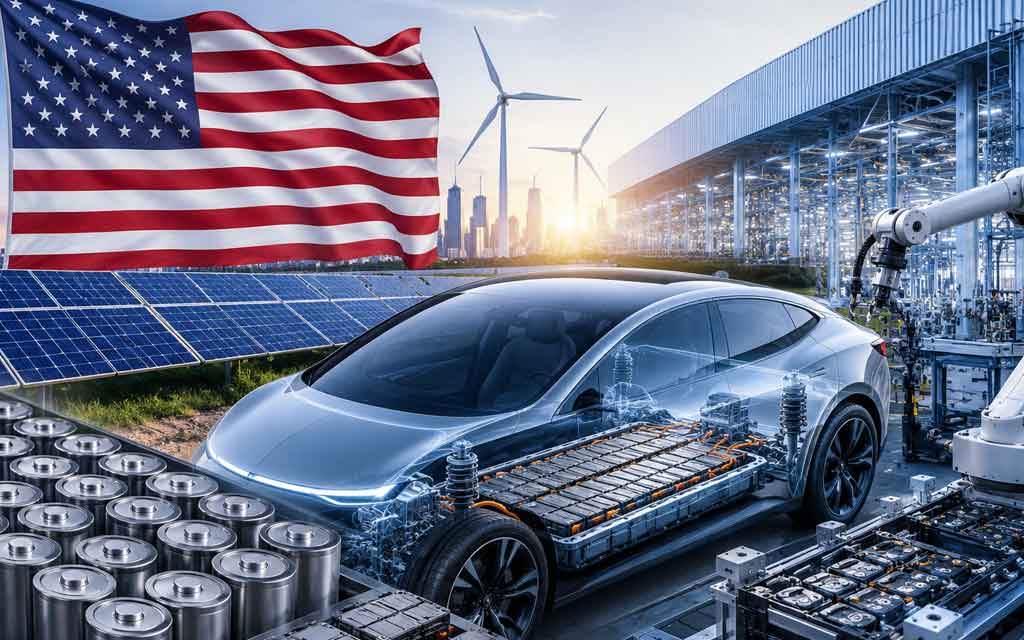
The Inflation Reduction Act (IRA) of 2022 remains one of the most significant pieces of U.S. industrial policy in decades, with battery manufacturing incentives at its core. Designed to reduce reliance on foreign supply chains — particularly China’s dominance in lithium-ion batteries — the IRA has funneled billions into American EV and battery production. However, by mid-2026, the landscape has shifted due to subsequent legislation like the One Big Beautiful Bill Act (OBBBA), which accelerated the phase-out of certain consumer EV tax credits.
As a tech and auto reporter, I’ll break down the key battery-related incentives, their current status, impacts, challenges, and relevance to America’s response to China’s record vehicle exports.
Core Battery Incentives Under the IRA
- Advanced Manufacturing Production Tax Credit (Section 45X)
- This credit supports domestic production of battery components, including electrode active materials, battery cells, and modules.
- Value: Up to $35 per kWh for cells and $10–$45 per kWh for modules, plus credits for critical minerals processing.
- Goal: Incentivize gigafactory construction and supply chain localization.
- Status in 2026: Still active for qualifying production, driving massive investments. It has spurred announcements of dozens of battery plants across the U.S. (e.g., in Michigan, Ohio, South Carolina, and Georgia).
- Investment Tax Credit (ITC) for Battery Storage and Related Projects
- Covers energy storage technologies, including standalone battery systems.
- Base Credit: Up to 30% (with prevailing wage/apprenticeship requirements).
- Domestic Content Bonus: Additional 10% if projects meet steel/iron and manufactured products thresholds (e.g., escalating from 40% domestic content pre-2025 to 55% later).
- Applies to manufacturing facilities and large-scale storage deployments.
- Clean Vehicle Tax Credit (Section 30D) – Consumer Side (Mostly Phased Out)
- Originally up to $7,500 per qualifying EV ($3,750 for critical minerals + $3,750 for battery components).
- Requirements:
- Final assembly in North America.
- Increasing North American battery component value (starting at 50% in 2023, rising annually).
- Critical minerals sourcing rules (phasing out “foreign entities of concern” like China-linked suppliers from 2024/2025 onward).
- 2026 Update: Largely terminated for new purchases after September 30, 2025, under OBBBA. Retroactive claims possible for earlier acquisitions. Some loan interest deductions or state-level incentives remain.
- Other Supporting Provisions
- Loan programs and grants for critical minerals processing.
- Ties to CHIPS Act and Defense Production Act for broader supply chain resilience.
- Prevailing wage and apprenticeship bonuses to ensure high-quality American jobs.
Impact on U.S. Battery Manufacturing
Since the IRA’s passage, the U.S. has seen explosive growth:
- Over 120 battery manufacturing projects tracked, with capacity exceeding 200 GWh for cells/modules.
- Major investments from LG Energy Solution, SK On, Panasonic, GM, Ford, and others. Joint ventures and “friend-shoring” have accelerated.
- Potential cost parity or advantage: With tax credits, U.S. production costs could undercut China’s in some scenarios by the end of the decade.
This directly counters China’s scale advantage, where companies control ~70-80% of global battery capacity. The IRA mimics aspects of China’s earlier subsidy-driven playbook but emphasizes North American content and exclusion of adversarial supply chains.
Relevance to China’s June 2026 Export Record: As China ships record NEVs (many with advanced batteries), U.S. incentives aim to build a resilient domestic alternative. Tariffs on Chinese EVs (100%+) pair with IRA carrots to encourage onshoring.
Challenges and Criticisms
- Supply Chain Gaps: The U.S. still relies heavily on imports for critical minerals and some processing. Battery imports rose significantly post-IRA.
- Policy Volatility: Changes under OBBBA and shifting administrations create uncertainty for long-term investments.
- Implementation Hurdles: Strict “foreign entity of concern” rules limit partnerships (e.g., with CATL). Domestic content compliance adds costs and complexity.
- Workforce and Speed: Scaling requires skilled labor; U.S. permitting and construction timelines lag behind China’s.
- Global Trade Tensions: Allies have raised concerns about IRA’s “Buy American” tilt, though many have been resolved through negotiations.
Future Outlook and Strategic Recommendations
The IRA has successfully attracted hundreds of billions in announced investments, positioning the U.S. as a growing battery powerhouse. To maximize impact against Chinese competition:
- Sustain and refine manufacturing credits.
- Invest in next-gen technologies (solid-state, sodium-ion, recycling).
- Expand critical minerals domestic mining/processing.
- Pair with AI/automation for competitive manufacturing edges.
For American automakers and consumers, these incentives support long-term affordability and security, even as direct purchase subsidies wane. States like California, New York, and others continue offering complementary rebates and infrastructure support.
In the context of global EV wars, the IRA represents America’s bet on innovation and resilience over pure volume. It won’t overnight dethrone China’s current export dominance, but it builds the foundation for technological leadership in the electrified, AI-powered mobility era.
This exploration draws on IRS guidelines, industry analyses, and policy updates as of July 2026. For the latest eligibility, consult IRS.gov or a tax professional.


Leave a Comment