
Published on vfuturemedia | December 19, 2025
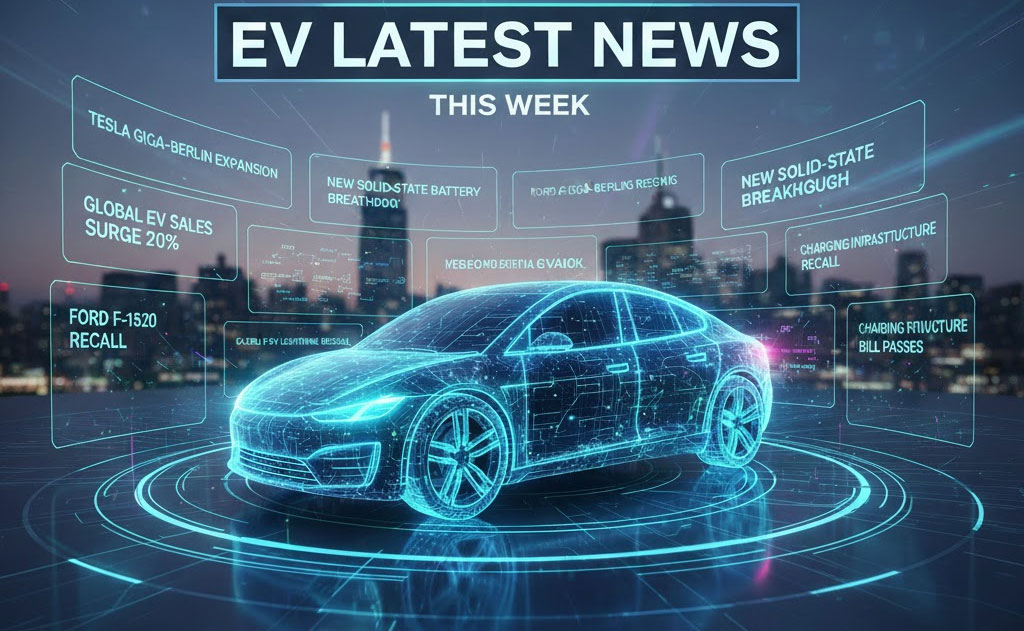
The electric vehicle (EV) sector concluded 2025 on a bittersweet note this week, blending historic global sales achievements with significant strategic retreats by major players. As EV latest news dominates headlines, the industry celebrates surpassing 25% global market share for electric and plug-in hybrid vehicles, largely fueled by emerging markets. However, policy reversals in the US and Europe, coupled with Ford’s massive writedown, underscore a transitional phase where hybrids and extended-range EVs (EREVs) are gaining traction amid slower-than-expected pure EV demand in mature markets.
This comprehensive roundup dives deep into the week’s key developments, exploring implications for consumers, manufacturers, and the broader electric vehicle market. From battery innovations to year-end deals, here’s everything you need to know about the EV latest news shaping the future of mobility.
Historic Global EV Sales Milestone: Over 25% Market Share in 2025
One of the brightest spots in EV latest news this week came from energy think tank Ember, which reported that more than 25% of new cars sold globally in 2025 were fully electric or plug-in hybrids. This represents a monumental leap from previous years, with EVs accounting for just a fraction of sales as recently as 2019.
The surge is increasingly driven by emerging markets, where adoption is accelerating from low bases. Countries like Thailand achieved a 20% EV share, while Brazil and others in Southeast Asia and Latin America are leapfrogging traditional combustion-engine dominance. EVs’ superior efficiency—up to three times that of internal combustion engines—has played a key role, particularly in regions with cleaner electricity grids. This efficiency translates to reduced fossil fuel demand and lower operational costs for owners.
Analysts from Ember and EV Volumes project continued momentum into 2026, with forecasts of 22.1 million units sold worldwide and a sustained 24% market share. China’s dominance persists, with BYD and other local giants pushing affordable models that are now cheaper than gasoline equivalents on average. This global shift highlights how the electric vehicle market is no longer confined to Europe and North America; emerging economies are becoming the new growth engines.
Despite regional slowdowns, the long-term trajectory remains upward. Falling battery costs, expanding infrastructure, and improving technology are making EVs more accessible, positioning them to potentially reach 26-30% of US sales by 2030.
Ford’s $19.5 Billion Writedown: A Stark Signal of EV Industry Reset
The most dramatic EV news this week was Ford Motor Company’s announcement of a $19.5 billion charge tied to scaling back its pure EV ambitions. This includes $8.5 billion in asset writedowns for canceled models and additional cash outflows through 2027.
Ford is canceling several planned all-electric vehicles, including a next-generation commercial van and large pickup. The iconic F-150 Lightning will transition to an extended-range EV (EREV) architecture in future versions, incorporating a gasoline generator for longer range without relying solely on battery power. Additionally, Ford is repurposing battery production facilities in Kentucky and Michigan for stationary energy storage systems, diversifying away from vehicle-exclusive use.
This pivot reflects broader challenges: waning pure EV demand in the US following the expiration of federal tax credits and eased emissions regulations under the Trump administration. US EV sales dropped sharply in November, contributing to Ford’s reassessment. CEO Jim Farley emphasized flexibility, noting the company is “following the customer” toward hybrids and EREVs, which offer familiarity and range anxiety relief.
Ford raised its 2025 adjusted earnings guidance to $7 billion, signaling confidence in its core truck and SUV lineup. By 2030, the company expects 50% of global volume to come from hybrids, EREVs, and full EVs—up from 17% this year. This move aligns with trends at General Motors and others, prioritizing profitable segments amid policy uncertainty.
The writedown also involved ending a joint venture with SK On, splitting battery responsibilities to reduce costs. While painful short-term, analysts view this as pragmatic, allowing Ford to focus on affordable EVs starting around $30,000 by 2027.
EU Softens 2035 Combustion Engine Phase-Out Amid Automaker Pressure
In Europe, the European Commission proposed reversing its aggressive 2035 ban on new internal combustion engine sales, opting instead for a 90% reduction in CO2 emissions from 2021 levels. This effectively allows continued sales of plug-in hybrids, range-extenders, and certain combustion vehicles using CO2-neutral fuels like advanced biofuels.
The decision responds to lobbying from Germany, Italy, and major automakers facing fierce competition from Chinese EV leaders like BYD. It marks a significant retreat from prior green ambitions, acknowledging slower EV adoption rates needed to meet original targets.
Critics argue this could delay infrastructure investments and hinder Europe’s competitiveness against China. However, proponents, including Volkswagen, see it as pragmatic, allowing technology neutrality while pushing fleet electrification targets—especially for corporate vehicles, which comprise 60% of new sales.
National targets vary by GDP, with richer countries aiming higher. Incentives will favor EU-made clean vehicles, boosting local production. Volvo opposed the change, reaffirming full EV commitment, but most legacy makers welcome the flexibility.
This policy shift echoes US changes, highlighting a global “reset” where hybrids bridge the gap to full electrification.
Emerging Trends: Battery Advancements, Infrastructure, and Manufacturer Updates
Battery technology remains a hotspot in EV latest news. Lithium-iron-phosphate (LFP) cells continue dominating affordable segments due to lower costs and stability, with BYD extending warranties to 8 years/250,000 km—surpassing Tesla’s terms. Sodium-ion batteries gained traction, with CATL and HiNa launching improved generations offering better density and charging.
Solid-state batteries edge closer to commercialization, promising higher ranges and safety, though scaling challenges persist. Innovations like silicon anodes and advanced management systems are enhancing existing lithium-ion packs.
Charging infrastructure expands rapidly, with projections of over 20 million public points by 2030. Year-end deals abound: Kia offers low-rate financing and discounts on models like the Niro EV (leasing under $200/month in some cases), while Rivian rolls out software update 2025.46 featuring hands-free driving, digital keys, and new drive modes.
Rivian also launched promotions with free paint options. BYD previewed flagship Sealion 08 SUV and Seal 08 sedan, targeting premium segments. Tesla maintains US dominance at nearly 50% market share, though midprice competition intensifies.
Chinese and Korean EV pickups surge overseas, contrasting US pullbacks. Kia eyes PHEV variants for its Tasman pickup.
Challenges and Opportunities in the Electric Vehicle Market
Short-term headwinds include policy volatility, with US tax credit expiration and EU softening contributing to slower growth in mature markets. North America may see its first annual EV sales decline since 2019.
Yet, opportunities abound. Hybrids and EREVs address range concerns, potentially accelerating overall electrification. Emerging markets’ rapid adoption compensates for Western slowdowns, with China accounting for two-thirds of global sales.
Affordability improves as battery prices fall toward $80/kWh by 2030. Recycling and second-life applications enhance sustainability.
Analysts predict a hybrid-dominant bridge phase through the late 2020s, leading to renewed pure EV growth as infrastructure matures and costs drop further.
Outlook for 2026: Resilience Amid Transition
The EV latest news this week illustrates an industry in flux but fundamentally strong. Global milestones affirm electrification’s inevitability, while pivots ensure survival.
Consumers benefit from diverse options: pure EVs for urban efficiency, hybrids for versatility. Manufacturers like BYD and Tesla thrive on scale, while legacies adapt.
Stay informed with vfuturemedia for ongoing coverage of EV news, battery breakthroughs, charging developments, and market analyses. The road to sustainable mobility continues—albeit with a few detours.
I’m Ethan, and I write about the tech that’s actually going to change how we live — not the stuff that just sounds impressive in a press release. I cover AI, EVs, robotics, and future tech for VFuture Media. I was on the ground at CES 2026 in Las Vegas, walking the show floor so I could give you a real read on what matters and what’s just noise. Follow me on X for daily takes.


Leave a Comment