
By VFuture Media Staff December 24, 2025
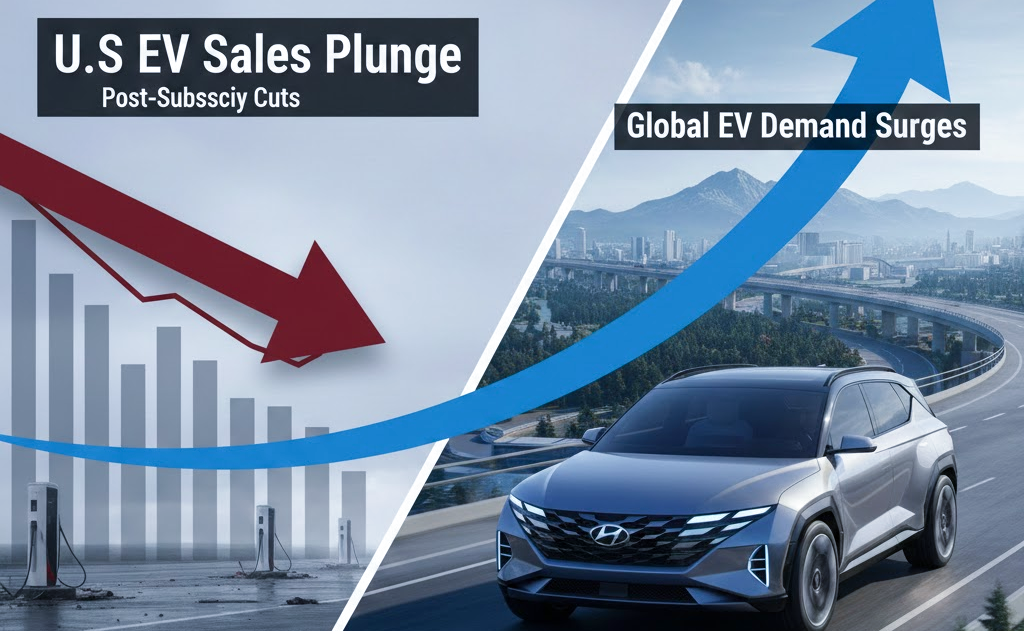
As 2025 draws to a close, the electric vehicle (EV) landscape is experiencing a stark divide: a sharp slowdown in the United States following the abrupt end of federal tax incentives, contrasted by robust global sales growth driven by China and emerging markets. This “market reset” highlights the fragility of subsidy-dependent demand while underscoring the unstoppable momentum of electrification worldwide. Amid the turbulence, Hyundai is generating buzz with a teaser for its biggest EV to date – a potential game-changer set for reveal in early 2026.
The U.S. Pullback: Subsidy Cliff and Automaker Reckoning
The U.S. EV market hit a wall in the fourth quarter after federal $7,500 tax credits expired on September 30, 2025. Buyers rushed to claim incentives in Q3, pushing EV market share to a peak of over 10%. But post-subsidy, demand cratered.
- Q4 EV sales are estimated at just 230,000 units – a 46% drop from Q3 and 37% year-over-year decline.
- Full-year 2025 U.S. EV sales are projected around 1.275 million, down 2.1% from 2024 – the first annual decline since 2019.
- Market share slipped to about 5.7% in Q4, with November hitting multi-year lows.
Major automakers felt the pain acutely. Ford announced a massive $19.5 billion writedown in mid-December, canceling several pure-EV models, ending production of the F-150 Lightning, and pivoting toward hybrids and extended-range EVs (EREVs). The company now expects 50% of its 2030 volume to come from hybrids, EREVs, and EVs – a significant scale-back from earlier all-electric ambitions.
Hyundai and Kia saw steep drops too: Ioniq 5 sales plunged 59% in November. To soften the blow, Hyundai offered $7,500 cash rebates on 2025 models and slashed prices on 2026 Ioniq variants by up to $9,800. Ford’s Mustang Mach-E and other models posted 50-60% declines post-incentive.
This reset exposes how much U.S. growth relied on subsidies rather than pure consumer demand. Affordability concerns, charging infrastructure gaps, and policy uncertainty under the new administration have amplified the slowdown. Yet, hybrids are surging as a bridge technology, with strong gains reported across brands.
Global Resilience: 20+ Million EVs Sold Despite Headwinds
Zoom out, and the picture is far brighter. Global EV sales (including BEVs and PHEVs) are on track to exceed 20 million in 2025 – a roughly 20-25% increase over 2024.
- China remains the powerhouse, accounting for over 60% of sales with steady growth fueled by affordable models and vast charging networks.
- Europe saw a 33% year-to-date surge through November, driven by tightening CO2 targets and recovering subsidies in some markets.
- Emerging economies are leapfrogging: Thailand hit 20% EV share, Indonesia 15% (surpassing the U.S.), and markets like Brazil, Mexico, and India posted rapid gains thanks to low-cost Chinese imports.
Analysts note that falling battery costs, improving efficiency, and expanding model choices are driving organic demand beyond subsidies. Global EV penetration approaches 25% of new car sales, with projections for continued 20%+ annual growth into the late 2020s.
This divergence shows electrification isn’t stalling – it’s accelerating where policies and economics align.
Hyundai’s Bold Move: Teasing Its Largest EV Ever
Against this backdrop, Hyundai is charging forward aggressively. Just days ago, the Korean giant teased “its biggest EV yet” ahead of a world premiere at the Brussels Motor Show on January 9, 2026.
The single teaser image reveals a futuristic full-width LED light bar, hinting at an 800-volt architecture for ultra-fast charging and “state-of-the-art electric technology.” Speculation points to an all-electric version of the Staria minivan – a boxy, spacious people-mover longer than the flagship Ioniq 9 three-row SUV.
If confirmed, the Staria Electric would target Europe, Australia, and other markets hungry for practical, family-hauling EVs. It could feature massive interior space, advanced driver assists, and Hyundai’s signature pixel lighting – positioning it as a unique alternative to SUV-dominated lineups.
Hyundai’s push comes as it expands its IONIQ family and performance N variants, signaling confidence in long-term EV demand despite U.S. challenges.
What Does This Market Reset Mean for the Future?
Late 2025 has delivered a dose of realism to the EV hype cycle. In the U.S., the subsidy cliff has forced a painful recalibration, delaying aggressive targets and boosting hybrids as a pragmatic stepping stone. Automakers like Ford are “following the customer,” prioritizing profitability over forced electrification.
Globally, however, the transition marches on. Cheaper batteries, better ranges, and policy support in key regions ensure steady progress. The U.S. risks falling further behind without renewed incentives or infrastructure investment.
For investors and enthusiasts eyeing EV news 2025, this reset separates winners from laggards. Companies like Hyundai – innovating with bold new models – are poised to capture growth in resilient markets. Tesla continues dominating volume, while Chinese brands flood emerging regions.
As we head into 2026, expect more affordable EVs, hybrid bridges, and potential policy reversals. The electric future isn’t canceled – it’s just maturing into a more balanced, global reality.
VFutue Media will track upcoming reveals like Hyundai’s massive EV and monitor how the U.S. market rebounds (or doesn’t) in the new year.
I’m Ethan, and I write about the tech that’s actually going to change how we live — not the stuff that just sounds impressive in a press release. I cover AI, EVs, robotics, and future tech for VFuture Media. I was on the ground at CES 2026 in Las Vegas, walking the show floor so I could give you a real read on what matters and what’s just noise. Follow me on X for daily takes.
If you found this useful, the best thing you can do is share it with someone who’d actually appreciate it. And if you want more like it, we’re here every week.


Leave a Comment